
What Is Semana Santa Holy Week Explained Travel Guide
Discover what is Semana Santa, Spain's Holy Week — its history, processions, best cities to visit, and tips for planning your 2026 trip.
On this page
What Is Semana Santa? Holy Week in Spain Explained
Semana Santa — Spanish for Holy Week — is one of the most visually powerful religious celebrations in the world. Every spring, Spanish cities transform as thousands of hooded penitents, massive flower-covered floats, and marching bands fill the streets. Whether you're drawn by the religious meaning, the cultural spectacle, or simple curiosity, this is a week that leaves a lasting impression.
The celebration runs from Palm Sunday through Easter Sunday, though in some cities it stretches even longer. We've broken down everything you need to know — from the history and traditions to the best cities and practical planning advice. If you're considering a trip to Spain for Holy Week, Spain's festival calendar holds other unmissable events worth pairing with your visit.
Free guide: Europe's Festival Calendar
A month-by-month map of Europe's unmissable festivals — with the best dates to visit each and a local tip you won't find in the guidebooks.
What Is Semana Santa and When Does It Happen
Semana Santa is Spain's version of Holy Week, the Christian period commemorating the final days of Jesus Christ before Easter Sunday. The celebrations blend deep religious devotion with street processions, live music, and centuries-old ritual. For many Spanish families, this is the most important week of the year — more so than Christmas.
The dates shift every year because Easter follows an astronomical rule established at the Council of Nicaea in AD 325. Easter Sunday falls on the first Sunday after the first full moon following the spring equinox. This means Semana Santa can occur anywhere from late March to late April, so always check the specific dates before booking travel. In 2026, Easter Sunday falls on 5 April, placing the peak of Semana Santa processions in the final days of March and the first days of April.
In Andalusia, celebrations officially begin on Palm Sunday and run through Easter Sunday. In regions like Castile and León, observances start earlier — sometimes the preceding Friday — and carry a more subdued, reflective tone. The city of Toledo begins its ceremonies on the preceding Thursday, making it one of the longest Holy Week schedules in Spain.
The History and Origins of Semana Santa
The roots of Semana Santa stretch back to the sixteenth century, when the Catholic Church used public processions to teach the story of Christ's death and resurrection. A turning point came in 1521, when the Spanish nobleman Marqués de Tarifa returned from a pilgrimage to the Holy Land. Inspired by what he witnessed, he introduced the Via Crucis — or Stations of the Cross — to Spain, a fourteen-step retelling of Christ's journey to Calvary.
These early processions were modest walks through the streets, with participants pausing at symbolic points for prayer. Over the following century, Catholic brotherhoods called cofradías took over organizing the events and transformed them into elaborate spectacles. By 1604, Seville had established an official procession route called the Carrera Oficial, and lifelike wooden figures were being crafted and carried through the streets by the 17th century.
Today, the brotherhoods still organize every procession independently, each carrying their own floats from their parish church to the cathedral and back. The tradition has remained remarkably consistent for over four hundred years, even as the scale and artistry of the floats has grown dramatically. For visitors curious about Spain's most intense public rituals, Semana Santa stands in a category of its own.
The Processions, Costumes, and Floats Explained
The most striking image of Semana Santa is the Nazareno — a penitent dressed in a long robe and a tall pointed hood called a capirote. The covered face represents mourning and repentance for the death of Christ. Capirotes come in many colors — red, purple, black, white — each identifying a specific brotherhood, not a political statement. Despite a superficial visual resemblance to KKK hoods, the capirote predates that organization by centuries and carries an entirely different meaning.
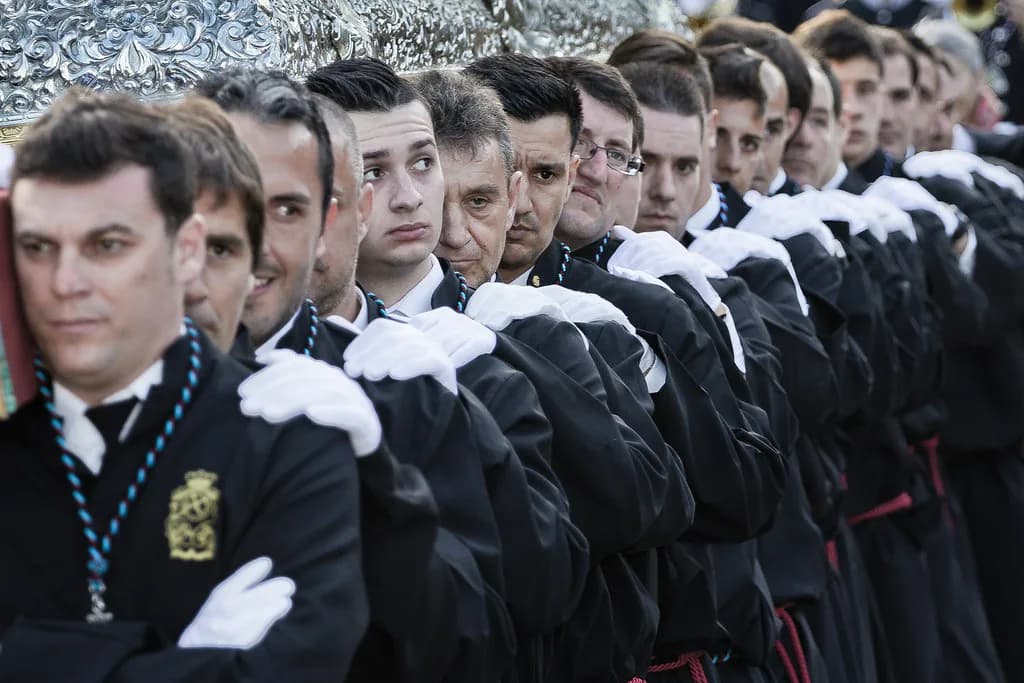
The floats, known as pasos, are elaborate wooden platforms depicting scenes from the Passion of Christ or the Virgin Mary in mourning. Beneath each float are the costaleros, the men and women who carry the entire weight on their shoulders for hours at a stretch. Some Nazarenes walk barefoot with shackles and chains for up to 14 hours — a deliberate act of physical penance meant to mirror Christ's suffering.
On Holy Thursday, or Jueves Santo, church bells fall silent across Spain — they won't ring again until Easter morning. In Seville, the night of Holy Thursday — known as Madrugá — sees every brotherhood begin a procession simultaneously, with candlelit streets stretching as far as the eye can see. Good Friday brings the most solemn processions, with robed penitents carrying wooden crosses through city streets in near-silence.
One of the most distinctive sounds of Semana Santa in Andalusia is the saeta, a raw flamenco prayer sung from balconies as processions pass below. These unaccompanied vocal outbursts are especially powerful in Granada's Sacromonte neighborhood, where flamenco has deep roots. On Easter Sunday, the mood lifts entirely — floats are covered in flowers, bands play upbeat music, and families gather for festive meals.
- Key days of Semana Santa
- Palm Sunday: processions begin, palm branches carried to the cathedral
- Holy Thursday: church bells silenced, Madrugá processions in Seville
- Good Friday: solemn marches, wooden crosses, fasting observed
- Easter Sunday: joyful processions, flower-covered floats, traditional feasting
Semana Santa Around the World
Spain exported its Holy Week traditions to its colonies over centuries, and today Semana Santa is celebrated across Latin America with enormous devotion. Mexico, Guatemala, Peru, and Colombia are all known for their large-scale processions and richly colored traditions. In Guatemala, participants create intricate street carpets made of colored sawdust and flowers that get trampled by the procession — an intentional symbol of impermanence.
In Bolivia, thousands of pilgrims make a 150 km journey on foot from La Paz to the Copacabana Sanctuary on the shores of Lake Titicaca over just two days. The Philippines hold some of the most intense Holy Week observances in the world, including voluntary public re-enactments of the crucifixion. Communities in the United States, particularly in New Mexico, also maintain strong Semana Santa traditions brought over by Spanish settlers.
The global reach of Holy Week reflects how deeply Catholicism shaped the cultures of former Spanish and Portuguese territories. Each country adds its own local flavor — music, food, art, and customs that differ significantly from what you'd see in Spain. For travelers who love festival culture, Holy Week abroad offers a striking contrast to European festival customs closer to home.
Best Places to Experience Holy Week in Andalusia
Andalusia is the spiritual home of Semana Santa in Spain, and three cities in particular draw visitors from around the world. Each offers a distinctly different atmosphere — from the grandeur of Seville to the emotional intimacy of Granada. Choosing which city to visit depends on what kind of experience you're looking for.
Seville hosts 58 official brotherhoods, making it the largest and most dramatic Semana Santa in Spain. The Madrugá on Holy Thursday night — when processions from La Macarena and El Gran Poder flood the candlelit streets — is considered the highlight of the entire week. Accommodation books out months in advance, so plan well ahead if Seville is your target.
Málaga takes a more celebratory approach, with military parades and brass bands accompanying the pasos rather than the solemn silence of Seville. A unique local tradition dates to the 18th century, when King Charles III granted Málaga the privilege of releasing a prisoner during Holy Week — a custom still observed today. The procession of El Cautivo, featuring a white-robed figure of Christ, draws enormous crowds and genuine emotional responses from locals.
Granada offers the most atmospheric setting — narrow winding streets, the Alhambra as backdrop, and the Cristo de los Gitanos procession winding up to the Sacromonte caves. Flamenco saetas echo through the hillside neighborhoods, and the scent of incense lingers well after the processions have passed. Granada suits travelers who want a more intimate, less touristy Semana Santa experience than the larger cities provide.
- Seville — grandest Semana Santa in Spain
- Brotherhoods: 58 official processions across the week
- Highlight: Madrugá on Holy Thursday night
- Best for: first-time visitors, maximum spectacle
- Tip: book accommodation 6+ months in advance
- Málaga — celebratory and brass-band-led
- Style: military bands, larger and more festive floats
- Unique tradition: historic prisoner release ceremony
- Best for: visitors who prefer a lively, upbeat atmosphere
- Tip: the El Cautivo procession is the most famous
- Granada — intimate and atmospheric
- Setting: Alhambra backdrop, Sacromonte cave district
- Highlight: Cristo de los Gitanos procession with live flamenco
- Best for: travelers seeking a quieter, spiritual experience
- Tip: watch from the Albaicín neighborhood for the best views
Reasons to Visit Spain's Easter Week
Semana Santa is worth making a specific trip for, even if you have no religious connection to the event. The processions are unlike anything else in Europe — slow-moving, emotionally charged, and deeply embedded in local identity. Watching a thousand-kilo float sway silently through a narrow medieval street while crowds press close in silence is an experience that stays with you.
Spain at Easter also means the country is fully alive and buzzing. Most Spanish workers take Semana Santa as a national holiday, so restaurants, tapas bars, and plazas fill with locals in a way they rarely do the rest of the year. The food alone makes the trip worthwhile: seasonal specialities like torrijas and pestiños appear only during this week and disappear as quickly as Easter ends.
The visual and sensory richness of the week is something no photograph fully captures — the smell of incense, the sound of drums echoing off stone walls, the flicker of thousands of candles in the dark. Importantly, Semana Santa is entirely free to attend. No ticket is needed to watch any street procession, which means the experience is equally accessible regardless of budget. The main cost is simply getting to Spain and sleeping there during peak demand.
How to Watch a Semana Santa Procession as a First-Time Visitor
Most visitors simply join the crowd along the street, but this approach has a major downside: you may spend two hours waiting, only to see the procession from behind four rows of people. Arriving at your chosen spot at least 45 minutes before a procession's scheduled start time is the minimum. The best unobstructed views are at street corners and on raised steps outside churches, where the procession must slow or turn — the float tilts slightly, and the crowd naturally thins.
In Seville, paid grandstand seats called palcos are set up along the Carrera Oficial route — the official route that runs through the city centre. These sell out weeks in advance and cost roughly EUR 30–100 per seat depending on the day and location. If you want a guaranteed seated view of multiple processions without fighting for pavement space, booking a palco in Seville is by far the most comfortable option.
Photography is generally permitted and no one will object to a camera or phone pointed at the pasos. However, photographing individual penitents at close range with a flash can feel intrusive — most Nazarenos are participating in a sincere act of devotion, not a performance. Keeping a respectful distance and avoiding blocking other spectators' sightlines are the basic unwritten rules. Expect to hear drums and brass bands before you see anything; follow the sound and the crowd movement to locate an approaching procession from several streets away.
What Easter Celebrations in Spain Are Like Today
Modern Semana Santa is both a deeply religious observance and a major cultural event that draws millions of visitors to Spain each spring. For Spanish families, the week is a national holiday — schools and many businesses close, and people travel home or head to Andalusia for the celebrations. The energy in cities like Seville is unlike anything else in Europe: reverent during processions, then festive once they pass.
Visitors should expect higher prices across the board during Holy Week — hotels, restaurants, and tours all reflect peak demand. Streets can become completely impassable when a procession passes, sometimes for 30 minutes or more at a stretch. Planning your days around the procession schedule, rather than against it, makes the week far more enjoyable.
Traditional Easter foods are part of the celebration too — torrijas are honey-dipped bread soaked in milk and egg, then fried in olive oil, and sold at stalls throughout the week. Pestiños are orange-flavored fried dough squares covered in sugar or honey, another seasonal favorite found across Andalusia. These foods only appear during Semana Santa, so trying them is one of the best insider experiences of the week.
If you're planning to attend, we recommend arriving at least a day before Palm Sunday to get your bearings. Most travelers find that three to four nights in one city is enough to absorb the main processions without exhaustion. Pair a Semana Santa trip with other iconic Spanish events to build a fuller picture of Spain's festival culture throughout the year.
Frequently Asked Questions
What is Semana Santa about in simple words?
Semana Santa is Spain's Holy Week — a week of Catholic religious processions held each spring before Easter Sunday. Brotherhoods carry heavy decorated floats through city streets while hooded penitents march alongside. It commemorates the final days of Jesus Christ, from Palm Sunday through the Resurrection on Easter Sunday.
What are the 7 days of Holy Week?
Holy Week runs from Palm Sunday through Easter Sunday: Palm Sunday (processions begin), Holy Monday, Holy Tuesday, Spy Wednesday, Holy Thursday (Jueves Santo — bells fall silent), Good Friday (El Viernes Santo — most solemn day), Holy Saturday, and Easter Sunday (joyful celebration and feasting). See our guide to European festival customs for broader context.
What should you not do during Holy Week in Spain?
Avoid booking last-minute accommodation — prices spike and rooms sell out months ahead. Don't expect to cross a street freely when a procession is passing; you may wait 30 minutes or more. Also avoid scheduling tight transport connections on peak days like Holy Thursday and Good Friday, when city centers become completely pedestrianized.
Is Semana Santa only celebrated in Spain?
No — Semana Santa is observed across Latin America, the Philippines, and parts of the United States. Mexico, Guatemala, Colombia, Peru, and Bolivia all hold major Holy Week celebrations. In Bolivia, thousands walk 150 km from La Paz to the Copacabana Sanctuary in just two days as an act of devotion.
Related in Spain: Best Fiestas in Spain (2026).
Semana Santa is one of those rare events that genuinely earns its reputation — there's nothing quite like watching a centuries-old procession move through candlelit streets at midnight. Whether you choose the grandeur of Seville, the atmosphere of Granada, or the coastal energy of Málaga, each city delivers its own unforgettable version of Holy Week. The key is to plan ahead, embrace the pace of the week, and let the processions come to you rather than chasing them.
If you're building a wider Spain itinerary around festivals, our guide to planning a European festival trip covers logistics, packing, and timing strategies that apply directly. Spain's festival calendar is one of the richest in Europe, and Semana Santa sits right at the heart of it. Wherever you experience it, Holy Week in Spain is a week you won't forget.
Free guide: Europe's Festival Calendar
A month-by-month map of Europe's unmissable festivals — with the best dates to visit each and a local tip you won't find in the guidebooks.
You might also like

Continue reading
More guides you'll find useful


