What Is La Tomatina And How Did It Start
Discover what La Tomatina is, how it started in 1945, why Franco banned it, and what to expect if you plan to attend this legendary tomato fight in Spain.
On this page
La Tomatina Explained: History, Origin, and What to Expect
Every last Wednesday of August, the small Spanish town of Buñol transforms into the world's messiest battleground. More than 100 tons of overripe tomatoes fly through the air as 20,000 people hurl them at each other in a single frenzied hour. This is La Tomatina — a festival that began as an accident in 1945 and grew into one of Europe's most recognisable annual events. Understanding how it started — and why it survived a government ban — makes the experience far richer than simply showing up in a white T-shirt.
Buñol is a modest agricultural town of around 9,000 residents, located inland from Valencia in eastern Spain. For 51 weeks of the year, life there is quiet and unhurried. On one Wednesday in late August, however, it hosts a spectacle that Guinness World Records recognises as the largest annual food fight on the planet.
Free guide: Europe's Festival Calendar
A month-by-month map of Europe's unmissable festivals — with the best dates to visit each and a local tip you won't find in the guidebooks.
What Is La Tomatina?
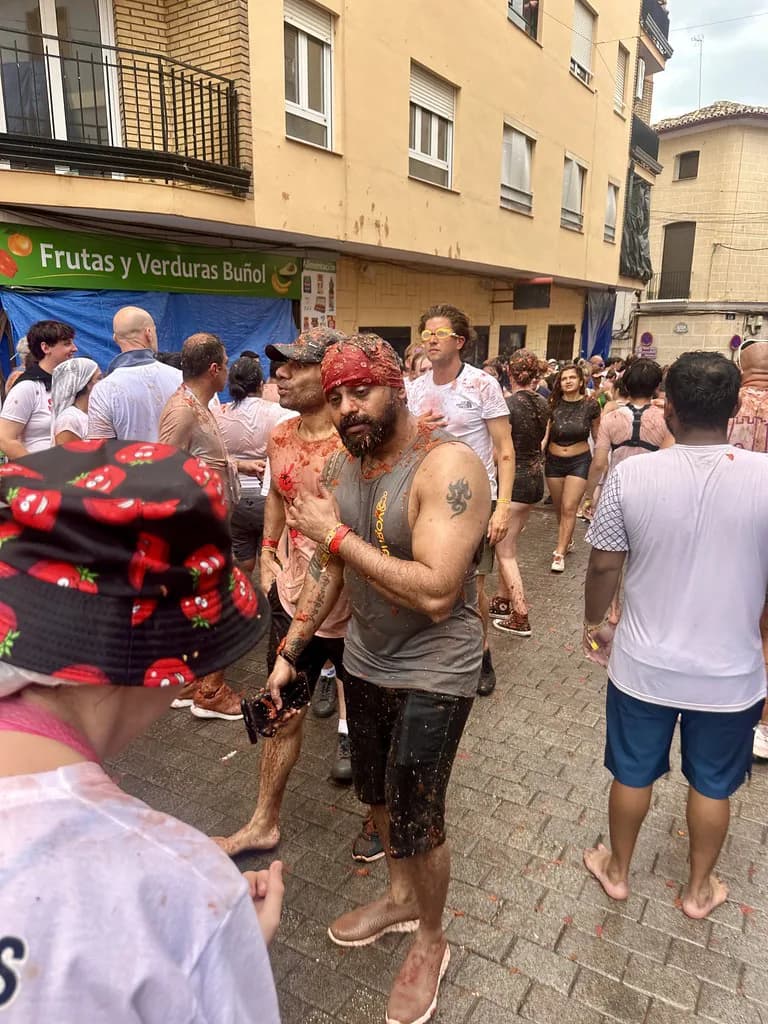
La Tomatina is an annual tomato-throwing festival held in Buñol, Spain, on the last Wednesday of August. Participants hurl over 100 tons of soft, overripe tomatoes at each other for roughly one hour before a cannon signals the end. Spain officially designated it a Festivity of International Tourist Interest, giving it a formal cultural status alongside events like the Running of the Bulls. For many attendees, it is part celebration, part catharsis — a rare moment of joyful, sanctioned chaos.
The setting is Calle del Cid, a narrow street in the town centre where buildings are covered in protective tarps before the fight begins. Loud music fills the air, and the atmosphere has been compared to an outdoor rave — one soaked in tomato juice. Unlike many European street festivals, La Tomatina has just one official rule: squish the tomato before throwing it to prevent injury. That single rule keeps things energetic but avoids the worst bruising that a hard throw might cause.
Attendance was once as high as 40,000 people, but organisers capped it at around 20,000 in 2013 to make the event manageable for the small town. The hour-long fight ends as abruptly as it begins — the cannon fires, the tomatoes stop, and a surreal quiet settles over a street painted entirely red. Communal showers and fire hoses help participants rinse off before they head back to their hotels or trains.
How La Tomatina Began: The 1945 Scuffle
La Tomatina has its roots in a street parade gone sideways in August 1945. During a local festival procession in Buñol's town square, a group of young people began jostling to join the parade. The jostling turned into a scuffle, and the nearest available ammunition happened to be tomatoes from a market stall. Within moments, the air was full of flying tomatoes — and something unexpected was born.

No one knows which individual threw the first tomato, and the oral history has shifted over the decades. What sources agree on is that the fight was entirely spontaneous — there was no plan, no organiser, no political message. Valencian history teacher Enric Cuenca Yxeres told the BBC that the identity of that first thrower remains unknown to this day. The tomatoes came from a nearby vegetable stall, and the unlucky stallholder watched the stock disappear in minutes.
The following year, the same group of young people returned to the town square with their own tomatoes, determined to repeat it. What started as an accident became a deliberate annual tradition for local youth — even before it had a name or a date. The town itself was divided: some residents embraced the playful chaos, while others were less enthusiastic about the mess. Within a few years, it had grown enough to attract attention — and the disapproval of authorities.
Banned by the Franco Regime
In the early 1950s, Spain's dictator Francisco Franco ordered the festival banned. Under Franco, public gatherings without official approval were tightly controlled, and an anarchic tomato fight did not fit the regime's vision of orderly public life. Locals who defied the ban faced fines and, in some cases, were forced to carry a tomato through the streets as a public humiliation. Rather than killing the tradition, the crackdown seems to have strengthened local attachment to it.
Residents of Buñol protested the ban persistently, pushing for the festival's reinstatement through the mid-1950s. Their efforts paid off: in 1957, officials allowed La Tomatina to return, this time with a degree of formal recognition. The comeback gave the festival a new legitimacy — it was no longer just a youth prank but a community tradition with a history of resistance behind it. That resilience story is part of why La Tomatina carries real emotional weight for locals today.
Since 1957, the festival has run every year except during the Covid-19 pandemic, when it was suspended in 2020 and 2021. Its survival through a dictatorship, a global health crisis, and decades of tourism pressure makes it one of the more durable grassroots traditions in Europe. You can learn how similar spirit-driven celebrations have shaped the continent in our guide to what Semana Santa is and how it is celebrated across Spain.
The World's Largest Food Fight
La Tomatina's scale today is hard to picture without the numbers. Trucks carry more than 100 tons — roughly 320,000 pounds — of overripe tomatoes into Calle del Cid before the fight begins. The tomatoes are not food-quality produce; the Associated Press reports that they are surplus stock that would be discarded anyway, so the event creates no additional food waste. That detail tends to surprise first-time visitors who worry about the environmental impact.

The one-hour fight is launched by a cannon shot and ends the same way. Between those two signals, participants are free to throw as much as they can grab. Squishing each tomato before throwing is the only enforced rule — it reduces the risk of eye and skin injuries from a hard-thrown fruit. Some attendees use goggles for extra protection, which organisers quietly encourage.
The festival draws tourists from dozens of countries and has been covered by major media outlets every year since the 1990s. Political statements sometimes appear during the event — in 2025, a large Palestinian flag was unfurled mid-fight, drawing international attention to the political statements some participants embed in the spectacle. For most people, though, it remains simply a moment of uncomplicated, tomato-soaked joy. Buñol's economy benefits significantly from the event: ticket sales, accommodation, and catering all receive a boost during the week surrounding the fight.
Tickets, Costs, and What to Expect
Attending La Tomatina requires a ticket, which costs around €15 for non-local visitors, according to the AP. Tickets must be bought in advance through the official festival channels, as the event sells out well before the August date. Book accommodation in Valencia city if you cannot find anything in Buñol itself — the two towns are connected by a short train ride. Prices for hotels in Valencia tend to spike during La Tomatina week, so booking at least two to three months early is advisable.
The unwritten dress code is a white T-shirt, which quickly becomes a tomato-stained memento. Closed-toe shoes that you are willing to ruin are essential — the streets turn into a red, slippery mess within minutes of the cannon firing. Leave cameras, expensive phones, and jewellery at your accommodation; waterproof cases help for quick photos, but most participants simply enjoy the chaos without trying to document it. Sealed water bottles and sunscreen are worth packing for the wait before the fight begins.
The festival forms part of a wider week of events in Buñol, including parades, music, and fireworks. If you are planning a European festival trip around La Tomatina, the surrounding days offer a more relaxed look at Valencian local life. The event consistently sells out, so treating ticket purchase as your first step — before booking flights or trains — is the single most important piece of practical advice we can offer.
- Practical checklist for La Tomatina
- Tickets: Buy official tickets early — around €15 for non-locals
- Date: Last Wednesday of August each year
- Base: Stay in Valencia if Buñol is full; 45-minute train connects them
- Clothing: Old white T-shirt, closed shoes you can throw away after
- Gear: Goggles optional but recommended; leave valuables at the hotel
- Duration: The tomato fight lasts one hour; arrive early for good position
La Tomatina 2026: Date and What to Know This Year
In 2026, La Tomatina falls on Wednesday, 26 August — the last Wednesday of the month, as always. The 80th anniversary edition in 2025 drew particular emotional weight. That year's official theme was Tomaterapia — a Spanish portmanteau of "tomato" and "therapy" — chosen as a direct reference to the devastating floods that struck eastern Spain in October 2024, killing more than 200 people across the Valencia region and affecting towns close to Buñol. The festival became an act of collective healing as much as celebration, a dimension of La Tomatina that outside coverage rarely acknowledges.
For 2026, the cap of approximately 20,000 tickets remains in place. Buñol's town council releases tickets in spring; demand reliably exceeds supply. If you are booking, treat late February or early March as your target window. Train services from Valencia Estació del Nord to Buñol run frequently on festival day, with journey times of around 45 minutes — plan to stay in Buñol for the afternoon rather than rushing back immediately. The town's bars reopen once the streets are hosed down, and a post-fight hour eating paella in a now-quiet Buñol is one of the underrated pleasures the event offers.
Is La Tomatina Safe? What the Safety Record Shows
People searching for La Tomatina commonly ask whether anyone has died at the festival. No fatalities directly caused by the tomato fight itself are recorded in modern accounts of the event. The squish-before-throwing rule exists precisely to reduce impact injuries — a hard, un-squished tomato at close range can cause bruising and eye damage. Organisers enforce it seriously, and the crowd culture tends toward exuberance rather than aggression.
Minor injuries do occur every year. Cuts from slipping on the tomato-slicked cobblestones are the most common complaint, followed by mild eye irritation from tomato acid. Goggles address the second problem almost entirely. Footwear matters more than most guides admit: sandals and flip-flops are genuinely dangerous on a street covered in wet pulp. Closed shoes with grip — ones you plan to discard afterward — are a safety choice, not just a practical one. For people with mobility limitations or claustrophobia, the narrow fight zone is not suitable, but attending the surrounding week's parades and fireworks offers the festival atmosphere without the crowd pressure of Calle del Cid.
Frequently Asked Questions
How did La Tomatina start the tomato fight?
La Tomatina began accidentally in August 1945 during a parade in Buñol, Spain. Young people started jostling a procession, a scuffle broke out, and someone grabbed tomatoes from a nearby market stall. The identity of the first thrower remains unknown. Local youth repeated the fight deliberately the following year, and the tradition grew from there.
What are the rules of La Tomatina?
La Tomatina has just one rule: squish each tomato before throwing it to reduce the risk of injury. Organizers enforce this to prevent hard projectiles from hitting people. Beyond that, participants are free to throw as much as they like during the one-hour fight, which begins and ends with a cannon blast.
How long does La Tomatina last?
The tomato-throwing portion of La Tomatina lasts exactly one hour. A cannon fires to signal the start and fires again to mark the end. The wider festival in Buñol runs for several days either side of the fight, with parades, music, and fireworks filling the surrounding evenings.
Why was La Tomatina banned by Franco?
Francisco Franco's regime banned La Tomatina in the early 1950s because it was an unsanctioned public gathering that did not align with the regime's expectations of orderly civic life. Local protests in Buñol pushed for its return, and the festival was officially reinstated in 1957. It has run every year since, except during the Covid-19 pandemic. Learn more about Spanish festival traditions like Semana Santa that also carry deep historical weight.
How much does a La Tomatina ticket cost?
Non-local visitors pay around €15 for a La Tomatina ticket, according to the Associated Press. The event is capped at approximately 20,000 people since 2013, and tickets sell out months in advance. Book through the official festival website as early as possible to avoid missing out entirely.
Related in Bunol: How to Watch La Tomatina.
La Tomatina is far more than a novelty photo opportunity — it is an 80-year-old grassroots tradition that survived a dictator's ban and became a global phenomenon. Understanding how a spontaneous 1945 street scuffle in a small Valencian town turned into the world's largest annual food fight adds real meaning to the experience. Whether you attend for the history, the chaos, or simply the unforgettable spectacle, Buñol in August is unlike anywhere else in Europe.
Planning ahead is the critical step: tickets at €15 sell out months before the last Wednesday of August. Dress in clothes you can discard, leave valuables behind, and arrive early enough to secure a position on Calle del Cid. If you enjoy this kind of deep-rooted European festival culture, our guide to European festival etiquette and customs will help you navigate similar events with more confidence.
Free guide: Europe's Festival Calendar
A month-by-month map of Europe's unmissable festivals — with the best dates to visit each and a local tip you won't find in the guidebooks.
You might also like


Continue reading
More guides you'll find useful