
Semana Santa in Seville Dates: 10 Essential Tips for Holy Week
Plan your trip with the official Semana Santa in Seville dates for 2026 and 2027. Includes procession schedules, La Madrugá tips, and local cultural highlights.
On this page
Semana Santa in Seville Dates: 10 Essential Tips for Holy Week
Semana Santa in Seville is one of the most intense religious spectacles in Europe. Every spring, dozens of Catholic brotherhoods carry enormous floats through the old city over eight consecutive days. The streets fill with incense smoke, candlelight, and solemn music from brass bands. No other city in Spain stages Holy Week at this scale.
See also: Semana Santa In Seville Guide Travel Guide.
Planning your visit around the Semana Santa in Seville dates requires early preparation. Hotels fill up six months in advance, and transport into the historic center becomes blocked during peak procession hours. Understanding the basic structure of the week — who marches, when, and where — transforms a confusing spectacle into a meaningful experience.
Free guide: Europe's Festival Calendar
A month-by-month map of Europe's unmissable festivals — with the best dates to visit each and a local tip you won't find in the guidebooks.
Easter Week in Seville: Upcoming Dates (2026–2027)
The Semana Santa in Seville dates for 2026 run from Sunday 29 March to Sunday 5 April. In 2027, Holy Week falls earlier: Sunday 21 March to Sunday 28 March. The dates shift each year because Easter Sunday is calculated from the first full moon after the spring equinox.
Processions take place every day of the week, including Palm Sunday and Easter Sunday itself. Most brotherhoods march in the afternoon and evening, with peak activity between 18:00 and 01:00. The single exception is La Madrugá, which begins at midnight on Thursday and runs through Friday noon.
If you can only attend one day, Holy Thursday and Good Friday carry the most weight culturally and religiously. The largest and most elaborate brotherhoods march on those two days. Palm Sunday draws enormous crowds but features shorter, more relaxed processions suited to families.
When Do the Seville Holy Week Processions Take Place?
The time of day dramatically changes the character of what you experience. Each window has a different crowd type, lighting, and atmosphere. Understanding these windows helps you match your presence to your own preferences.
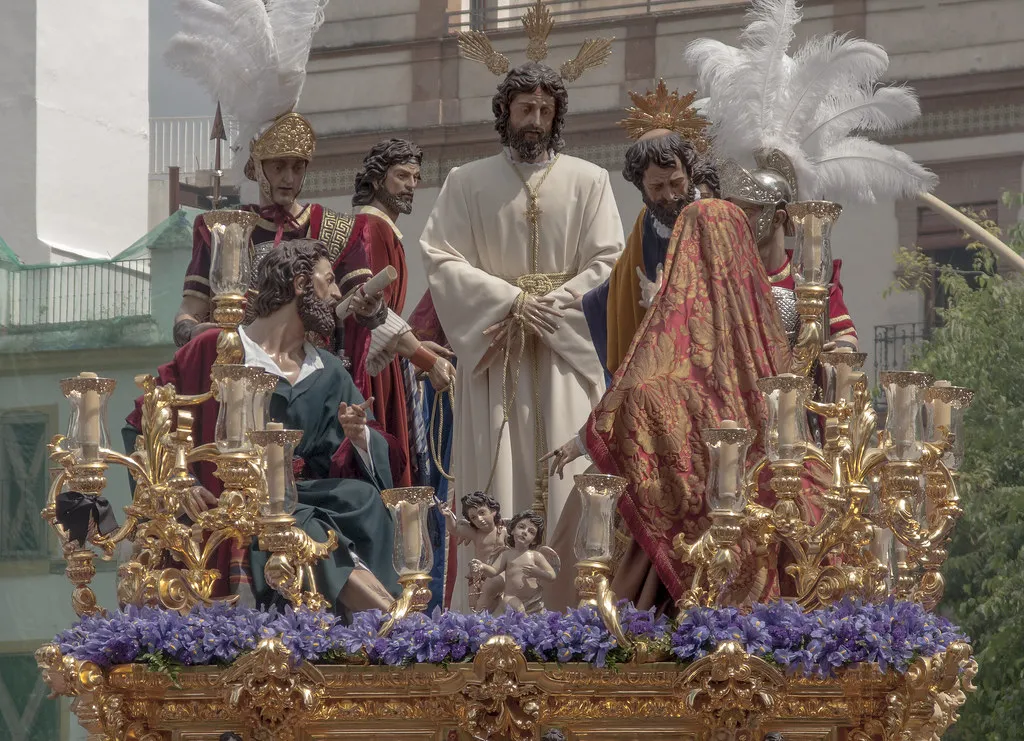
- Between 16:00 and 21:00. Best for families and first-time visitors. The floats are visible in daylight, showing their full sculptural detail. Crowds are large but manageable.
- Between 21:00 and midnight. Families and children gradually leave the streets. The atmosphere becomes more devotional. This is when the candlelight processions look most dramatic.
- After midnight. Processions are returning to their home churches. Crowds thin considerably, and you can often stand in the front row. Watching a float return through the narrow doors of a parish church at 02:00 is one of the most intimate moments of the entire week.
Monday through Wednesday traditionally attract smaller crowds because many attendees are local residents following specific brotherhoods they know personally. Palm Sunday and the Thursday-to-Friday stretch are the busiest periods by a wide margin.
Procession Basics: Brotherhoods, Pasos, and the Official Route
Every procession is organized by a hermandad (brotherhood), a Catholic lay association tied to a specific parish church. The procession departs from the brotherhood's home church, travels to the Seville Cathedral for a blessing from the archbishop, and returns. The route must be the shortest feasible path to the Cathedral.
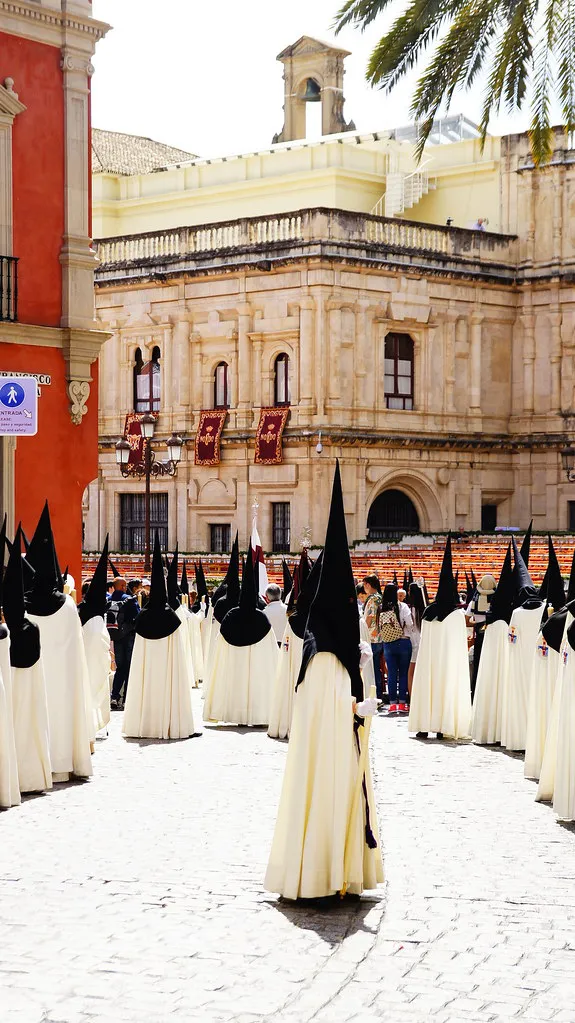
The final stretch before the Cathedral is shared by all brotherhoods and is called the Carrera Oficial (Official Path). It runs from a square known as La Campana, down Sierpes street, through Plaza San Francisco, and along Avenida de la Constitución to the Cathedral entrance. If you want to guarantee seeing multiple floats without chasing them through the city, station yourself anywhere along this corridor.
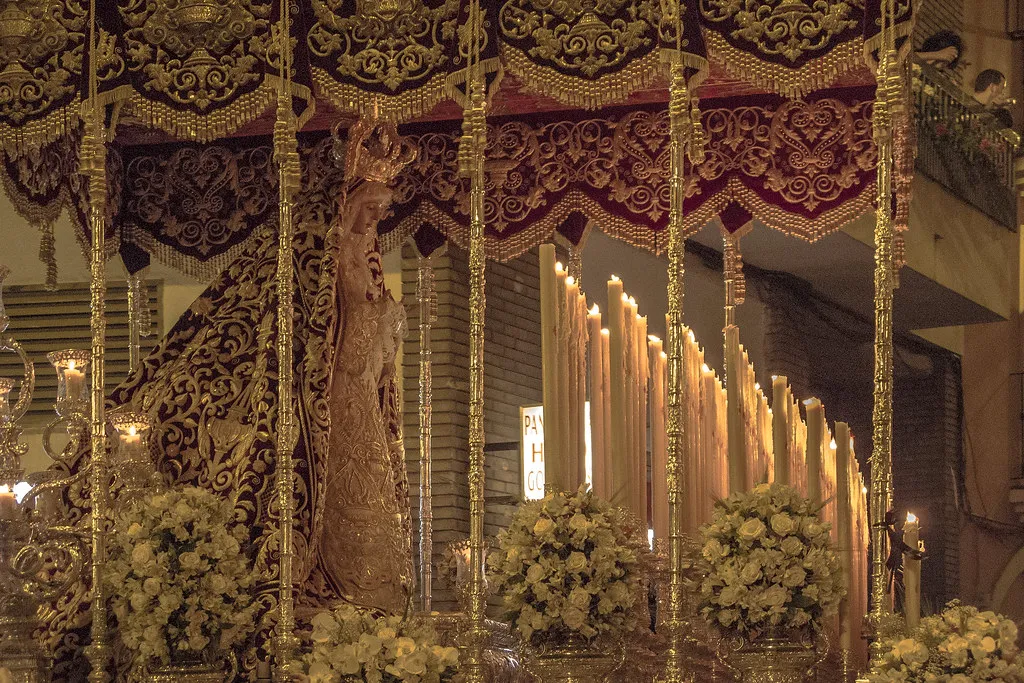
The floats themselves are called pasos. There are two types: El Cristo (depicting scenes from the Passion of Christ, usually covered in gold) and La Virgen (showing the grieving Virgin Mary, usually covered in silver and sheltered by an ornate canopy called a palio). Each paso can weigh over 2,000 kg and measures roughly 2 m high, with a velvet hem concealing the carriers underneath.
How Is the Marching Order of a Procession?
Every procession follows the same internal structure, which means you can read where the float is before you even see it. At the front comes the Cruz de Guía (Guiding Cross), a tall ceremonial cross that opens the route. Behind it march the nazarenos — members of the brotherhood dressed in long robes, a pointed capirote hood that conceals their face, and sometimes a cape. Colors vary by brotherhood.
Between the lines of nazarenos, diputados de tramo walk to keep the formation disciplined. A group of altar boys and incense bearers follows. Then comes the paso itself, accompanied before or after by a musical band. Some brotherhoods march entirely in silence. Finally, penitents wearing the brotherhood habit but a flat hood (not pointed) carry wooden crosses at the rear.
This structure repeats for each paso in the procession. A brotherhood can carry two or three pasos, so the full sequence plays out multiple times. A single procession can include up to 3,000 nazarenos and last between 4 and 14 hours. Large processions take over 90 minutes to pass one fixed point.
Knowing the order has a practical benefit: once you see the Cruz de Guía pass, you know the float is still minutes to an hour away, giving you time to reposition or cross the street before the paso arrives.
The Essential Role of the Costaleros
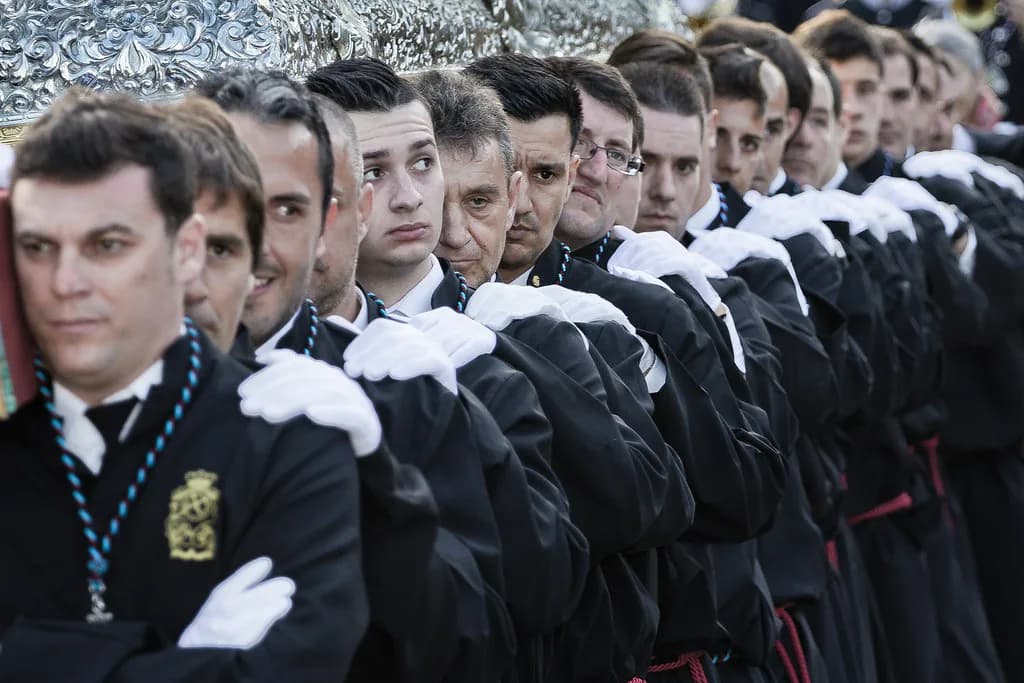
The costaleros are the hidden carriers who physically move each paso. They crouch beneath the float in a narrow internal frame, supporting wooden beams on their shoulders and necks. Because they work in complete darkness and cannot see out, a capataz (overseer) stands at the side and guides the team through voice commands and a ceremonial hammer called el llamador, which is struck against the paso's frame.
On average, 40 costaleros carry each paso, each bearing approximately 50 kg. The largest floats require up to 60 carriers. Because each procession lasts many hours, costaleros rotate in shifts, each carrying for roughly one hour at a stretch before being replaced. Months of coordinated training precede the event — the goal is to move the paso smoothly enough that the figures on top appear to walk.
Carrying a paso is considered a profound act of devotion and penance. Many costaleros participate year after year, and places on carrying teams are highly sought after within each brotherhood.
How to Watch La Madrugá Like a Sevillano
La Madrugá is the most important night of the entire week. Six of the most revered brotherhoods depart after midnight on Thursday night / Friday morning and march through until around noon. The old city center will be packed — do not underestimate the crowds at 03:00.
Locals split into two strategies: staying awake through the night and heading home around 08:00–09:00, or sleeping and heading out at 08:00–09:00 to catch the final hours in morning light. A practical middle path is to go out from 05:30 to 10:00 — the crowds thin after the peak midnight rush, the processions are still moving, and you can often find a front-row position.
Bring warm layers. Spring nights in Seville are colder than they appear, and the combination of open plazas and flagstone streets amplifies the chill. Charge your phone fully before going out — you will use the battery for maps and photos. Finding a public toilet becomes nearly impossible after midnight, so plan accordingly.
The 'saeta' adds a spontaneous layer to the night. This is a traditional flamenco song sung from a balcony or the crowd to a passing float. When a singer begins, the entire procession halts, the band falls silent, and the crowd follows. Moving or talking during a saeta is considered deeply disrespectful. Read more on how to watch Semana Santa in Seville for further guidance on positioning yourself along the route.
How to Navigate Seville During Holy Week
Public transport routes change significantly during procession days. Buses cannot enter the historic center when a procession is moving through. Some metro stations may close briefly if platforms become unsafe. Walking is the fastest and most reliable way to move around.
Crossing a street blocked by a procession looks impossible but has a clear rule: wait for the procession to stop. Costaleros need frequent breaks, and the float pauses every 20–30 minutes. When it halts, locals cross calmly in front of the paso. You will hear the capataz strike the floor three times with his staff before the procession resumes — that is your cue to get out of the way immediately. Never walk through the middle of a moving procession or between the nazarenos.
Avoid stationing yourself at the start or end points of any procession. You will wait hours and see nothing at the departure church, or arrive too late at the home church entry. Instead, find a side street at an off-peak hour and wait for the procession to come to you. Once you spot the Cruz de Guía, you know roughly when the paso will arrive. Check the Feria de Abril dates if you are planning consecutive festivals — it falls two weeks after Easter ends and requires separate hotel planning.
2027 Cultural Highlights: Alejandro Sanz and Jamiroquai
The Semana Santa 2027 dates (21–28 March) coincide with an unusually strong concert programme. Spain's official tourism calendar lists both an Alejandro Sanz tour and a Jamiroquai concert in the Seville area around Holy Week 2027. These events make the 2027 edition particularly attractive for visitors who want cultural entertainment alongside the religious processions.
The Real Alcázar also runs its Nights in the Gardens concert series during spring, offering classical and flamenco performances inside the palace gardens after the main monuments close to day visitors. This is a quieter alternative if the street crowds become overwhelming. Book tickets for these events well in advance — they sell out faster than the procession-week hotel rooms.
Make sure to book your tickets and tours for Semana Santa well in advance, particularly for any guided procession walks or reserved tribuna (grandstand) seats along the Carrera Oficial.
Frequently Asked Questions
How long is Semana Santa in Seville?
Semana Santa lasts for eight days, starting on Palm Sunday and ending on Easter Sunday. The most intense activities occur during the final three days. Most visitors find that staying for four days provides a great overview.
Is Seville too busy during Holy Week?
Seville is extremely crowded during Holy Week with over a million visitors. The narrow streets of the city center can become completely blocked by processions. You should plan extra time for every movement across the city.
What time do the Easter parades start in Seville?
Most processions start between 13:00 and 16:00 in the afternoon. They continue through the evening, with many reaching the Cathedral after midnight. The schedule varies daily based on the brotherhood's home church location.
Visiting Seville for more than one festival? See our complete guide to festivals and events in Seville.
Visiting Seville during Holy Week is a powerful and unique experience. By knowing the Semana Santa in Seville dates, you can plan a perfect trip. Whether you seek religious devotion or cultural spectacle, the city delivers. Make sure to book your tickets and tours well in advance.
Respecting local traditions will ensure you have a meaningful visit. Remember to stay patient with the large crowds and changing schedules. Seville's beauty during the spring is something every traveler should see once. Enjoy the scent of incense and orange blossoms in this historic city.
Free guide: Europe's Festival Calendar
A month-by-month map of Europe's unmissable festivals — with the best dates to visit each and a local tip you won't find in the guidebooks.
You might also like


Continue reading
More guides you'll find useful


