Sunflower Fields in Tuscany: 9 Tips to Find the Best Blooms
Discover the best time to see sunflower fields in Tuscany. Our guide covers top locations like Val d'Orcia, peak bloom dates, and photography tips for your road.
On this page
Sunflower Fields in Tuscany: 9 Tips to Find the Best Blooms
Tuscany transforms into a golden paradise when millions of sunflowers tilt their heads toward the warm Italian sun during the summer months. Travelers flock to the rolling hills to witness these vibrant blooms that define the iconic landscape of central Italy every year. Finding the perfect yellow horizon requires a bit of planning because these flowers follow a strict agricultural cycle across the region. This guide explores the best flower fields in Europe to help you locate the most stunning blossoms in Tuscany.
Free guide: Europe's Festival Calendar
A month-by-month map of Europe's unmissable festivals — with the best dates to visit each and a local tip you won't find in the guidebooks.
When do Sunflowers Bloom in Tuscany?
The peak season for sunflowers in Tuscany typically runs from the final week of June through the middle of July each year. Weather patterns heavily influence the exact timing — early heatwaves can cause the flowers to bloom faster than usual, while a wet or cool spring can push the window into late July. Aim for the first two weeks of July if you want the most intense yellow colors across the valleys. By late July, the flowers begin to dry out as they prepare for the harvest in early August.
Understanding the three phases of growth is essential for managing your expectations. In early June the stalks are tall but the buds remain tightly closed and green — fields are photogenic but not yet golden. From late June into mid-July the petals unfurl rapidly, creating the famous yellow carpets that photographers seek. By August the heads bow downward, heavy with seeds, and the petals darken toward brown — atmospheric in a rustic way, but past prime for classic shots.
A useful rule of thumb: look for fields where the buds are fat but still green. That signals a bloom within five to ten days. Fields where the centers are dark and the outer petals droop have already peaked. Both the green phase and the post-peak brown phase are commonly misidentified as "not blooming" — they are simply different chapters of the same plant's story.
Top Locations: Val d'Orcia and Southern Tuscany
The Val d'Orcia region offers some of the most picturesque backdrops for sunflower enthusiasts due to its UNESCO World Heritage status. Rolling hills and solitary cypress trees create a dramatic contrast against the bright yellow fields that line the provincial roads. Drive toward the town of Pienza or explore the outskirts of San Quirico d'Orcia to find large concentrations of these summer blooms. The stretch of the Via Cassia just south of Monteroni d'Arbia is particularly rewarding — from one roadside pull-off you can frame a castle, a vineyard, and a sunflower field in a single shot.
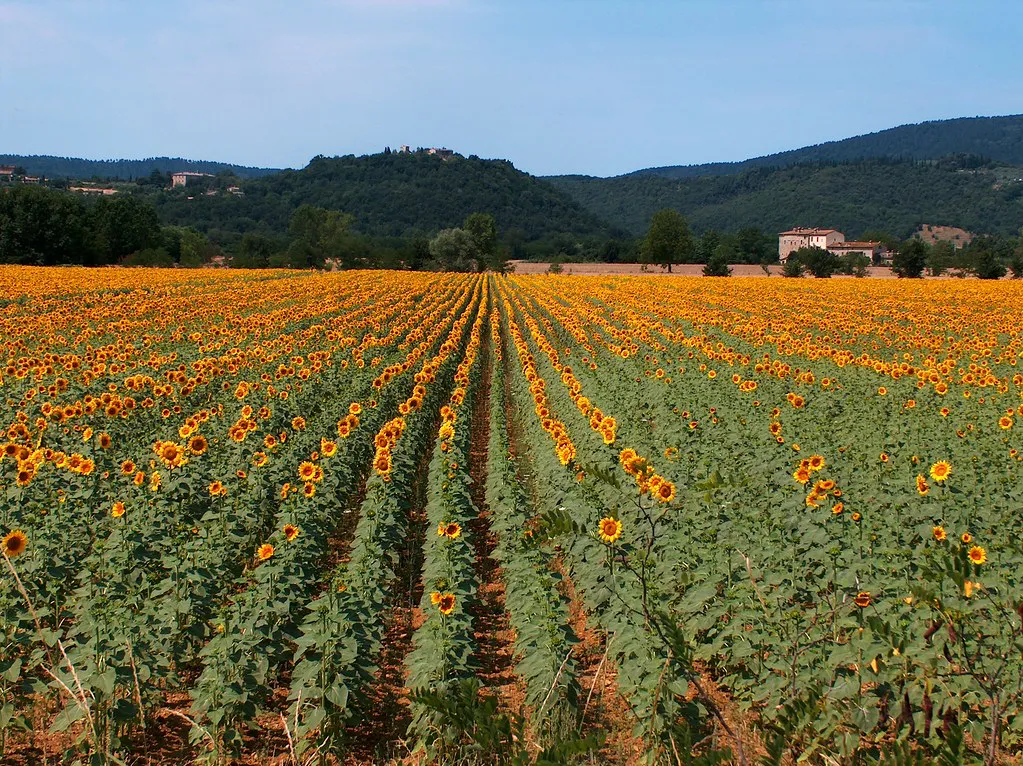
Southern Tuscany provides a more rugged landscape where sunflowers often grow alongside ancient stone farmhouses and sprawling vineyards. The area around Montalcino frequently features sunflower rotations that offer incredible views of the surrounding medieval fortresses. Many of these spots are among the best places to see flowers in Europe during the peak summer months. Take the smaller backroads that connect the major hill towns in this famous wine region — they consistently turn up hidden fields that the main roads miss entirely.
Exploring the Maremma and Massa Marittima Fields
The Maremma coastline offers a different perspective on the Tuscan landscape with its flat plains and proximity to the Tyrrhenian Sea. Sunflowers thrive in the fertile soil near Massa Marittima where the fields often stretch as far as the eye can see. The SP541 road, known locally as the Traversa Maremmana, is a legendary route for spotting massive yellow blooms in this region. Start the trip at Colle Val d'Elsa, follow the SP541 south, then connect to the SP73bis and SR439 toward Follonica — sunflower fields appear on both sides of the road, interspersed with driveways lined with Mediterranean pines.
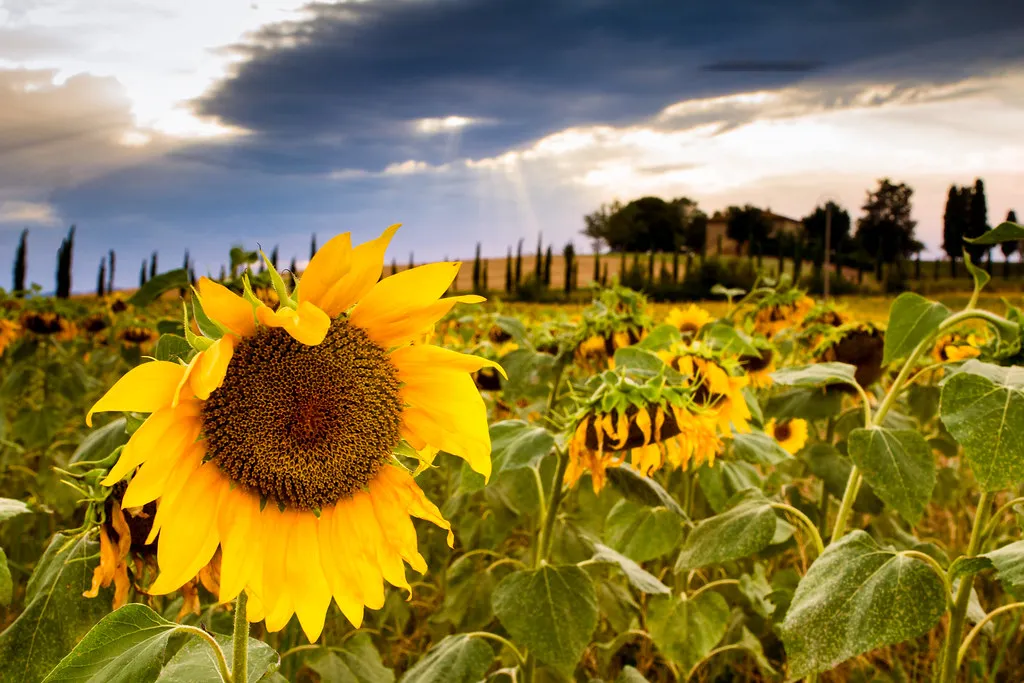
Exploring this area allows you to combine flower hunting with a visit to some of Italy's most beautiful beaches and pine forests. The fields near Grosseto are particularly impressive because the flat terrain makes the horizon look like a literal sea of gold. You will find fewer tourists in the Maremma compared to the more famous Val d'Orcia, allowing for a quieter and more spontaneous experience. Stop at a local farmhouse in the area to sample fresh sunflower oil or honey produced by the surrounding agricultural estates.
Sunflower Spotting in Mugello and Casentino
Northern Tuscany holds an unexpected treasure in the Mugello valley, just a short drive northeast of Florence and perfect for a day trip. The cooler mountain climate can push the bloom a few days later than the southern provinces, so it often serves as a useful backup if the Val d'Orcia fields have already passed peak. Head just past Lake Bilancino toward the Villa Medici at Cafaggiolo and you will find fields that most visitors completely miss. This region is ideal for travelers who want to escape the city heat while still enjoying quintessential Tuscan scenery.
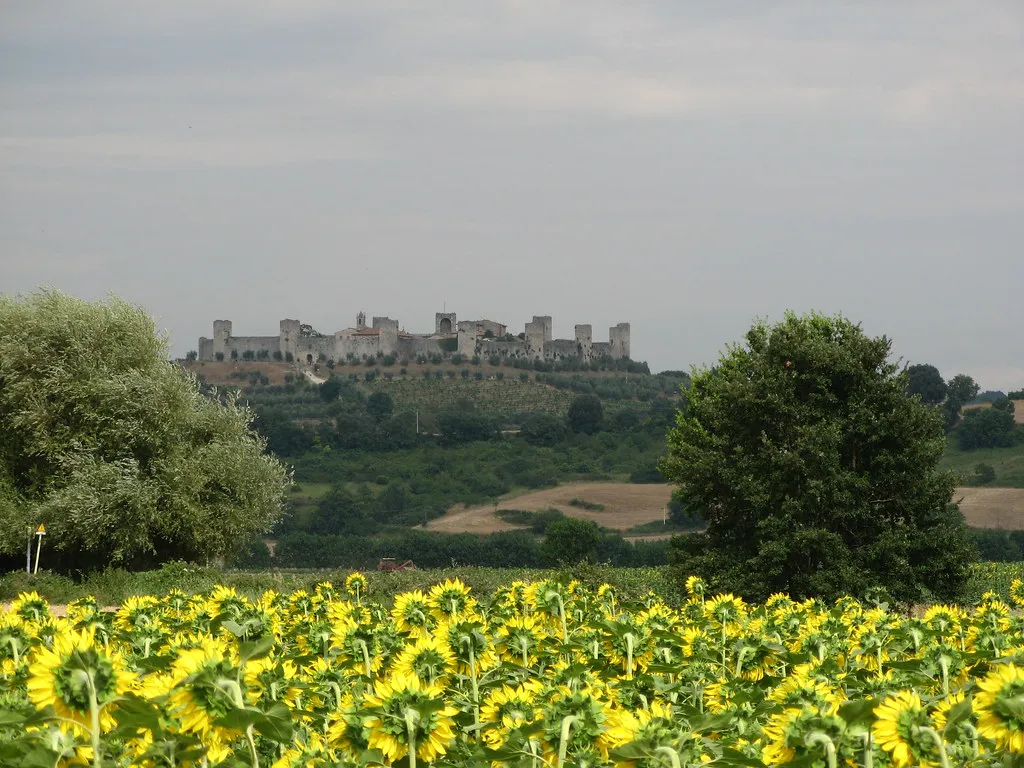
The Casentino valley, located between Florence and Arezzo, offers another alternative for those seeking sunflowers amidst dense forests and ancient monasteries. Fields are smaller here but more intimate, framed by the high peaks of the Apennine Mountains and occasionally fronted by medieval pieve churches. Local farmers in this northern corner of Tuscany maintain traditional agricultural methods including crop rotation, so the fields shift position year to year. Keep your camera ready as you drive through the winding mountain passes that lead into these fertile and secluded valleys.
The Best Scenic Routes: Via Cassia and Chianti
The Via Cassia (SR2) is the most reliable road for sunflower spotting in the whole of Tuscany. This historic highway connects Siena to Rome through the heart of the Val d'Orcia and passes some of the most fertile agricultural land in the country. The stretch between Montalcino and Siena is particularly productive — look for pull-offs just after the roundabout at Monteroni d'Arbia for the classic composition that postcards have used for decades. Record-low nights in spring can delay the bloom here by a week or two, so check local sources before driving specifically for flowers.
The Chianti region is better known for its world-class vineyards but sunflowers regularly appear between the rows on the SR222 Chiantigiana road. Near Taverna di Bibbiano, north of San Gimignano, you can sometimes find sunflowers growing alongside unexpected patches of lavender. The contrast between the deep green of the Sangiovese vines and the bright yellow of the sunflowers creates a stunning visual palette. Driving toward San Gimignano from the south often reveals golden fields that perfectly frame the famous medieval towers in the distance. The Valdichiana stretch along the Autostrada del Sole is also worth watching — fields appear midway between the exits for Chiusi/Chianciano Terme and Sinalunga, on both sides depending on your direction of travel.
Why Sunflower Fields Move Every Year
One of the most important things to know about sunflowers in Tuscany is that they are part of a crop rotation system. Farmers rarely plant sunflowers in the exact same field two years in a row because sunflowers are heavy nitrogen feeders that rapidly deplete the soil. This means that a field that was golden last summer might be filled with green wheat or tall corn in 2026. Rotation also helps prevent the buildup of pests and keeps yields high without relying on heavy chemical inputs.
Never rely on old maps or blog posts from previous years when planning your specific driving route. The best strategy is to drive with a sense of adventure, scanning the horizon for the yellow glow that signals a field ahead. Detours are not obstacles — many of the best finds happen on roads you took by accident. Consult the lavender fields in Provence guide for a parallel example of how other regions manage their seasonal agricultural displays and how rotation affects planning there too.
How to Find Sunflower Fields in Real Time
Because rotation means last year's field is this year's grain crop, real-time intelligence is far more valuable than any static guide. The most reliable method in 2026 is to search Google Maps in Italian: type "campi di girasoli" (sunflower fields) or "girasoli Toscana" into the search bar and filter by photos added in the last 30 days. Recent geotagged uploads from local photographers will cluster around the active fields even before travel blogs catch up.
Instagram and Facebook also work well for this. Search the hashtag #girasoliToscana or #girasoliItalia in the days before your trip and sort by most recent. Many Italian agriturismo owners post photos of their own surrounding fields as a form of informal marketing — these accounts are particularly reliable because they are tied to a fixed location. Local agricultural cooperative Facebook groups sometimes announce when their fields are at peak as a way of welcoming responsible visitors.
The phrase "Sagra del Girasole" is worth searching too. Several small Tuscan villages hold annual harvest festivals around the sunflower crop, usually in late July or early August. These events are listed on the websites of local comuni (municipal councils) and occasionally in the Discover Tuscany events calendar. Attending one gives you a guaranteed field visit plus access to sunflower-seed oil, fresh bread, and local wine.
Photography Tips: Capturing the Golden Soul
Capturing the perfect image of a sunflower field requires an understanding of heliotropism — the way young plants follow the sun. Immature sunflowers track the sun from east in the morning to west in the evening to maximize their exposure to warmth and light. Once the plants reach full maturity and the flowers open completely, they stop moving and fix permanently facing east. This is the critical detail for photographers: a field of mature, fully open sunflowers faces east, meaning morning light hits the faces of the flowers directly and evening light hits their backs.
Plan your photography sessions for golden hour in the morning, roughly 06:00 to 08:00 in July, when the sun is low in the east and the flowers are turned directly toward it. Avoid shooting at noon because the harsh overhead sun creates deep shadows and washes out the vibrant yellow. Try to include a rustic element like a stone barn or a row of cypress trees to add depth to your composition. Getting low to the ground and shooting upward can make the sunflowers look like a towering forest of gold against the blue Italian sky.
How to Plan a Sunflower Tour: Bike vs. Car
Renting a car is the most practical way to cover the large distances between Tuscan provinces. A car lets you pull over whenever you spot a golden field and change your route instantly when social media tips point you somewhere unexpected. Be careful when stopping on narrow provincial roads and always pull your vehicle completely off the carriageway. The self-drive approach is particularly powerful when combined with the real-time search methods above — you can triangulate Instagram posts and keep driving until you find active fields.
Cycling offers a much more intimate way to experience the sights and smells of the sunflower fields at a slower pace. E-bike tours have become very popular in areas like the Val d'Orcia because they help you tackle the steep Tuscan hills without exhausting yourself in the July heat. The famous strade bianche — white gravel roads packed hard between rows of vines — lead you into field interiors that are entirely inaccessible to cars. Chianti in particular has several bike tour operators who have already mapped reliable sunflower detours into their summer routes, blending the flowers with wine tastings and medieval village stops.
Essential Travel Tips for a Sunflower Hunt
Always remember that most sunflower fields in Tuscany are private property and part of a working farm's livelihood. Never walk deep into the fields or pick the flowers — both actions damage the crop and can result in fines under Italian agricultural trespassing law. Stick to the edges and use a zoom lens to get close-up shots without stepping on plants. Respecting the local land ensures these beautiful displays remain accessible to everyone in future summers.
Prepare for the heat of the Italian summer by wearing light, breathable clothing and carrying a wide-brimmed hat. Comfortable walking shoes are essential if you plan to walk along the dusty paths that border large agricultural estates. Carry at least two litres of water per person — there are few shade structures in open sunflower country and midday temperatures regularly exceed 35°C in July. An early start also helps you beat both the heat and the other visitors who arrive from the hill towns after 10:00.
Frequently Asked Questions
When is the best month to see sunflowers in Tuscany?
The best month to see sunflowers in Tuscany is July. While some fields may begin blooming in late June, the peak intensity usually occurs during the first two weeks of July. By August, most flowers have finished blooming and are ready for harvest. Check the bloom timing guide for similar European flowers.
Where are the most famous sunflower fields in Italy?
The most famous fields are located in the Val d'Orcia and the Maremma regions of Tuscany. You can find stunning displays along the Via Cassia and near the town of Massa Marittima. These areas offer the classic rolling hill backdrops that Italy is known for globally.
Do sunflowers in Tuscany bloom in August?
Most sunflowers in Tuscany have finished their bloom by early August. During this time, the heads turn brown and heavy as the seeds mature for harvest. While they lose their bright yellow color, they still offer a rustic and atmospheric look for late summer travelers.
Why do sunflower fields change locations every year?
Tuscan farmers use a crop rotation system to keep the soil healthy and productive. Sunflowers are typically rotated with wheat, corn, or legumes every one to two years. This practice prevents soil depletion and helps manage pests naturally without excessive chemicals.
Related in Italy: Best Christmas Markets in Italy.
Finding the perfect sunflower fields in Tuscany is a rewarding adventure that captures the true essence of an Italian summer. Whether you explore the famous Val d'Orcia or the wild Maremma, the sight of a golden horizon is an unforgettable experience. Remember to respect the local farms, plan your timing carefully for the peak July window, and use real-time Italian-language searches to find the fields that are blooming right now. Grab your camera and head out on the Tuscan roads to discover the golden soul of this magnificent Mediterranean landscape.
Free guide: Europe's Festival Calendar
A month-by-month map of Europe's unmissable festivals — with the best dates to visit each and a local tip you won't find in the guidebooks.
You might also like


Continue reading
More guides you'll find useful