Palio Di Siena Guide Travel Guide
Palio di Siena runs July 2 and August 16 in the Piazza del Campo: a 90-second bareback race, free standing by 14:00, or grandstand seats at EUR 250-600.
On this page
Palio Di Siena Guide
Siena transforms into a vibrant medieval stage twice every summer for its legendary horse race.
This Palio di Siena guide helps you navigate the complex traditions and electric atmosphere of the city.
Understanding the local passion is essential for any visitor hoping to witness this historic event.
It stands among the best cultural and national festivals in Europe for its raw intensity.
Free guide: Europe's Festival Calendar
A month-by-month map of Europe's unmissable festivals — with the best dates to visit each and a local tip you won't find in the guidebooks.
The Siena Palio
The Palio di Siena is a horse race held twice a year in the Piazza del Campo, on July 2nd and August 16th. It began in the 13th century and has been run in its current form since 1659. Ten horses and bareback jockeys represent ten of the city's 17 districts, racing three laps around the cobbled square — roughly 1,000 metres — in about 90 seconds. The winner receives a painted silk banner, the "palio," which the winning district prizes above any trophy.
This is not a tourist performance. The rivalry between districts runs through generations, and the emotions on race day — from joy to anguish — are completely unscripted. More than 100 horses are evaluated by veterinarians and expert trainers in the days beforehand, and only ten are selected. Each horse is then randomly assigned to a contrada by public draw outside the Town Hall.
The race can be decided in seconds, and the winning horse crosses the line even if its jockey has fallen off. A single cannon shot announces the start; another announces the winner. The entire city holds its breath for that minute and a half.
The Contrade Lottery
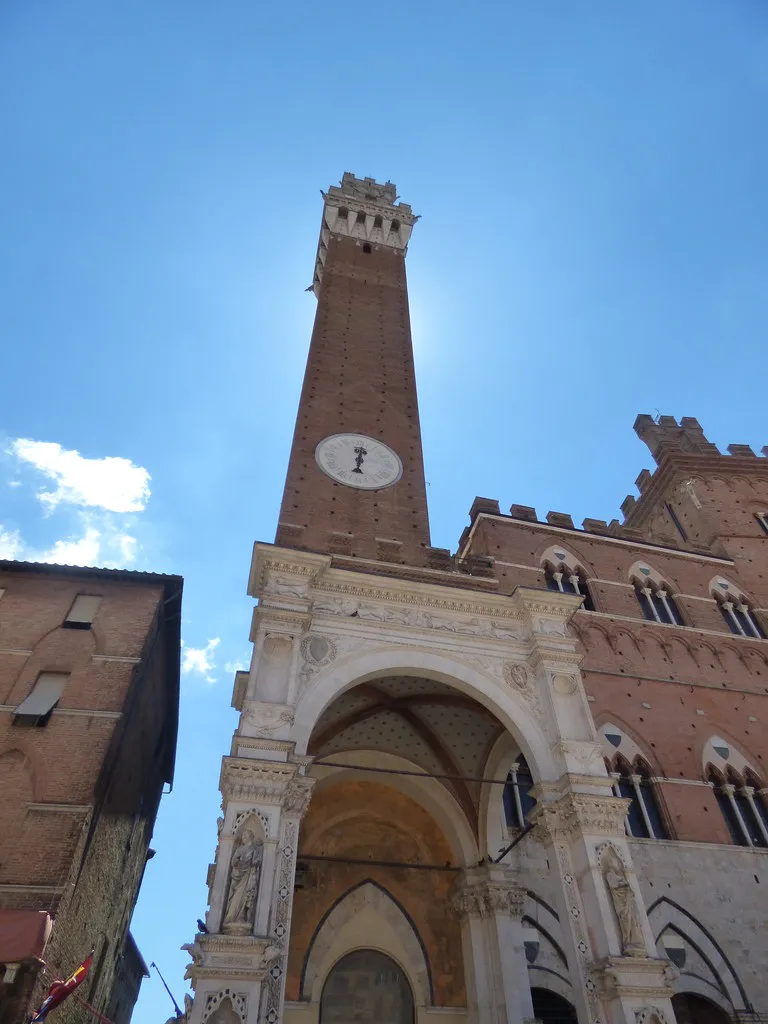
Siena is divided into 17 historic districts called contrade, each with its own animal symbol, flag, church, museum, and centuries of neighborhood pride. Only ten contrade race in each Palio. The selection follows a strict rule: the seven districts that did not race on the same date the previous year automatically qualify. The remaining three spots are drawn by lot from the ten eligible contrade about 20 days before each race.
This lottery system means allegiances shift race by race. A contrada that last won decades ago carries a burning motivation that shapes how its members interact with rivals, negotiate with jockeys, and celebrate even minor advantages during the days of preparation. Knowing which contrade are racing — and which historic rivalries are live — adds enormous depth to what you watch in the square.
- All 17 contrade symbols include the Eagle (Aquila), Snail (Chiocciola), Porcupine (Istrice), She-wolf (Lupa), Goose (Oca), Dragon (Drago), and Giraffe (Giraffa), among others.
- District boundaries are marked by ceramic plaques on street corners throughout the old town — worth tracing on foot the day before the race.
- Detailed records of each contrada's history and current status are published at Ilpalio.org.
Practice Runs
Starting the evening after the horse lottery, there are six practice runs spread over three days before each Palio. Two heats run each day: one at 09:00 and one at 19:30. These are not rehearsals — jockeys test the horses, assess the track surface, and quietly gauge their rivals. Contrada members escort their horse from its temporary stable to the square in a procession of singing and drumming that already feels like a celebration.
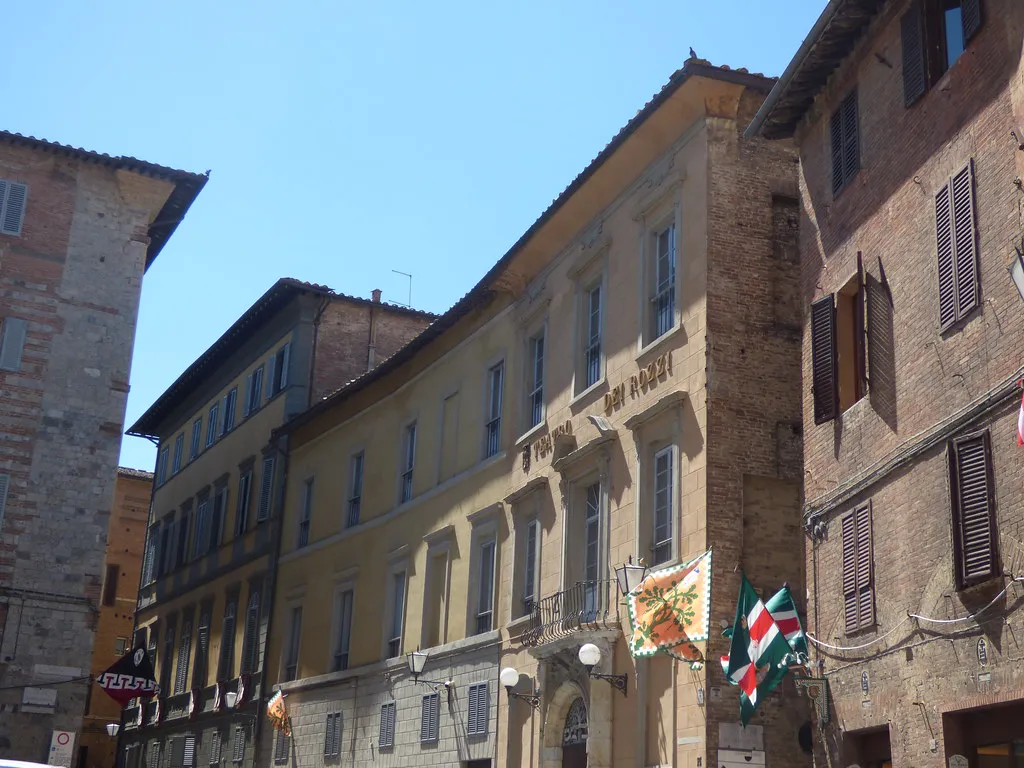
The fifth practice run, the "Prova Generale," is followed by the "cena propiziatoria" — a pre-victory feast held in the heart of each contrada. The sixth and final run on race day morning is called the "Provaccia," or bad trial, because jockeys deliberately hold back to save energy for the evening race. The Archbishop of Siena celebrates Mass for the jockeys at 08:00 that morning in the chapel near the Town Hall.
For visitors, practice runs offer a rare low-pressure window to see the race course. Crowds are a fraction of race-day size, entry to the center of the square is easy, and you can move freely. If you are traveling with children or want a calmer first view of the Piazza del Campo before the main event, arriving for an evening practice run is the smartest move.
The Historical Parade
On race day, the "Corteo Storico" — the historical parade — fills the streets of Siena with over 600 participants in 15th-century costumes. Representatives of the city and each contrada march through the old town, stopping in Piazza Salimbeni, in front of Palazzo Chigi Saracini, and at the Duomo for elaborate flag-waving displays. The parade reaches the Piazza del Campo around 17:00.
Drummers and flag-throwers called "alfieri" perform routines that take years to master. The pageantry is genuinely impressive even for visitors who know nothing about the race — but understanding that each costume corresponds to a real district with real stakes in the evening event adds another layer entirely. The parade is free to watch from the streets, though prime spots along the route fill up fast after 15:00.
When the horses finally enter the Campo, a cannon shot fires and the crowd noise shifts from festive to tense. Each jockey receives an ox-hide whip that can be used on their own horse or on rivals. The starting order is determined by a second draw using small colored wooden balls called "barberi." The Starter, the "Mossiere," drops a rope to begin the race once all ten horses are positioned.
Where does the horse race take place?
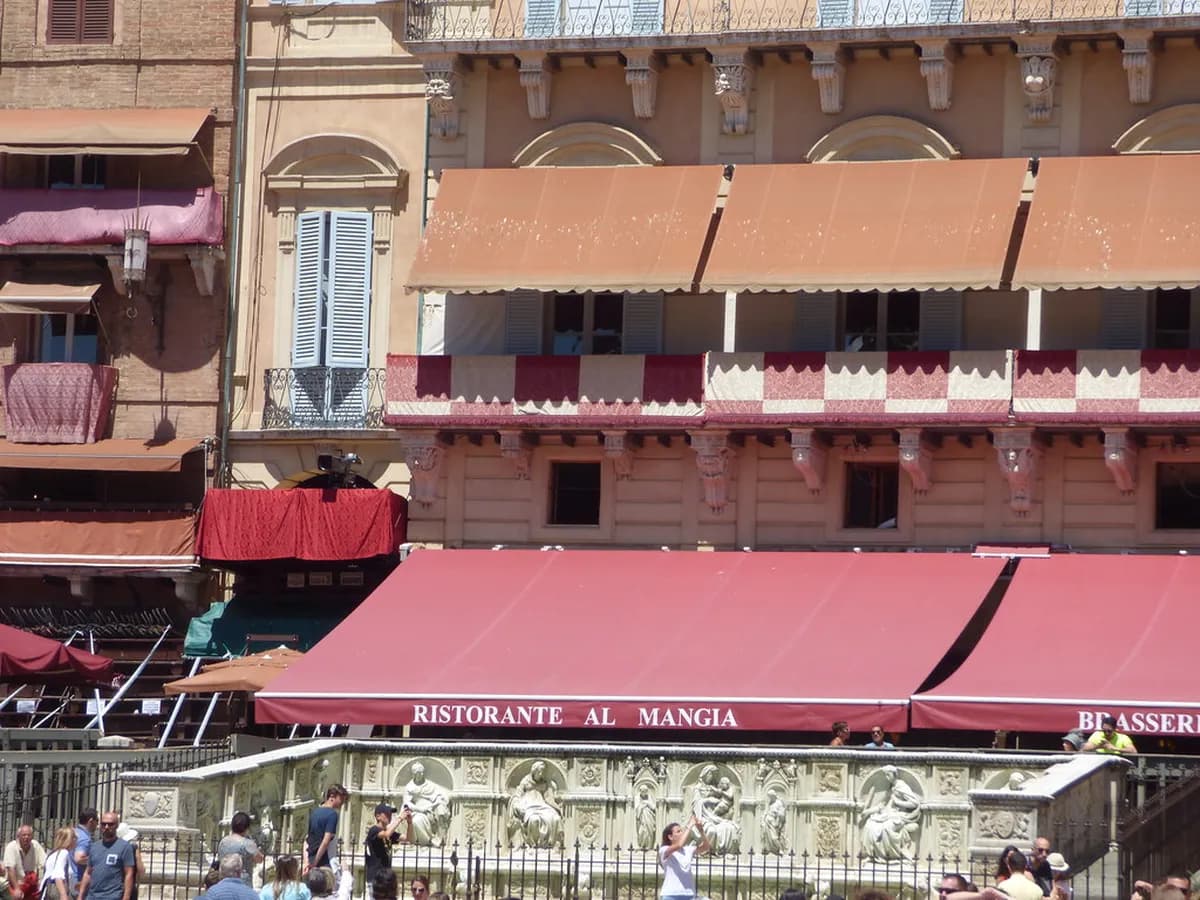
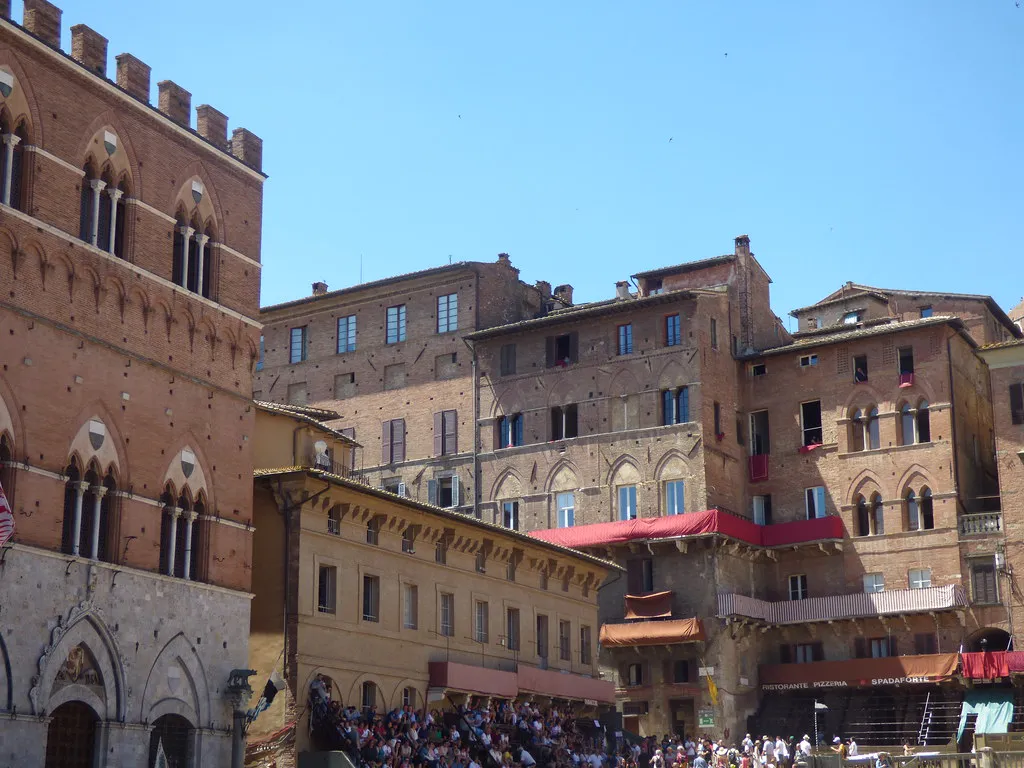
The race is run in the Piazza del Campo, Siena's shell-shaped central square and one of the best-preserved medieval public spaces in Europe. In the days before each Palio, workers lay a thick bed of tufa clay over the stone perimeter of the square to create a dirt track. The track curves sharply at three points — San Martino corner is the most dangerous — which is why horse falls occur in nearly every race.
Up to 60,000 spectators pack the square on race day. The center (the "mossa" area) is free and standing-only. Grandstand seats and window balconies around the perimeter are ticketed and must be booked well in advance — most are allocated through contrada contacts or specialist tour operators rather than open sale. The July race starts at around 19:30; the August race begins at around 19:00, slightly earlier due to sunset timing.
- Free standing area in the center of the square: arrive by 14:00 to secure a position. Once the gates close, no re-entry is allowed.
- Grandstand tickets: typically €250–€600 per seat, booked months ahead through tour operators or direct contrada contacts.
- Balcony windows on surrounding palaces: the most expensive option, often arranged through luxury villa or hotel concierges.
The Te Deum and the Never-Ending Festivities
The moment the winning horse crosses the finish line, the winning contrada's members rush to collect the palio banner — sometimes physically wrestling it from attendants in their excitement. The winning district then marches with the banner to the Provenzano Church in July or the Cathedral in August to sing the Te Deum, a traditional hymn of thanksgiving. This religious ceremony is as central to the victory as the race itself.
Celebrations continue in the winning district for months. In September or October, the Contrada holds its "Cena della Vittoria," a Victory Dinner attended by thousands — including the winning horse, who is given a ceremonial seat of honor at the table. The horse is treated as a member of the contrada, not a piece of equipment, and this feast can draw crowds larger than some of the city's festivals.
For visitors, the hours after the race are worth staying for. The losing districts process quietly back to their neighborhoods while the winning contrada turns its streets into an open-air party. Following the noise is the surest way to find it. If your accommodation is in the city center, expect celebrations to carry past midnight.
The Contrada Dinner: What Most Guides Don't Tell You
The evening before each race, every participating contrada holds an outdoor dinner — the "cena della vigilia" — in its own streets and piazzas. Long tables fill narrow alleys. Hundreds of residents eat together, sing, argue strategy, and build the collective intensity that makes the next day's race mean something beyond sport. This is the most authentic evening you can spend in Siena during Palio week, and almost no guidebook explains how to access it.
As an outsider, your best route in is through a local contact or a specialist tour operator who has an established relationship with a specific contrada. Some contrade occasionally accept paying guests for their dinner — typically through concierge networks at upscale agriturismi or tour companies focused on Siena. The cost varies but expect to contribute significantly (€80–€150 per person is not unusual) and to follow the dress code: wear that contrada's colors if you can, and never show up in a rival's colors.
The alternative is to walk through the old town on the evening before the race and watch the preparations from the street. Tables are set in public alleys, and the atmosphere spills outward. You won't be seated, but you will absorb more of the real Palio culture in one hour of walking than in an entire day of standard sightseeing.
Traveling from Florence to Siena
Florence is the most common gateway for visitors to the Palio, and the journey is straightforward under normal conditions. The fastest option is the Sena or Tiemme express bus from Florence's Autostazione (near Santa Maria Novella station), which takes about 75 minutes and costs €8–€12 each way. Buses run regularly and tickets can be bought online or at the station. On race day, additional services are added, but they fill quickly.
By train, the journey from Florence Santa Maria Novella to Siena takes about 90 minutes via Empoli, with a change required — there is no direct high-speed rail connection. Driving takes roughly one hour but parking near the historic center is extremely limited on Palio days. Several designated car parks operate on the city outskirts with shuttle buses into the center. Book your onward transport out of Siena for the evening of the race if you are not staying overnight — trains and buses sell out fast after the event ends.
Enjoying the Culture of Siena
The culture of Siena is defined by a fierce sense of belonging to a district. The race is the visible peak of a year-round cycle of district life: baptisms registered at the contrada fountain, marriages blessed in the contrada church, and funerals mourned collectively. Dining at a contrada open-air banquet is a once-in-a-lifetime culinary experience.
Beyond the Palio, Siena rewards slower exploration. The Piazza del Campo is one of the most carefully preserved medieval squares in existence. The Siena Cathedral holds works by Pisano, Michelangelo, and Donatello. Siena's own culinary traditions include pici pasta — a hand-rolled thick pasta with a rich meat ragu — and cantucci biscuits served with Vin Santo. The city sits inside Tuscany's finest wine country; a glass of Brunello di Montalcino or Chianti Classico is never far away.
The atmosphere is similar to the intensity found in a Calcio Storico guide for Florence — both events are neighborhood competitions with genuine stakes dressed in historical costume. Respect the local traditions and avoid wearing the colors of a rival district while inside the old town.
Exploring the Contrade of Siena
There are 17 contrade in total, but only 10 race in each Palio. Each district maintains its own private museum housing ancient banners, painted silk palii from past victories, costumes, and silver trophies. Access usually requires a local connection or a pre-booked guided tour — most are not open to casual drop-in visitors. The art within these walls reflects centuries of neighborhood pride.
You can trace district boundaries on foot by looking for ceramic plaques on street corners. Each contrada also has a distinctive fountain animal: the She-wolf, the Eagle, the Goose, the Porcupine, the Dragon. Spending a morning walking between neighborhoods before the race gives you a sense of how tightly woven the identity of each district is — and how different the atmosphere feels as you cross invisible lines that have separated families for generations.
You can find more on the race structure and contrada history in our how to experience Palio di Siena guide, which covers behind-the-scenes access options and contrada museum visits in detail.
Frequently Asked Questions
When is the Palio di Siena?
The race takes place twice every year on fixed dates. The first race is on July 2nd, and the second occurs on August 16th. These dates remain the same regardless of the day of the week. You can find more best cultural festivals in Europe for other summer dates.
Where does the horse race take place?
The race is held in the Piazza del Campo in the heart of Siena. This historic square is transformed into a dirt track for the event. Thousands of spectators fill the center of the square to watch for free.
When does the Palio start?
The actual race usually starts around 7:30pm in July and 7:00pm in August. However, the historical parade begins much earlier in the afternoon. You should be in your viewing position by 4:00pm to ensure entry into the square.
What are the Contrade?
The contrade are the 17 distinct neighborhoods or wards within the city walls of Siena. Each has its own flag, church, museum, and social club. The race is a competition between these districts for the painted silk banner prize.
Experiencing the Palio di Siena is a deep dive into the soul of Tuscany.
By following this Palio di Siena guide, you can navigate the crowds and respect the local customs.
Whether you stand in the square or watch from a balcony, the energy is unforgettable.
Start your planning early to witness one of the world's most authentic traditions.
Free guide: Europe's Festival Calendar
A month-by-month map of Europe's unmissable festivals — with the best dates to visit each and a local tip you won't find in the guidebooks.
You might also like


Continue reading
More guides you'll find useful