
Stuttgart Christmas Market: 9 Things to Know Before You Go
Plan your visit to the Stuttgart Christmas Market with our guide to 2026 dates, food prices, and the best nearby markets like Esslingen. Don't miss out!
On this page
Stuttgart Christmas Market: 9 Things to Know Before You Go
Last updated June 2026. The Stuttgart Christmas market is one of the oldest and largest holiday events in Europe, dating back to at least 1692. Late November to mid-December is the best window for most travelers, with the most vibrant atmosphere during the first two weeks of December.
Stretching across the city center, this event features nearly 300 uniquely decorated wooden stalls. The market transforms the area between Schlossplatz and Marktplatz into a winter wonderland. Planning a visit requires understanding the local weather and the specific Swabian traditions. This guide covers everything from 2026 dates to the best local snacks to try.
Many travelers combine this trip with other best Christmas markets in Germany for a full experience. Stuttgart serves as an ideal base for exploring the surrounding region of Baden-Württemberg. You can easily reach neighboring towns that host their own specialized holiday markets. Prepare for a mix of historical charm and modern holiday efficiency during your stay.
Free guide: Europe's Festival Calendar
A month-by-month map of Europe's unmissable festivals — with the best dates to visit each and a local tip you won't find in the guidebooks.
Why Visit the Stuttgart Christmas Market?
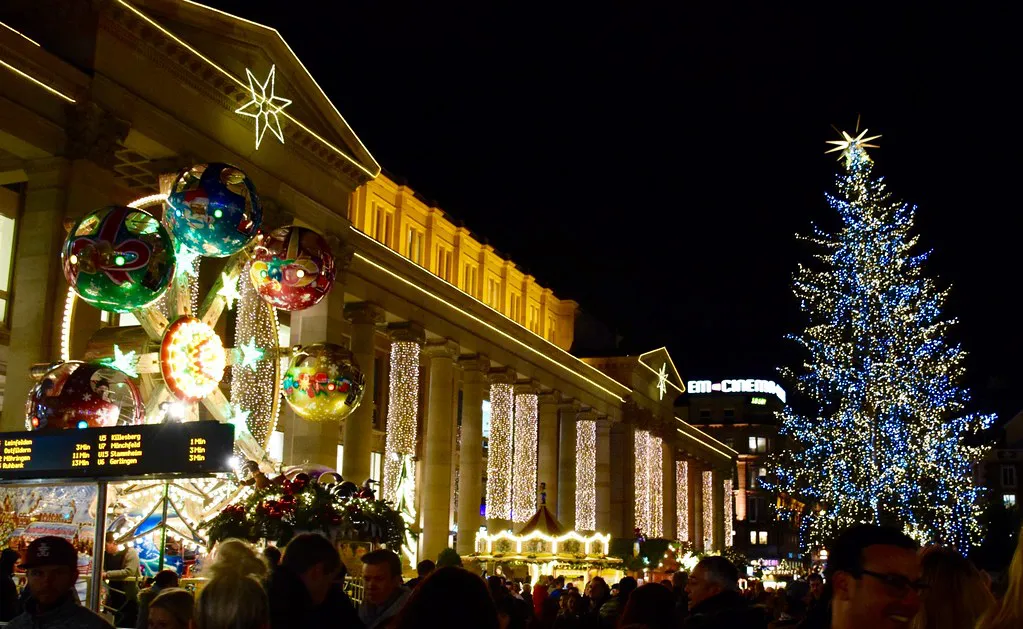
The Stuttgart Christmas market stands out because of its incredible rooftop decorations. Stallholders compete annually for the title of the most beautiful stand in the city, producing elaborate displays of reindeer, baubles, Santas, and mechanical figures atop every booth. These decorations make Stuttgart visually distinct from the Nuremberg Christmas market and most other major German markets where rooftops are far more modest.
The central location allows you to walk between several major squares in minutes. At Schillerplatz, the Old Castle provides a stunning backdrop for traditional craft stalls. Daily concerts at the Rathaus steps at 18:00 add a musical layer to the festive shopping. Over 60 choir and music groups from the metro area perform during the 26 days the market runs.
Typical temperatures in December range from 0–6°C during the day. The regional weather often includes a light drizzle or occasional morning frost, which makes a hot mug of Glühwein feel especially necessary. This combination of spectacle, Swabian food culture, and proximity to two other world-class markets — Esslingen and Ludwigsburg — makes Stuttgart the strongest base for a multi-market trip in all of Germany.
2026 Dates and Opening Hours
The Stuttgart Christmas market is provisionally scheduled to run from late November to 23 December 2026 — confirm exact opening and closing dates on the Official Stuttgart Christmas Market Site before booking travel. The 2025 edition ran 26 November to 23 December, and the 2026 window is expected to be similar.
Standard opening hours are Monday to Thursday 10:00–21:00, Friday and Saturday 10:00–22:00, and Sunday 11:00–21:00. Upwards of 4 million visitors pass through across the season, so timing your visit wisely is essential. The market is least crowded on weekday mornings; evenings and weekends attract the thickest crowds.
The opening ceremony on the first evening is worth catching if your schedule allows. The Stuttgart mayor officially opens the market at 18:00, after which the 25-meter-high Christmas tree is illuminated and special choir concerts begin on the Rathaus steps. If you miss opening night, evening concerts at 18:00 repeat daily throughout the season.
The Best Market Locations in the City
Stuttgart's Christmas market is not a single venue — it spreads across four distinct squares, each with its own character. Arriving without a mental map means you can easily miss the most rewarding parts of the experience.
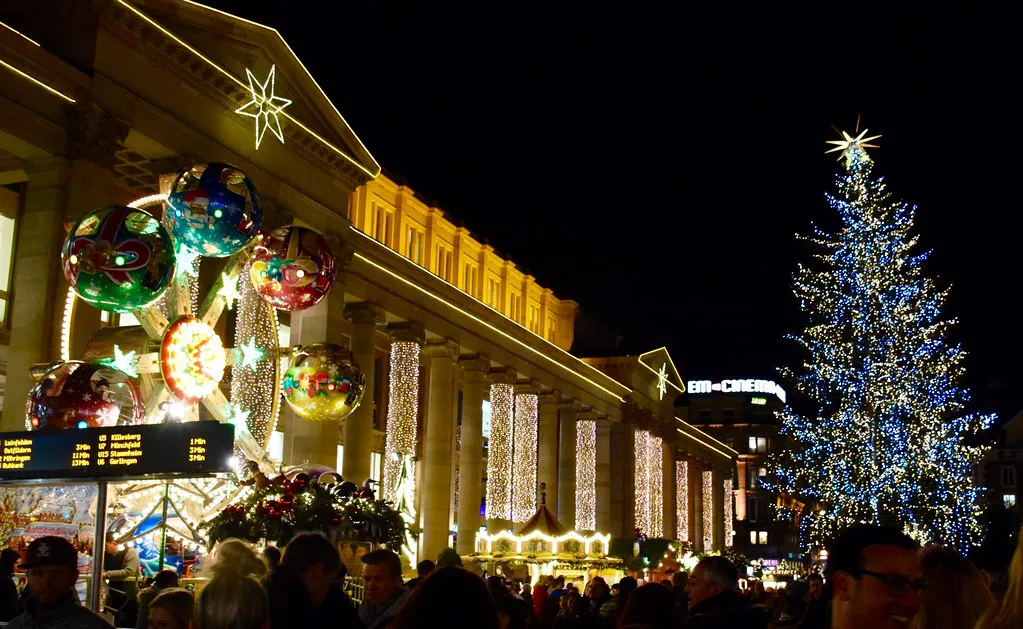
Marktplatz is the heart of the market and the place most visitors photograph. The Rathaus here transforms into a giant Advent Calendar from 1 December, with one window opened each day to reveal the coat of arms of a different Stuttgart district. The Rathaus steps host the 18:00 concerts, and the rooftop competition among stallholders reaches its peak intensity here. The Stuttgarter Staffele stall in Marktplatz is the go-to spot for traditional Swabian dishes.
Schillerplatz sits a short walk away, framed by the Old Castle and the Collegiate Church. It has a slightly quieter feel than Marktplatz and is where to find fresh Flammkuchen served on wooden boards. Karlsplatz hosts the Finnish Christmas Village — a cozy cluster of Nordic stalls with a heated Lavvu tent, Glögi, and flame-grilled salmon. Right next door is the antiques market inside a long white tent, worth browsing for unusual souvenirs. Schlossplatz adds the outdoor ice rink, a children's mini-train, and light sculptures in front of the Neues Schloss.
All four locations are within easy walking distance of each other. From Stuttgart Hauptbahnhof, walk down Königstrasse and you will reach Schlossplatz within five minutes. U-Bahn lines U5, U6, U7, U12, and U15 all stop at Schlossplatz; the S-Bahn stops at nearby Charlottenplatz.
What to Eat and Drink (Swabian Specialties)
Food is a central part of the Stuttgart Christmas market experience. You must try Maultaschen, traditional Swabian meat-filled pasta pockets — the market in Marktplatz sells a handheld version you eat like a savoury pastry, and it works better than it sounds. Kässpätzle, a local version of egg noodles with melted cheese, is another warm favorite. Prices for hearty snacks typically range between 5 and 8 Euros.
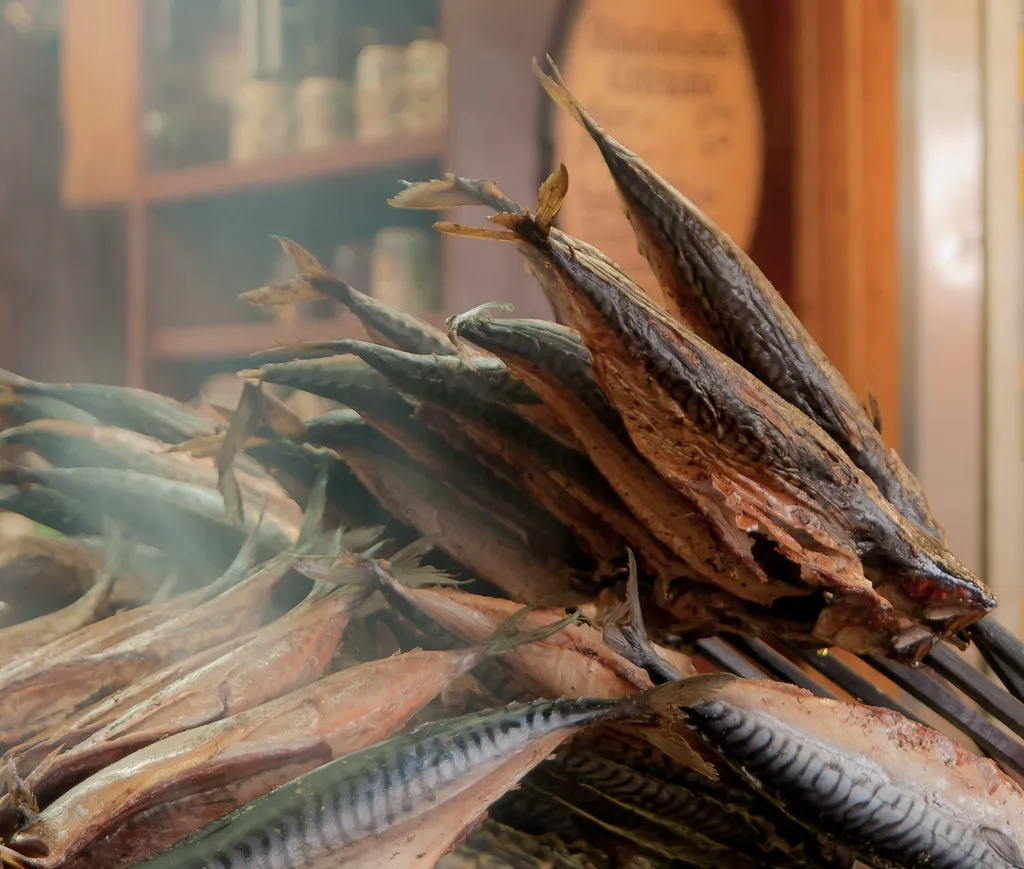
For sweet treats: Gebrannte Mandeln (hot cinnamon almonds) cost around 4 €, a Nutella crepe around 4.50 €, and a slice of Stollen around 4 €. Roasted chestnuts, Lebkuchen (gingerbread), and Feuerzangenbowle (a rum-flaming punch) are all available across the various squares.
The Glühwein follows a strict Pfand (deposit) system. You pay an extra 2.50 € when you first buy a drink — this is the mug deposit. Return the mug to any stall displaying the same logo (look for the word "Pfandrückgabe" or "Rückgabe") to get your money back. Many visitors keep the mug as a souvenir instead, which is fine — it is effectively a cheap keepsake at that price.
The Finnish Christmas Village at Karlsplatz offers a different culinary angle. You can find flame-grilled salmon (Flammlachs) and reindeer sausages here, plus Glögi, the Finnish mulled wine, served inside a genuine Lavvu tent. This section provides a warm escape from the more exposed main aisles.
Unique Highlights and Rooftop Decorations
The rooftop competition is the feature that most surprises first-time visitors. Unlike Munich or Cologne, where stall rooftops are simple wooden gables, Stuttgart stallholders invest heavily in their displays because there is a formal annual competition for the most beautiful roof. Expect mechanical reindeer, cascades of baubles, stuffed bears, glittering fruit, and full light rigs on individual stalls. Looking up while walking through Marktplatz is as rewarding as looking at what is for sale inside.
The Rathaus Advent Calendar is another stop that rarely features in basic guides. From 1 December, one numbered window opens each day after dark to reveal a new image. The whole facade is framed by lights and sits directly above the evening concert stage, so arriving at Marktplatz around 17:30 on any December weekday lets you watch the window reveal and catch the 18:00 concert without planning around a separate trip.
Schlossplatz adds a different type of spectacle: eight large light sculptures shaped after Stuttgart landmarks and symbols, which change from year to year, illuminate the grass in front of the Neues Schloss. The outdoor ice rink adjacent to these sculptures is open throughout the market season and offers skate rental for visitors. Children's rides including a mini-train and a Ferris wheel round out the entertainment at this end of the market.
Essential Practical Tips for Visitors
Bring cash. Many traditional stalls do not accept international credit cards, and while there are ATMs within the market footprint (one is near the Schlossplatz U-Bahn stop), queues build up on busy evenings. Budgeting around 12–15 € for a Glühwein and a Bratwurst is a reasonable baseline; double that for two people and add extra for the mug deposit. Larger or more upscale gift stalls may accept card payments — ask before buying.
Public restrooms around the market charge 0.50 €, so carry small coins. The restrooms are marked with a WC sign; there are facilities near the Schillerplatz and Karlsplatz sections. Information booths staffed in English are located near the entrance between the ice rink and the children's train at Schlossplatz — pick up a free paper map of the entire market layout here.
For timing your visit: arrive between 15:00 and 16:00 to walk the stalls in daylight first, see the rooftop details clearly, and then stay for the evening lights and the 18:00 concert. The blue-hour window between 15:30 and 16:30 is the best moment for photos — the decorative rooftops catch the low winter light before the sky goes fully dark. By 17:00 the lights are on and the atmosphere intensifies, but photography becomes harder in the full dark. Weekday afternoons offer this window with far smaller crowds than weekend evenings.
Cold cobblestones draw heat away from your feet faster than most visitors expect. Thick-soled waterproof boots are the single most important packing choice. Layer thermal base layers underneath your regular coat rather than relying on one heavy jacket — you will move in and out of warm tents and cold open squares repeatedly. A portable power bank is worth packing because cold temperatures drain phone batteries faster than usual.
Where to Stay Near the Market
The best strategy is to stay somewhere within the city center so that you can walk to the market in 5–15 minutes. This also lets you return to your hotel to drop off purchases or warm up without relying on public transport.
Hotel Unger sits within a short walk of the Hauptbahnhof and the Königstrasse pedestrian zone, putting Schlossplatz roughly five minutes on foot from the front door. It offers a large breakfast buffet and quiet rooms despite the central location. Motel One Stuttgart Hauptbahnhof is another well-located option close to the train station and the market, with comfortable rooms at a lower price point. For more space or a kitchen, an apartment in the city center puts you within walking distance of Marktplatz and gives you a base to store mulled wine mugs and gifts.
Hotels in the immediate center command a premium during December, particularly in the second and third weeks of the month. Staying in an inner suburb and using the S-Bahn or U-Bahn to reach the market is a legitimate budget option — the network runs frequently until late evening and the Schlossplatz stop is well served.
Nearby Markets: Esslingen and Ludwigsburg
Stuttgart's strongest advantage over almost any other German market city is its position as a 15-minute hub. Two completely different world-class markets — one medieval, one Baroque — are both reachable by local train in the same time it takes to walk across Stuttgart's city center.
The Esslingen Medieval Market is one of the most visually striking in Europe. The town's half-timbered buildings and riverside setting provide the backdrop; the market fills the spaces between them with fire-breathers, jugglers, artisans in period-accurate costumes, and stalls selling liquors bottled like alchemist potions. The vibe is entirely distinct from Stuttgart's urban market — it is immersive and theatrical in a way no city-center market can replicate. Take the S1 line from Stuttgart Hauptbahnhof to Esslingen (Neckar) — the journey takes around 15 minutes and trains run every few minutes.
The Ludwigsburg Baroque Market is a short ride north on the S4 or S5 line. It is calmer and more local in character than either Stuttgart or Esslingen, with stalls selling cured meats, cheese wheels, Stockbrot (bread grilled on a stick), and Knoedel dumplings. The symmetrical Baroque town layout makes the market feel spacious and unhurried. Come here hungry and buy a day ticket covering the entire VVS regional transport network — a single ticket covers Stuttgart, Esslingen, and Ludwigsburg without needing separate fares.
| Market | Vibe | Distance from Stuttgart | Highlight | Train Line |
|---|---|---|---|---|
| Stuttgart | Urban, competitive rooftop displays | — | Rathaus Advent Calendar + Finnish Village | In-city |
| Esslingen | Medieval, theatrical, costumed | ~15 min | Fire-breathers, half-timbered backdrop | S1 |
| Ludwigsburg | Baroque, spacious, local | ~20 min | Stockbrot, symmetric palace grounds | S4 / S5 |
Frequently Asked Questions
Is Stuttgart Christmas Market worth visiting?
Yes, it is absolutely worth visiting for its unique rooftop decorations and central location. The market offers a massive variety of stalls and easy access to nearby medieval markets. You will find a highly authentic German holiday atmosphere here.
Where is the main Stuttgart Christmas market?
The main market is located in the heart of the city center. It spans from the Schlossplatz to the Marktplatz and Schillerplatz. All these areas are within easy walking distance of the main train station.
What city has the best Christmas markets in Germany?
Stuttgart is often cited as a top contender alongside the Dresden Christmas market. While 'best' is subjective, Stuttgart's proximity to Esslingen and Ludwigsburg makes it a superior logistical hub. It offers three distinct styles of markets within minutes.
Related in Stuttgart: Essential Tips.
The Stuttgart Christmas market offers a perfect blend of tradition and visual spectacle. By planning your visit for early December and arriving around 15:00 on a weekday, you can enjoy the rooftop details in daylight, catch the blue-hour photography window, and stay for the 18:00 Rathaus concert. Remember to bring cash, carry 50-cent coins for restrooms, and budget 2.50 € for the Glühwein mug deposit.
Whether you are there for the crafts, the Swabian food, or the Finnish Village at Karlsplatz, the four-square layout rewards a full day. Add Esslingen or Ludwigsburg on a second day using a VVS regional day ticket and you have one of the best multi-market itineraries in Germany. Safe travels and enjoy the holiday spirit in Stuttgart this season.
Free guide: Europe's Festival Calendar
A month-by-month map of Europe's unmissable festivals — with the best dates to visit each and a local tip you won't find in the guidebooks.
You might also like


Continue reading
More guides you'll find useful


