
Wiesbaden Christmas Market Guide: 8 Essential Tips
Plan your visit to the Wiesbaden Sternschnuppenmarkt with 2026 dates, must-try wild boar sausages, and tips for the best light displays and local gifts.
On this page
Wiesbaden Christmas Market Guide: 8 Essential Tips & Highlights
The Wiesbaden Christmas market — known as the Sternschnuppenmarkt, or Shooting Star Market — is one of the most visually distinctive festive events in Germany. It runs each year on the Schlossplatz in the heart of Hesse's spa capital, nestled between the historic City Hall, the Hesse State Parliament, and the red-brick Marktkirche. Last updated June 2026.
What sets it apart from dozens of larger German markets is the emphasis on quality over scale. Local craftspeople, Rheingau vintners, and regional food producers dominate the stalls. Wiesbaden is consistently cited among the best small and secondary christmas markets in Europe for exactly that reason. This guide covers the 2026 dates, the food you should not skip, the family entertainment on offer, and practical tips to make the most of your visit.
Free guide: Europe's Festival Calendar
A month-by-month map of Europe's unmissable festivals — with the best dates to visit each and a local tip you won't find in the guidebooks.
2026 Dates, Locations, and Opening Hours
The Wiesbaden Christmas market is expected to run from late November through late December 2026 (the 2025 edition ran November 25 through December 23, 2025); confirm the exact 2026 dates on the official Sternschnuppenmarkt site before you travel. The central location is the Schlossplatz, which spreads around the front of the City Hall and extends toward the Marktkirche. A second cluster of stalls lines the space in front of the Hesse State Parliament building.
Opening hours vary slightly by day. Monday through Thursday the market opens at 10:30 and closes at 21:00. Friday and Saturday the closing time extends to 21:30. On Sundays the market opens at noon and closes at 21:00. Arriving in the late afternoon on a weekday gives you the best of both worlds — smaller crowds and the full spectacle of the lights switching on around dusk.
The "Shooting Star" Experience: What to Expect
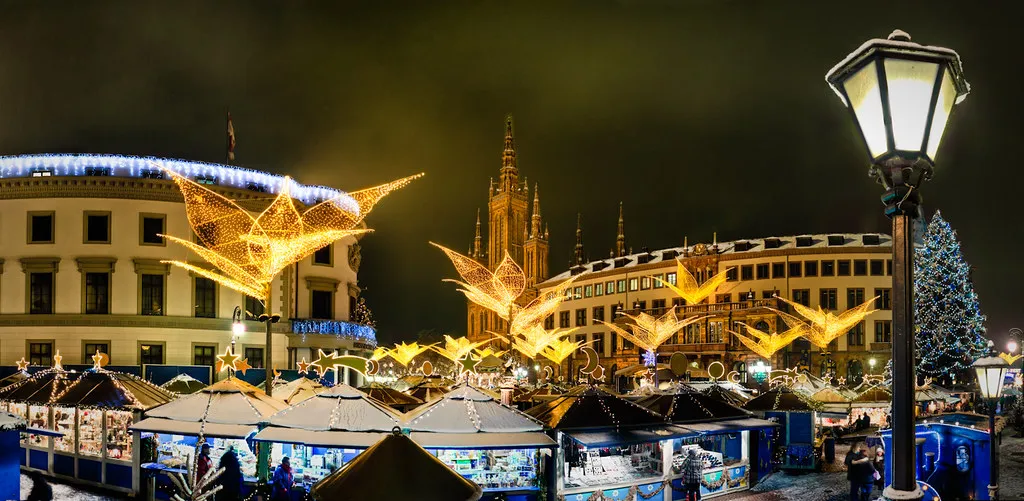
The Sternschnuppenmarkt takes its name from the shooting star, but the signature visual is the lily — the motif on Wiesbaden's official coat of arms. Ten-meter-high lily-shaped light sculptures glow across the square throughout the evening. The effect is subtler and more elegant than the standard red-and-green German market aesthetic: the whole color scheme leans on blue and gold.
The centrepiece is a nearly 30-metre Christmas tree decorated with 3,000 pears and 1,000 blue-gold ribbons, with a life-size carved wooden nativity scene at its base. Four large illuminated gates mark the entrances to the market. The gate closest to the City Hall — entered from Marktstraße — offers the best first view of the lily sculptures and the church facade behind them. It is the most photographed angle at night.
A mainstage in front of City Hall hosts evening performances on Fridays through Sundays. Inside the Protestant Marktkirche itself, a daily organ music ritual takes place at 17:45 on weekdays. This 15-minute performance offers a quiet break from the cold and the crowd — and it is free to attend.
Must-Try Local Foods and Festive Drinks
The food at this market is unusually good by German Christmas market standards. The standout dish is the wild boar sausage — sourced directly from local hunters who manage the forests around the Rheingau. The seller at the stall is often the hunter himself, which is rare and worth seeking out. Pair it with kartoffelpuffer, the crispy potato pancakes served with applesauce that appear at almost every German market but taste particularly good here alongside the game sausage.
For drinks, look specifically for stalls marked "Rheingauer Glühwein" rather than generic mulled wine. The local Rheingau region produces some of Germany's finest Riesling, and the spiced wine versions sold by the region's own vintners are noticeably better than mass-produced alternatives. Their stalls tend to be simpler and less elaborately decorated — that is how you spot them. Glühwein is served in a specially designed collectible mug each year using the "Pfand" deposit system: you pay a deposit of 3 to 5 EUR on top of the drink price and get it back when you return the mug, or keep it as a souvenir.
Beyond sausage and wine, keep an eye out for Plätzchen (handmade German Christmas cookies) sold near the western entrance on Marktstraße, and Odenwald-style Lebkuchen gingerbread — a softer, honey-forward version that is distinct from the Nuremberg Elisenlebkuchen sold at most other markets.
Handcrafted Gifts and Unique Shopping Finds
The stalls here skew heavily toward local and handmade goods — roughly 70 percent of what is on sale comes from the region. Sizable beeswax candles are priced at around 5 EUR and represent genuine value; the same candles sell for double that in Frankfurt or Berlin. Traditional wooden ornaments, locally made marmalades, spice mixes, and Rheingau wines in decorative bottles all make excellent gifts.
One stall that stands out is the Krumpholz goldsmith, who works on delicate handmade jewelry right at his stall. Prices are high, but the craftsmanship is exceptional. In the line of stalls in front of the Parliament building, you will also find more practical items: spices, kitchenware, specialty meats and cheeses from the Black Forest, and olive wood pieces. Carry cash — many of the smaller craft vendors do not accept cards — and budget some time to look beyond the first row of stalls, where the more interesting artisans tend to be.
Family-Friendly Highlights and Entertainment
The market is well set up for families with children. A historic carousel runs throughout the evening on the main Schlossplatz; for younger children, a separate smaller carousel is positioned in front of the Marktkirche. A children's railway loops around part of the square and is consistently the most popular ride for small visitors. There is also a children's bakery where kids can decorate and bake their own Christmas cookies — it tends to book up quickly on weekends, so arrive early if this is a priority.
The evening mainstage performances on Friday, Saturday, and Sunday draw families as well as solo visitors. The 17:45 weekday organ concert inside the Marktkirche is calm enough that even young children can sit through it comfortably. The market's compact footprint means it is easy to navigate with a pushchair — the Schlossplatz is largely flat cobblestone with no significant steps between the main sections.
Wiesbaden vs. Mainz: Which Market to Visit
Mainz is 15 minutes from Wiesbaden by train, and the two markets are frequently compared. They run on the same dates, so a dual-visit day trip is very practical. The question is which deserves your primary attention — or whether to split an afternoon between them.
| Factor | Wiesbaden Sternschnuppenmarkt | Mainz Christmas Market |
|---|---|---|
| Vibe | Elegant, local, spa-city feel | Traditional, historic, larger |
| Setting | Schlossplatz between parliament and church | Domplatz and surrounding lanes |
| Stall count | 100+ stalls | 120+ stalls across multiple squares |
| Food highlight | Wild boar sausage, Rheingauer Glühwein | Mainzer Spundekäs, Bembel cider |
| Craft quality | Strongly local and handmade | Mixed — traditional and commercial |
| Crowds | Manageable on weekdays | Heavier, especially weekends |
Both markets have their advocates, and the honest answer is that regular visitors to both often call it a tie. If you can only do one, Wiesbaden wins on food quality and artisan craft. If you have a full day, take the train to Mainz in the morning, browse the cathedral quarter, then return to Wiesbaden for the evening lights at the Sternschnuppenmarkt.
Essential Tips for a Smooth Visit
Arrive before sunset. The market is pleasant during the day, but watching the lily sculptures and illuminated gates switch on as darkness falls is genuinely worth timing your arrival around. This typically happens around 16:30 to 17:00 in late November and early December.
- Weekdays are significantly quieter than Fridays and weekends. Visitors pour in from Mainz, Frankfurt, and the wider Rheingau on Saturdays — expect compressed stall areas and longer queues for food.
- Bring coins for the Pfand deposit (3 to 5 EUR) so the mug transaction is smooth. Larger notes cause delays at busy stalls.
- Waterproof boots are worthwhile. Rhine valley fog settles over Wiesbaden in December and makes the cobblestones slippery when wet or icy.
- The mainstage performances on Friday through Sunday evenings draw additional crowds — if you want the calmer atmosphere, go Thursday evening or a weekday afternoon.
- The organ concert at 17:45 inside the Marktkirche is free and lasts 15 minutes. It requires no ticket — just walk in and find a pew.
Wiesbaden's main train station (Wiesbaden Hauptbahnhof) is a 15-minute walk from the Schlossplatz, or a short bus ride. From Frankfurt Hauptbahnhof, S-Bahn line S1 reaches Wiesbaden in around 45 minutes. The Wurzburg Christmas market is another worthwhile day trip from the region for a Franconian contrast.
Top Christmas Markets to Visit Near Wiesbaden
Wiesbaden sits at a natural crossroads for German Christmas market travel. Mainz is the obvious first stop — 15 minutes by train and easily combined on the same day. Frankfurt's markets are around 45 minutes east on the S1 and offer a much larger, more commercial experience across multiple city squares.
Further afield, the Munster Christmas market has a medieval cathedral backdrop worth the extra travel time. The Dortmund Christmas market is one of the largest in Germany and a strong choice for families who want a full day of entertainment. The Bremen Christmas market adds a maritime flavour that stands apart from the Rhine valley markets. All are reachable by regional rail without a car.
Frequently Asked Questions
Is there a Christmas market in Wiesbaden?
Yes, Wiesbaden hosts the famous Sternschnuppenmarkt annually at the Schlossplatz. It is known for its lily-shaped lights and elegant atmosphere. The market is a major highlight of the winter season in Germany.
What are the dates for the Wiesbaden Christmas market 2026?
The 2026 market is expected to run from late November to late December 2026 (the 2025 edition ran November 25 to December 23, 2025); check the official site for confirmed dates. It opens daily at 10:30 AM on weekdays and Saturdays. Sunday hours begin at 12:00 PM.
Is the Wiesbaden Christmas market worth visiting?
The market is definitely worth visiting for its unique blue and gold lighting theme. It offers high-quality crafts and a refined food selection. Many travelers prefer its sophisticated vibe over larger, more commercial markets.
The Wiesbaden Sternschnuppenmarkt is one of the most satisfying Christmas market visits in Germany precisely because it has resisted the shift toward mass-produced goods. The combination of lily-lit squares, local vintner Glühwein, hunter-sourced wild boar sausage, and on-site artisans creates an atmosphere that larger markets struggle to match. Add in the children's railway, the free organ concerts inside the Marktkirche, and the easy train link to Mainz, and you have a well-rounded half-day or full-day winter excursion.
Plan your visit for a weekday evening in early December, arrive before dusk to catch the lights switching on, and bring enough cash for a mug deposit and a candle or two. The market runs until December 23 but the first two weeks are noticeably less crowded than the final stretch.
Free guide: Europe's Festival Calendar
A month-by-month map of Europe's unmissable festivals — with the best dates to visit each and a local tip you won't find in the guidebooks.
You might also like


Continue reading
More guides you'll find useful


