10 Essential Guides to the Erfurt Christmas Market and Thuringia
Plan your visit to the Erfurt Christmas Market with 2026 dates, travel times from Berlin, must-eat Thuringian specialties, and regional day trip tips.
On this page
10 Essential Guides to the Erfurt Christmas Market and Thuringia
Last updated June 2026. The Erfurt Christmas Market is one of the most beautiful holiday events in central Germany. It runs from late November to late December, drawing visitors from across Europe to a medieval square flanked by twin Gothic spires. This guide covers everything you need to plan a practical, enjoyable trip — from 2026 dates and tram numbers to the best food to order and the quietest time to visit.
Part of our Best Tips and Markets for Christmas in Germany series.
Erfurt is the capital of Thuringia and has a population of just over 200,000 people. The city sees far fewer international visitors than Dresden or Munich, which means the Christmas market here still feels local. More than 200 wooden stalls fill the Domplatz, and the surrounding old town rewards anyone who wanders beyond the main square. Visitors who come for the market often extend their stay to see Weimar, the Thuringian Forest, or Friedenstein Palace in Gotha. Visitors often prefer this medieval setting over the crowded Berlin Christmas market venues.
Free guide: Europe's Festival Calendar
A month-by-month map of Europe's unmissable festivals — with the best dates to visit each and a local tip you won't find in the guidebooks.
The Erfurt Christmas Market Experience
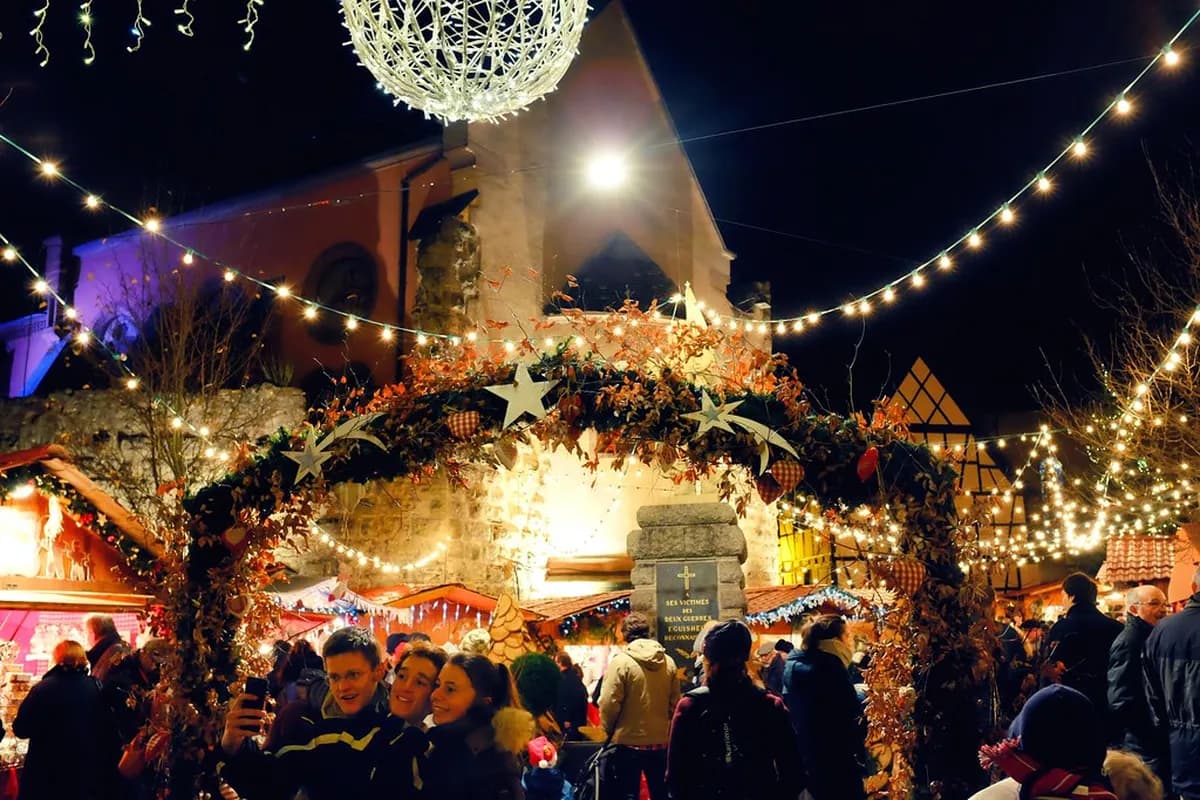
The heart of the market sits on the massive Domplatz square. St. Mary's Cathedral and St. Severus Church provide a stunning backdrop — their Gothic spires rise above the stalls and glow in the evening light in a way that few market settings can match. A 25-meter Christmas tree stands near the cathedral steps, while a 12-meter-high Christmas pyramid serves as the central landmark for visitors entering the square. The nativity scene features 14 life-sized wooden figures carved by local artists.
Artisans from across the region display traditional Ore Mountain woodcarvings. You will find hand-painted ornaments and intricate lace from nearby Plauen. The stalls lean heavily toward handmade regional goods rather than mass-produced items, so shopping here feels like discovering something you cannot find online. Children can enjoy the enchanted forest section and a historic carousel near the edge of the square.
A detail many visitors miss: Erfurt has over 15 Christmas markets scattered across the city, not just the main Domplatz event. Smaller clusters appear at the Anger, at Fischmarkt square, and at Wenigemarkt on the far side of the Krämerbrücke bridge. Each has its own distinct mood. The Wenigemarkt market in particular is a good spot for lunch, with bratwurst stalls and a noticeably more local crowd than the main square attracts.
The atmosphere remains cozy despite the large scale of the event. Locals gather here after work to share a glass of hot Glühwein. This social spirit makes the Erfurt event feel more authentic than many larger city fairs.
Is the Erfurt Christmas Market Worth It?
Erfurt offers a more intimate feel than the famous Nuremberg Christmas market. The medieval architecture creates a sense of stepping back in time. Climbing the stairs between the two main churches provides a perfect panoramic photo — this vantage point is free and offers the best view of the glowing stalls below. For an even wider perspective, the viewpoint next to the Citadel and Peterskirche sits a five-minute walk from Domplatz; a short elevator ride from the staircase takes you up to a full panoramic platform.

Food lovers will find unique regional items that differ from other German states. The Thuringian bratwurst is a pork sausage seasoned with marjoram, caraway, and garlic — expect to pay around €3 to €4 for one from a stall. Glühwein runs roughly €3 to €5, depending on the stall and whether a mug deposit is included. The Erfurter Puffbohne mugs are a genuine Erfurt collectible: the Puffbohne is the city's mascot, a broad bean figure that comes in a whole family of designs — papa, mama, baby, and a gingerbread version.
Food lovers must also try the Thuringian Schittchen. This local Christmas stollen dates back to 1329 and has a protected regional status, which means it follows a centuries-old recipe and cannot be produced under that name outside the region. This distinguishes it clearly from the more famous Dresden Stollen: the Schittchen is denser and less sweet, with a higher proportion of dried fruit to butter. Pair it with a Thuringian bratwurst for a thoroughly local meal.
The market is highly accessible for those on a German Christmas markets road trip. It sits as a natural mid-point between Dresden and Frankfurt. Crowds are manageable on weekdays — Tuesday mornings in particular are noticeably calm — allowing for a relaxed shopping experience. Most visitors find the festive spirit here well worth the travel time.
2026 Dates, Hours, and Location
The 2026 Erfurt Christmas Market is expected to run for roughly four weeks from late November to late December 2026 (the 2025 edition ran 25 November to 22 December 2025); check the official market website for confirmed 2026 dates before you book. Standard hours are Sunday through Wednesday from 10:00 to 20:00. On Thursday, the stalls remain open until 21:00. Friday and Saturday evenings offer extended hours until 22:00 — these are the best times for seeing the lights at full brightness, though crowds peak on Friday and Saturday nights. The market is free to enter.
Most of the action takes place at Domplatz in the city center. Smaller market clusters appear at the Anger and near the Krämerbrücke bridge. You should check the Official Market Website for specific daily events. The opening ceremony usually features the arrival of Father Christmas by tram, and special concerts are held inside the cathedral throughout the season — these events may require a separate ticket.
Plan to spend at least four hours exploring the various sections. If you want to cover Domplatz, Fischmarkt, Wenigemarkt, and the Krämerbrücke shops in one visit, budget the full afternoon into early evening. Evening visits from around 17:00 onward offer the market at its most photogenic.
The Katerexpress and Erfurt's Collector Mugs
One detail most travel guides skip entirely is the Katerexpress, a restored 1967 heritage tram that runs three distinct holiday tours during the Advent season. The Classic tour covers the main Advent highlights of the inner city. The Fairy Tale tour is designed for families with young children and narrates Thuringian folk stories along the route. The Anecdotes tour is aimed at adults and recounts unusual chapters from Erfurt's local history. All three depart from near the Hauptbahnhof. Check the city tourism site for current pricing and booking, as seats fill up on weekends.

The Puffbohne mugs deserve a paragraph of their own. The Erfurter Glühweinstübchen stall on Domplatz, located near the bumper cars, is the best-known spot to find the full family set. Collecting the Puffbohne series — papa, mama, baby, and the gingerbread variant — has become a tradition for repeat visitors. If you buy Glühwein in a Puffbohne mug, a deposit is included in the price; you can keep the mug by forfeiting the deposit, which most visitors choose to do.
Must-See Erfurt Attractions Beyond the Stalls
The Krämerbrücke is the single most distinctive sight in Erfurt. This medieval bridge has been continuously inhabited for over 500 years, longer than any other inhabited bridge in Europe. Half-timbered houses line both sides, and the lower levels house boutique shops selling crafts, chocolates, and local foods. Walking its full length takes about five minutes, but the side streets branching off each end reward slower exploration.
From the Krämerbrücke, the church of Ägidienkirche is a short walk away. Climbing over 100 steps to the top gives a full panoramic view of the bridge below, the orange rooftops of the old town, and the distant profile of Erfurt Cathedral. It is one of the most rewarding short climbs in the city and takes less than 20 minutes round trip. The Old Synagogue is also worth noting — it is one of the best-preserved medieval synagogues in Europe and houses a permanent exhibition on the history of Erfurt's Jewish community.
For chocolate and sweets, Goldhelm Schokolade on the Krämerbrücke is well-regarded by locals and visitors alike. Their ice cream shop on the bridge and the nearby dedicated chocolate shop both serve cake and hand-made truffles. It is a practical stop between the market and the Wenigemarkt cluster.
How to Get to Erfurt (Transport Guide)
Erfurt is a major railway junction in the center of Germany. High-speed ICE trains connect the city to Berlin in about 1.5 to 2 hours. Travel from Frankfurt takes roughly 2 hours, from Leipzig around 45 minutes, from Dresden 2 to 3 hours, and from Munich approximately 3 to 3.5 hours. You can use Deutsche Bahn (for train times) to book tickets in advance; prices are significantly lower when booked two or more weeks ahead.
You will arrive at Erfurt Hauptbahnhof. It is a 20-minute walk to the Domplatz market, or a 10-minute tram ride. Trams 1, 3, 4, and 6 all run frequently between the station and the market area. Tickets can be purchased at machines at most major stops. The tram is the practical choice in cold or wet weather and takes pressure off the cobblestone walk.
Drivers from Dresden face a 215 km route that takes about 2.5 hours. The drive from Erfurt to Cologne is 370 km and takes around 4 hours, making Erfurt a natural halfway stop on that route. During the Christmas market season, parking in the city center is limited. Parkhaus Domplatz sits directly across the street from the main square, but it fills quickly on weekends. Arriving before 11:00 on a weekday gives you the best chance of finding a space nearby.
Day Trips from Erfurt: Weimar, Thuringian Forest, and Friedenstein Palace
Erfurt serves as an ideal base for exploring the wider Thuringia region. Weimar is about 20 minutes by train and is the obvious first day trip. The city's main attractions include the Herzogin Anna Amalia Bibliothek (booking in advance is required), the Goethe National Museum, the Bauhaus Museum, and several UNESCO World Heritage sites. In winter, Weimar also has its own Christmas market in the town square. Johann Wolfgang von Goethe, Johann Sebastian Bach, and Franz Liszt all lived or worked in the city, and its connection to Martin Luther draws visitors throughout the year.
The Thuringian Forest lies to the southwest of Erfurt and is the best option for anyone who wants snow, nature, and a quieter pace. The town of Ilmenau sits on the forest's edge and is a practical base for winter walks. Cross-country ski trails open when conditions allow, and several hotels in the area have spa facilities. A German spa experience typically includes a long period on a heated pack before any treatment begins — a detail worth knowing if you have never used one.
Friedenstein Palace in Gotha is a 30-minute train ride from Erfurt. Built in the mid-17th century, it was once the main home of the Dukes of Saxe-Gotha, who had close ties to the British Royal Family through Prince Albert's marriage to Queen Victoria. The palace theatre, dating from the late 17th century, is one of the oldest in the world with working original stage machinery and still hosts performances today. Leuchtenberg Castle in the Saale Valley also runs a weekend Christmas market during Advent — smaller and more artisanal than Erfurt's, with a woodcarver, a metalworker, and a mistletoe maker operating in full view of visitors.
You might also enjoy combining Erfurt with a visit to the Dresden Christmas market for a different atmosphere, or pairing it with the Leipzig market on the same rail line.
Markets You Might Like Nearby
Thuringia has several smaller Christmas markets worth knowing if you are building a wider regional itinerary. The Leuchtenberg Castle market in the Saale Valley runs on weekends only and trades on a genuinely medieval atmosphere with artisans demonstrating their crafts live. The Weimar market on the town square is compact but holds its own against larger events thanks to the backdrop of the classical-era buildings and the quality of local food stalls.
For a contrast in scale and style, the Nuremberg Christmas market lies roughly 2.5 hours south by train. Nuremberg is the most famous market in Germany and is worth the detour if you have an extra day, though it is significantly more crowded than anything in Thuringia. Erfurt and Nuremberg together make a strong two-market itinerary from Frankfurt or Munich without doubling back on the same route. Consult the Erfurt Tourism Official Site for up-to-date details on all regional events during the Advent season.
Frequently Asked Questions
Does Erfurt have a Christmas market?
Yes, Erfurt hosts one of Germany's most traditional Christmas markets. It features over 200 stalls set against a medieval backdrop. The main event occurs at the Domplatz square each year.
What is the most authentic Christmas market in Germany?
Many travelers consider Erfurt to be among the most authentic markets. It focuses on regional Thuringian crafts and food rather than mass-produced items. The historic setting adds to the traditional feel.
Where is the prettiest Christmas market?
The market in Erfurt is often cited as one of the prettiest in Germany. This is due to the stunning cathedral and church towers overlooking the square. The glowing 12-meter pyramid is a highlight.
The Erfurt Christmas Market offers a perfect blend of history and holiday cheer. Visiting in mid-December provides the most festive atmosphere for international travelers. Remember to book your trains and hotels early to secure the best rates. Enjoy the unique tastes and sights of this central German gem.
Free guide: Europe's Festival Calendar
A month-by-month map of Europe's unmissable festivals — with the best dates to visit each and a local tip you won't find in the guidebooks.
You might also like

Continue reading
More guides you'll find useful