Quedlinburg Christmas Market: 8 Essential Tips for Your Visit
Plan your visit to the Quedlinburg Christmas Market with our guide to the 2026 dates, Advent in the Courtyards, and local Harz Mountain tips.
On this page
Quedlinburg Christmas Market: 8 Essential Tips for Your Visit
The Quedlinburg Christmas market is a premier destination for those seeking a medieval holiday atmosphere in Germany. Late November to mid-December is the best window to experience this UNESCO World Heritage town in its prime. Last updated June 2026, this guide covers the 2026 event dates and the famous Advent in the Courtyards. Visitors will find over 1,300 half-timbered houses transformed into a festive winter wonderland.
Quedlinburg serves as a historical anchor for the region and is often called the origin of the German Reich. King Henry I, known as Henry the Fowler, established the town as a royal residence over a millennium ago. The market combines this deep history with the cozy charm of the Harz Mountains. Travelers often rank it among the best small and secondary christmas markets in Europe for its intimacy.
Temperatures during the market season typically hover between -2°C and 4°C (28°F to 39°F). Snow is common in the surrounding Harz peaks, though it varies in the town center. Planning ahead is essential because the town's small size leads to limited accommodation during peak weekends. Use this guide to navigate the crowds and discover the unique flavors of Saxony-Anhalt.
Free guide: Europe's Festival Calendar
A month-by-month map of Europe's unmissable festivals — with the best dates to visit each and a local tip you won't find in the guidebooks.
2026 Market Dates and Opening Hours
The main Quedlinburg Christmas market for the 2026 season is expected to run from late November to shortly before Christmas, roughly late November to 22 December 2026 (the 2025 season ran 29 November to 22 December); check the official town portal for confirmed dates before booking. Stalls usually open daily at 11:00 AM and close around 8:00 PM on weekdays. Weekend hours often extend until 9:00 PM to accommodate the influx of visitors from nearby cities. Most activity centers on the historic Market Square in front of the Renaissance-style Town Hall, which dates to 1320.
Midweek visits are highly recommended for those who prefer a quieter experience with shorter lines. Tuesday and Wednesday afternoons offer the best chance to photograph the stalls without dense crowds. Fridays and Saturdays see the highest visitor numbers as regional tourists arrive for the courtyard events. Check the official town portal at www.quedlinburg.de for any last-minute schedule changes or extended holiday hours.
Advent in the Courtyards (Advent in den Höfen)
Advent in the Courtyards is the signature event that distinguishes Quedlinburg from other German markets. Around 20 private historic houses open their inner courtyards to the public on the first, second, and third Advent weekends of December. In 2026, the first three Advent weekends fall on November 28–29, December 5–6, and December 12–13; confirm the courtyard programme with the Tourist Information office before your trip. Each courtyard features unique artisan crafts, local delicacies, and intimate musical performances that are invisible from the street outside.
Walking through these hidden spaces feels like stepping back into the medieval era. The courtyards vary in size, with some offering enough space for small stages and multiple vendors. Expect to find handmade wood carvings, regional honey, and traditional Harz mountain pottery. Crowds in the courtyards can be dense, so arriving by 11:00 on Saturday mornings gives you the best chance to browse comfortably before the afternoon rush.
The courtyard event is free to enter and not ticketed. A printed map of participating courtyards is usually available at the Tourist Information office on Markt 4. The locations change slightly each year as different house owners volunteer to open their gates. Some courtyards also host live readings, folk musicians, and candlelit processions after dark.
The Living Advent Calendar at Schlossberg
One of Quedlinburg's most beloved December traditions unfolds on the castle hill, locally called Schlossberg. Each evening throughout Advent, a different window of the Collegiate Church complex is illuminated, counting down the days to Christmas. The effect — a flickering candle appearing in an upper window of the millennium-old sandstone building — is visually striking against the night sky. This living Advent calendar draws residents and visitors alike to the foot of the hill each evening.
The Collegiate Church of St. Servatius, which crowns the Schlossberg, is itself a Romanesque masterpiece begun in the 12th century. The crypt beneath contains the tombs of King Henry I and his wife Mathilde, the founders of the Ottonian dynasty that shaped early medieval Germany. Attending an Advent concert inside the church — typically held on the Advent Sundays — adds an acoustic dimension to the visit that no outdoor stall can match. Check the church's winter programme at the Tourist Information office as schedules vary year to year.
Historical Context: The UNESCO Old Town
Quedlinburg received UNESCO World Heritage status in 1994, covering the Collegiate Church, the castle, and the Old Town with its extraordinary density of half-timbered buildings. Over 1,300 such structures survive here, spanning six centuries of construction. In practical terms, this means the Christmas market backdrop is entirely authentic — no reconstructed facades, no postwar rebuilds. The town escaped significant bombing damage during World War II, which is a rarity in Germany.
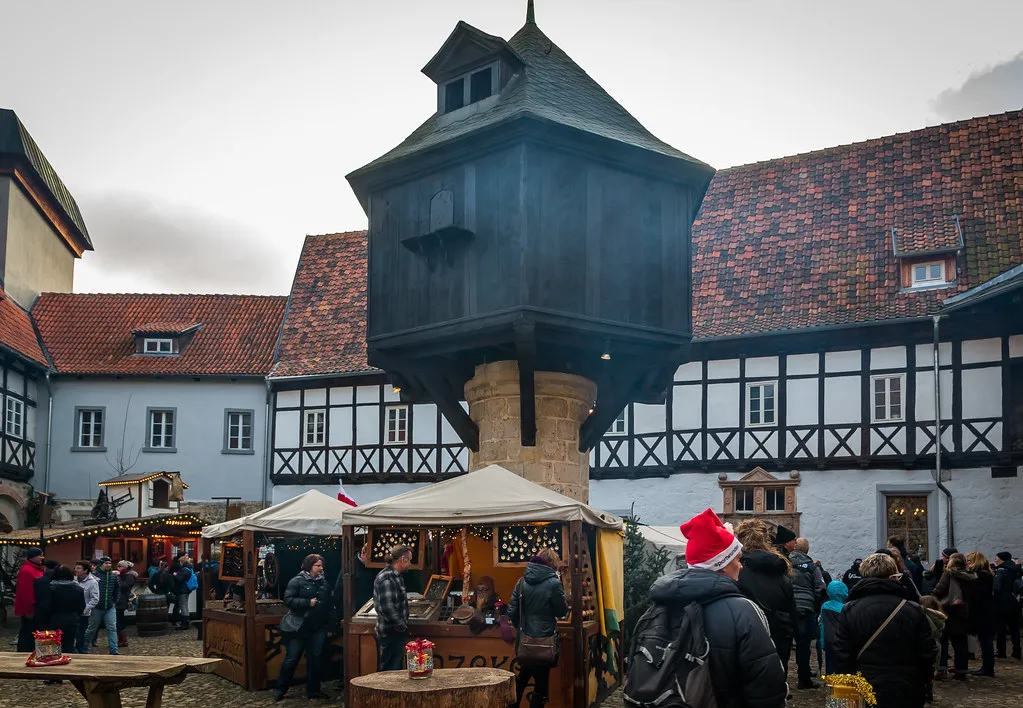
The historical depth runs even further. In 919, Franconian nobles offered Henry the Fowler the German crown here at Quedlinburg, making the town widely regarded as the origin point of the German Reich and of the Ottonian dynasty that would go on to shape medieval Europe. Henry's son, Otto I, became the first Holy Roman Emperor. That lineage began on this castle hill, which is worth remembering as you sip mulled wine in front of the Rathaus below.
The UNESCO designation also brings some practical benefits for visitors. The town has preserved its medieval street grid, which means the market is compact and walkable. The entire circuit from the Market Square to the Schlossberg and back takes around 20 minutes on foot, making it straightforward to revisit favourite stalls throughout the day.
Local Flavors: From Cheesecake to Mulled Wine
Quedlinburg is famous for a culinary rivalry that locals follow with genuine pride. Café Sieben Sommers — sometimes called the "Cheesecake King" — offers over 100 varieties of quark cheesecake and has been drawing visitors to Breite Straße for decades. The monastery bakery counter-programs with its own recipes, including rye-based spiced loaves and almond biscuits. Trying both sides of this rivalry is a reasonable excuse for a second pastry.
Beyond the bakery debate, the market stalls serve traditional Harz staples worth seeking out. "Schmalzkringel" are fried dough rings dusted with sugar, made fresh at a handful of stalls near the Rathaus. Harzer Käse — the pungent low-fat rind cheese of the region — pairs surprisingly well with dark bread and the local Harz apple cider. Game meat is a seasonal fixture: wild boar sausage and venison goulash appear on menus from late November onward.
The mulled wine (Glühwein) sold in the market uses local Harz berry varieties and is served in collectible ceramic mugs. Keeping the mug requires a deposit, typically around €2–3 per mug. Some stalls also offer a non-alcoholic punch based on elderflower and apple, which is worth asking for if you are travelling with children.
Practical Tips: Parking and Crowds
Quedlinburg is a small town and its historic center has very limited street parking, which effectively disappears during market weekends. The recommended approach is to use the designated park-and-ride areas on the town's outskirts, particularly at the sports grounds on Gernröder Weg or at the car parks near the train station. From the station, the Marktplatz is a flat ten-minute walk. Paid parking in the center costs around €1 per hour, but spaces run out by 10:00 on Saturday mornings in Advent.
Regional train connections make Quedlinburg accessible without a car. Direct regional services run from Magdeburg via Halberstadt, with a journey time of around 50–60 minutes. From Halberstadt, the local train takes approximately 20 minutes. If you are coming from Leipzig or Hanover, allow for one interchange. The station sits just outside the historic core, which makes the final approach on foot a gentle introduction to the town.
For crowd management, the market is busiest on the Advent Saturdays when the courtyard events are also running. If you want the Advent in den Höfen experience but dislike crowds, prioritize Sunday mornings, when visitor numbers are noticeably lower than Saturday afternoons. Weekday evenings between 17:00 and 19:00 offer a pleasant combination of market lights and manageable foot traffic.
Where to Stay: Winter Accommodation Guide
Quedlinburg has a modest but well-suited accommodation stock for a short winter break. The closest options to the market are the small hotels and guesthouses clustered around the Marktplatz and on the main pedestrian streets. These fill quickly for the first and second Advent weekends, so booking six to eight weeks in advance is practical rather than excessive. Rates for a double room typically range from €80 to €140 per night at three-star properties during market season.
Travelers who cannot find rooms in Quedlinburg itself often stay in Wernigerode, roughly 30 km west, and drive or take the train in for the day. Wernigerode has a larger hotel base and its own Christmas market, which makes it a functional hub for exploring both towns across a long weekend. Halberstadt, 20 km north, is another viable base with generally lower accommodation prices.
Self-catering apartments and holiday rentals have expanded in the area over recent years. These suit longer stays and families, and several proprietors offer properties with direct views of the half-timbered streets. Check the TripAdvisor User Discussion for recent first-hand reports on which properties are currently recommended for the Christmas market period.
Nearby Harz Markets: Goslar, Wernigerode, and Schierke
Quedlinburg sits within easy reach of several other markets that make sense to combine into a Harz region Christmas trip. Wernigerode, 30 km west, runs its Weihnachtsmarkt from around mid-to-late November to 22 December 2026 (the 2025 edition ran 21 November to 22 December); check the Wernigerode town site for confirmed 2026 dates. The market fills the area between the historic Marktstraße and Nicolaiplatz, with around 60 traders, a stage with carol performances, and atmospheric lighting around the Church of St. Sylvestri. It is the larger of the two town markets and better suited to families with children thanks to its broader programme.
Goslar, another 30 km further west, is also a UNESCO World Heritage town and runs its Christmas market and Christmas forest from late November 2026 (the 2025 edition opened 26 November); confirm the 2026 opening date on the Goslar tourism site. About 60 wooden huts occupy the central market square, with the Christmas forest section on the Schuhhof enclosed by conifers. The combination of market and forest gives Goslar a slightly different character — quieter and more contemplative than the Wernigerode stage-driven format.
Schierke, a small village in the Harz highlands above Wernigerode, runs a distinct event called the Lichterzauber (light magic) across the festive season into early January (the 2025/2026 edition ran 29 November 2025 to 3 January 2026); check the Schierke event listing for confirmed 2026/2027 dates. This is not a traditional market but a light installation festival: more than 289 LED spotlights and around 1,000 metres of cable illuminate 35 locations across the village, including the Mäuseklippen cliffs and the spa gardens. The lights run Friday to Saturday from 17:00 to 22:00, with mulled wine stands at selected spots. It is a high-tech counterpoint to the medieval markets of Quedlinburg and Goslar, and worth the 40-minute drive from Quedlinburg if you have a second evening spare.
Quedlinburg vs. Erfurt: Which Christmas Market Fits Your Trip?
The two markets are often mentioned together on planning forums, and the trade-off is straightforward. Erfurt's Christmas market on Domplatz is one of Germany's largest, with more than 200 stalls spreading between the cathedral steps and the Petersberg hill. The scale is impressive but the crowd density on Advent Saturdays can make it uncomfortable to browse slowly. Erfurt suits visitors who want maximum variety and a full-day program of events including children's rides, ice skating, and nightly cathedral illuminations.
Quedlinburg operates at a fundamentally different register. The market itself is compact — perhaps 50 stalls — but the surrounding town provides the spectacle that the stalls alone cannot. The UNESCO streetscape, the Schlossberg backdrop, and the Advent in den Höfen event give Quedlinburg a depth that Erfurt's flat market square does not replicate. A TripAdvisor user put it directly: "Quedlinburg is lovely and the market is nice — a couple of hours maximum and you will have seen it all and had time for food and drink." That is not a criticism; it describes the intimacy that makes the town memorable. If you want scale, choose Erfurt or Nuremberg. If you want atmosphere, Quedlinburg is the better call.
The two towns are roughly 130 km apart and not easily combined in a single day trip without a car. Travelers planning a broader Thuringia and Saxony-Anhalt Christmas circuit can use Erfurt as a base for the western portion and Quedlinburg for the Harz leg, treating them as two separate stops.
Frequently Asked Questions
What are the Quedlinburg Christmas market dates for 2026?
The 2026 market is expected to run from late November to around 22 December 2026 (the 2025 edition ran 29 November to 22 December); check the official town portal for confirmed dates. The special Advent in the Courtyards event only takes place on the first three Advent weekends, which in 2026 fall on November 28–29, December 5–6, and December 12–13. Plan your trip accordingly to see these hidden gems.
Is Quedlinburg the most Christmassy town in Germany?
Many travelers consider it the most atmospheric due to its 1,300 historic half-timbered houses. The UNESCO status and medieval architecture create a unique holiday backdrop. It offers a more intimate feel than larger city markets.
How do I get to the Quedlinburg Christmas market?
Quedlinburg is accessible by regional trains from Magdeburg or Halberstadt. Driving is possible, but parking is extremely limited during the market weekends. Use designated park-and-ride lots located on the town outskirts.
The Quedlinburg Christmas market offers a rare glimpse into a preserved medieval world. Its combination of UNESCO history and the unique courtyard event makes it a standout European destination. By planning for the 2026 dates and booking accommodation early for the Advent weekends, you ensure a memorable visit. Whether you come for the cheesecake rivalry, the Schlossberg's living Advent calendar, or the Harz light installations at Schierke, this corner of Saxony-Anhalt rewards the detour. The Wurzburg Christmas market offers a useful comparison for visitors deciding between Franconian and Harz-region options.
Free guide: Europe's Festival Calendar
A month-by-month map of Europe's unmissable festivals — with the best dates to visit each and a local tip you won't find in the guidebooks.
You might also like


Continue reading
More guides you'll find useful