10 Essential Tips for the Vilnius Christmas Market 2026
Plan your trip to the Vilnius Christmas Market with 2026 dates, locations, weather tips, and a local price guide for the best holiday experience.
On this page
10 Essential Tips for the Vilnius Christmas Market 2026
The Vilnius Christmas market is one of the most underrated winter destinations in Europe. The city's UNESCO-listed Old Town transforms from late November into a glowing maze of wooden stalls, artisan crafts, and the most creatively designed Christmas trees on the continent. Lithuania uses euros, the crowds are manageable compared to Western European markets, and the experience is genuinely different from a Tallinn christmas market trip or a weekend in Riga. This guide covers everything needed to plan a 2025 visit: confirmed dates, market locations, transport logistics, and a daily budget breakdown.
The market draws visitors who want festive atmosphere without the shoulder-to-shoulder crowds of Cologne or Vienna. Vilnius punches far above its weight on Christmas tree design — the Cathedral Square installation has ranked among Europe's best multiple times. Planning the right arrival time, knowing which square to visit first, and packing for Baltic winter are the decisions that make or break the trip.
Free guide: Europe's Festival Calendar
A month-by-month map of Europe's unmissable festivals — with the best dates to visit each and a local tip you won't find in the guidebooks.
Vilnius Christmas Market 2025: Opening Dates and Hours
The 2025 Vilnius Christmas market officially opens on November 29 and runs until December 28. Market stalls typically open at noon each day and close between 20:00 and 22:00, with weekends leaning toward the later closing time. Check the Official Vilnius Events page a week or two before arriving — the full concert and event schedule usually goes live in mid-November and includes specific dates for the 3D light show scheduled between Christmas and New Year.
The iconic Vilnius Christmas tree stays lit in Cathedral Square until January 6 (Epiphany), so visitors arriving just after December 28 can still see the centerpiece. The ice rink on Lukiškės Square typically remains open through early March, making it a draw well beyond the market season. The annual Vilnius Christmas Run takes place on a Sunday in mid-December and adds to the festive atmosphere around the same period.
For 2026, market dates have not been officially announced as of this writing. Based on the consistent pattern of opening on the last Saturday or Sunday of November, planning for late November through late December is a safe assumption. Bookmark the Vilnius Tourism Information site and check back in October for the confirmed schedule.
Market Locations: Cathedral Square vs. Town Hall Square
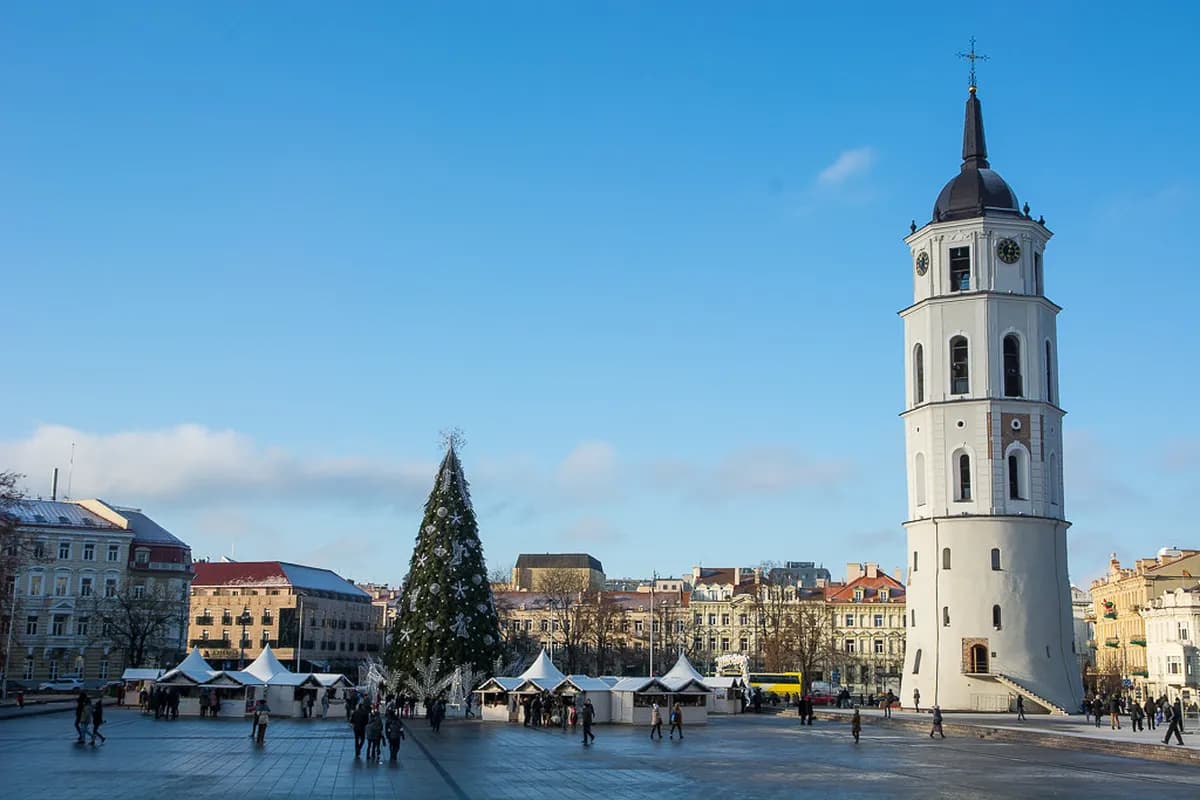
The two main market zones sit roughly one kilometer apart in the Old Town, and they feel quite different from each other. Cathedral Square is the showpiece: this is where the main Christmas tree stands with Vilnius Cathedral as the backdrop, where the largest concentration of traditional wooden chalets operates, and where the live carol performances and light shows take place. The scale here is impressive even by European standards, and the square fills quickly after 17:00 on weekends.

Town Hall Square offers a more intimate and modern feel. Rather than wooden chalets, this location features glass igloo stalls — each with a different theme, some functioning as small cafes and others selling crafts and designer goods. The vibes are calmer and more local. A third market zone exists along Gediminas Avenue (Gedimino prospektas) at Vincas Kudirka Square, which most visitors miss entirely and which is worth a detour for handmade Lithuanian goods with less tourist markup.
The walk from Cathedral Square to Town Hall Square takes about 12 minutes along Pilies Street, which is one of the most photogenic stretches in the Old Town. Pilies Street itself is lined with amber shops and cafes. If walking is not preferred, the Vilnius Christmas Train runs between the two squares on this exact route.
The Iconic Vilnius Christmas Tree: A Must-See Centerpiece
No two Vilnius Christmas trees look alike. The city commissions a new design concept each year, and the results have ranged from a 27-meter metal structure made from 600 branches and over 5 km of lighting to abstract geometric forms that look nothing like a traditional evergreen. In past years, the tree has ranked among the best in Europe according to international travel press. The design for the current season is announced with the market opening and is consistently a talking point among visitors.

A more traditional Christmas tree stands at Town Hall Square for those who prefer the classic silhouette. But the Cathedral Square installation is the one worth planning an evening around. The lights come on at dusk — around 16:00 to 16:30 in December — and the effect is significantly more dramatic after dark than in daylight. Arriving at the square around 16:00 gives time to explore the stalls before the light show begins and before weekend crowds peak.
The Presidential Palace, a short walk from Cathedral Square, is also beautifully lit during the holiday season. Its facade illuminations are free to view and make for a quiet alternative to the busier main square on evenings when Cathedral Square is packed.
Family Fun: The Vilnius Christmas Train and Ice Rink
The Vilnius Christmas Train has become a fixture of the market season. This small decorated tourist train runs daily from noon through the market hours, connecting Cathedral Square and Town Hall Square via Pilies Street with departures approximately every 30 minutes. Tickets are purchased directly from the driver. Children under 90 cm ride free. The ride is short — it covers just the two main stops — but it is a genuine treat for families and a painless way to move between the two market zones without walking the cobblestones in the cold.
The ice rink is located on Lukiškės Square, along Gediminas Avenue, a few minutes west of Cathedral Square. This is not a small tourist rink — it is a proper winter facility that operates from December through early March and draws local families alongside visitors. Skate rental is available on-site. Prices for both the train ride and ice skating are notably cheaper than equivalent attractions at Western European Christmas markets.
An animated Nativity scene is typically set up on Cathedral Square, which has in past years included live animals. For families with young children, the combination of the train ride, the Nativity scene, and the tree lighting covers a full festive afternoon without needing to visit any museums or paid attractions.
Top 7 Things to See and Do in Vilnius in December
The Christmas market is the anchor, but Vilnius rewards visitors who explore beyond the main squares. The Old Town is compact enough to cover the key sights on foot, even in cold weather, and most are free or low-cost to visit.
- Walk through the Gates of Dawn at sunrise before the market opens. This 16th-century gate on the Old Town's southern border houses the Chapel of Mary the Mother of Mercy, home to the famous Vilnius Madonna painting. Arriving at dawn means seeing the chapel in near-solitude — pilgrims and tourists arrive in larger numbers from mid-morning onward.
- Visit St. Anne's Church, a masterpiece of Flamboyant Gothic and Brick Gothic architecture built between 1495 and 1500. Napoleon reportedly wanted to take it home "in the palm of his hand." It stands beside the Bernardine Church on the banks of the Vilnia River.
- Cross into the Republic of Užupis, a self-declared micro-republic covering less than 1 sq km on the far side of the Vilnia River. This bohemian district has its own constitution, president, and a distinctive creative energy that is entirely different from the Old Town.
- Ride or walk along the Neris riverside for views of the floodlit city at dusk.
- Browse the amber shops along Pilies Street, where Lithuanian artisans sell genuine Baltic amber jewelry at prices well below airport retail.
- Take a half-day trip to Trakai Castle, a 14th-century red-brick island fortress 28 km from Vilnius, accessible by local train in about 30 minutes.
- Spend an evening at one of the Old Town's traditional Lithuanian restaurants to try the food that does not appear at the market stalls.
Local Food and Drink: What to Eat at the Market
The Vilnius Christmas market serves the standard mulled wine and waffles, but Lithuania has specific seasonal specialties that are worth seeking out and that no Western European market offers. Kisielius is a warm non-alcoholic jelly drink typically made from cranberries — order spanguolių kisielius for the cranberry version, which is tart, warming, and costs around 3 EUR. It is a better choice than plain hot chocolate for anyone who finds mulled wine too sweet or alcoholic.
Šližikai (also called kūčiukai) are small poppy seed pastry bites eaten traditionally on Christmas Eve — vendors at the market sell them in paper bags for a few euros. Meduoliai are Lithuanian gingerbread that come in elaborate shapes and sizes, making them the best edible souvenir to take home. For a proper meal, look for a stall or nearby restaurant serving cepelinai: oversized potato dumplings stuffed with meat or curd, which is the dish most closely associated with Lithuanian home cooking and which costs around 6 to 8 EUR at a sit-down restaurant.
These items are rarely mentioned in generic European Christmas market guides, but they are what local families actually eat during the season. Trying them turns the market visit from a generic tourist experience into something more grounded in where you actually are.
Budgeting Your Trip: Is the Vilnius Christmas Market Expensive?
Vilnius is one of the most affordable Christmas market destinations in Europe. Food and drinks at the market are comparable to Belgian Christmas market prices, not inflated London or Zurich prices. Expect to pay 3 to 4 EUR for non-alcoholic warm drinks (including kisielius), 5 EUR for mulled wine, and 5 to 8 EUR for hearty snacks like fried bread, sausages, or cepelinai. A full evening at the market — two drinks, a snack, one souvenir purchase — runs about 25 to 35 EUR per person.
Hotels are where Vilnius really delivers value. Four and five-star hotels in the Old Town center cost significantly less in December than equivalent properties in Warsaw, Prague, or Tallinn. Staying within the Old Town means walking to Cathedral Square in under five minutes, which removes any need for taxis in the evening. Budget options like Domus Maria and the 15th Avenue guesthouse sit alongside luxury properties like Hotel PACAI and the Grand Hotel Vilnius, all within close range of the markets.
The Vilnius Pass covers public transport and entry to major museums including the Palace of the Grand Dukes of Lithuania. For a 72-hour trip focused on the market, the pass typically pays for itself after three to four museum visits. If the itinerary is market-focused with limited museum time, individual tickets are likely cheaper. Airport transport adds modest cost: a Bolt ride from Vilnius Airport to the city center (approximately 6 km south) costs 10 to 15 EUR and takes around 15 minutes. Public buses are much cheaper but slower, and in cold or snowy conditions the warmth of a car is worth the extra few euros for most travelers.
Winter Weather Guide: Preparing for December in Lithuania
December temperatures in Vilnius typically range from -5°C to 10°C (23°F to 50°F), though cold snaps can push nights well below -10°C. Snow is possible but not guaranteed — the city is as likely to have rain and wet cobblestones as it is to have a white Christmas. The Baltic wind makes temperatures feel colder than the number suggests: a calm 0°C feels warmer than a windy -2°C, and the humidity in the city amplifies the chill. Plan clothing for wind rather than dry cold.
Sunset around December 21 falls at approximately 15:50, giving roughly seven hours of usable daylight. This sounds limiting but works in favor of the market atmosphere: the Christmas lights and tree installations are at their most dramatic in the long dark evenings, and the market stalls are open until 20:00 to 22:00. The short day effectively extends the "golden hour" photography window to several hours of blue and black sky contrasting with warm market lights.
Waterproof boots with a solid grip on the sole are the most important item to pack. Cobblestone streets in the Old Town become treacherous when wet or icy. Thermal base layers, insulated gloves, a windproof coat, and a wool hat are all necessary. A portable power bank is worth adding — cold weather drains smartphone batteries quickly, and battery failure at the tree lighting is a common frustration. Lithuania uses the euro and card payments are accepted in most restaurants and shops; bring some cash for market stalls, which typically do not accept cards.
Where to Stay: Best Hotels Near the Festive Action
Staying inside the Old Town is the right call for a Christmas market trip. Walking out of a hotel to find streets already lit with holiday decorations is a meaningful part of the experience, and the compact size of the Old Town means Cathedral Square is never more than ten minutes on foot from any central accommodation. Prices in December are lower than peak summer rates, making this one of the few European capitals where the festive season is not the most expensive time to visit.
Hotel PACAI is frequently cited as the standout luxury option — a 17th-century palace converted into a contemporary hotel within the Old Town. The Radisson Blu Royal Astorija and the Grand Hotel Vilnius both offer reliable quality at slightly lower price points and have confirmed wheelchair-accessible rooms, which matters in a city with extensive cobblestoned pedestrian streets. For mid-range stays, Artis Centrum Hotels has consistently strong reviews and an excellent Old Town location. Budget travelers do well at Domus Maria, a guesthouse run by a religious community that provides clean, well-located rooms at low rates.
Booking accommodation two to three months in advance for the Christmas period is advisable, particularly for stays around December 24 to 26. Restaurants in Vilnius largely close on December 24 (a family evening throughout Catholic Lithuania), so hotel dining is often the only practical dinner option that night — check whether the property's restaurant is open to non-residents before arriving without a reservation.
Beyond the Stalls: Special Holiday Events and Traditions
The market itself is only part of what makes December in Vilnius distinctive. The 3D Christmas fairy tale light show, projected onto a major Old Town building between Christmas and New Year, draws large crowds and is free to watch. This is an annual installation that changes each year and has ranged from abstract light art to architectural storytelling. The exact dates and location are announced on the events calendar in November.
The annual Vilnius Christmas Run, held on a Sunday in mid-December, fills the city center with thousands of participants in festive costumes and creates a lively atmosphere even for spectators. Youth choirs perform throughout the Old Town during the market weeks, particularly around Cathedral Square in the evenings — these performances are unscheduled and informal, but they are a reliable feature of most market evenings.
For a quieter tradition, the Gates of Dawn Chapel holds special masses during the Advent season and on December 24. The atmosphere inside the chapel — lit with candles and filled with pilgrims from across Lithuania and Poland — is entirely unlike anything at the market stalls and offers a grounding counterpoint to the commercial Christmas atmosphere outside. Check the best christmas markets in scandinavia and the baltics guide for a broader picture of how Vilnius compares to its Baltic and Nordic neighbors.
Frequently Asked Questions
When is the best time to see the Christmas tree?
The best time is between late November and January 6. Visit after 4:30 PM to see the lights fully illuminated. Weekdays are much quieter than weekends for photography.
Is the Vilnius Christmas market expensive?
Vilnius is quite affordable compared to Western European markets. Mulled wine is around 5 EUR and snacks cost 5-8 EUR. Budget about 30-40 EUR per person for a full evening.
How many days do you need in Vilnius?
Two to three days is perfect for the markets and Old Town. This allows time for the main squares and a few museums. You could also add a day for Trakai Castle.
The Vilnius Christmas market rewards visitors who come prepared. Confirm the official dates before booking, stay inside the Old Town, and plan at least one evening around the Cathedral Square tree lighting. The market is smaller than its Western European counterparts, but that is the point: it offers a genuine festive atmosphere rather than a managed tourist spectacle. Try the kisielius, walk Pilies Street at dusk, and build in time for the Gates of Dawn at sunrise before the crowds arrive.
Free guide: Europe's Festival Calendar
A month-by-month map of Europe's unmissable festivals — with the best dates to visit each and a local tip you won't find in the guidebooks.
You might also like

Continue reading
More guides you'll find useful