
Semana Santa in Malaga Dates: 10 Essential Guide Sections
Discover the official Semana Santa in Malaga dates for 2026. Includes day-by-day itineraries, the official route map, and local tips for the best viewing spots.
On this page
Semana Santa in Malaga Dates: 10 Essential Guide Sections
The Semana Santa in Malaga dates for 2026 run from March 29 (Palm Sunday) through April 5 (Easter Sunday). That single week turns the city into one of the most dramatic spectacles in Europe. Over 40 brotherhoods carry towering tronos — some weighing more than 5,000 kg — through the narrow streets of the historic centre, accompanied by marching bands and thousands of nazarenos in pointed hoods. Declared a Festival of International Tourist Interest, this is one of the best festivals in Spain for cultural depth.
See also: Semana Santa In Malaga Travel Guide.
Planning requires understanding the complex schedule of the various brotherhoods. Each day features massive wooden floats known locally as tronos, carried by hundreds. The atmosphere blends solemn religious devotion with a vibrant, festive public spirit. Knowing the logistical details — viewing spots, transport, food, and the official route — determines how much of the week you actually see.
Free guide: Europe's Festival Calendar
A month-by-month map of Europe's unmissable festivals — with the best dates to visit each and a local tip you won't find in the guidebooks.
📅 Dates for Holy Week in Malaga 2026
The official Semana Santa in Malaga dates for 2026 are set by the lunar calendar. Palm Sunday falls on March 29, marking the start of the public processions. The event concludes on Easter Sunday, April 5, 2026. Most major brotherhoods perform their penance walks between these two Sundays, with the heaviest concentration on Maundy Thursday and Good Friday.
The Official Poster Holy Week Malaga 2026 features the Virgen de la Soledad de Mena, created by Vélez-Málaga artist Martín España. Local authorities expect record-breaking attendance for the Thursday and Friday processions. The Agrupación de Cofradías coordinates movement of all 45 brotherhoods across the week, and their full Itinerary of the Agrupación de Cofradías is available online. Reviewing that schedule before you arrive is the single most important preparation step — knowing which brotherhood is where at what hour lets you position yourself correctly hours in advance.
To plan your travel to the event, check how to get to Semana Santa in Malaga before booking transport, since road closures around the official route start as early as 15:00 each day.
Official Route of Holy Week Málaga
Every brotherhood follows the same official route regardless of day. The circuit begins at the Alameda Principal, continues along Calle Larios (the city's pedestrian main street), passes through Plaza de la Constitución, and loops back through Molina Lario to the Cathedral zone. The full route typically takes a brotherhood two to three hours to complete from grandstand entry to grandstand exit, depending on the size of the trono and the number of penitents.
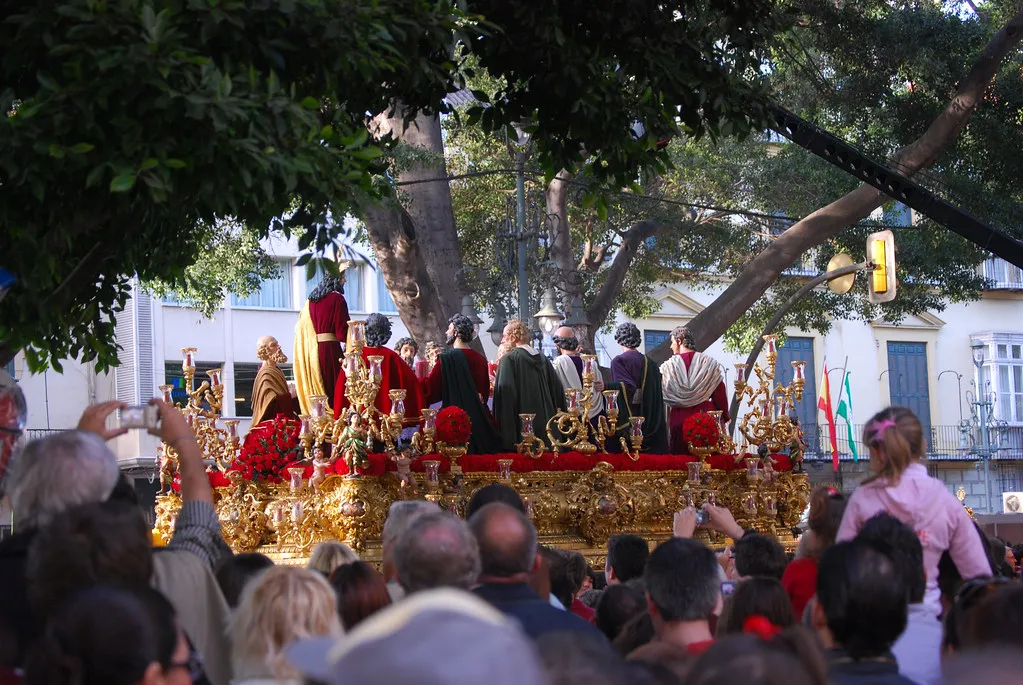
Grandstand seats are arranged along Calle Larios and are sold in advance through the Agrupación de Cofradías. They provide unobstructed views but sell out months before Holy Week. If you have not pre-booked, the paid seats on Alameda Principal are a secondary option that stays available longer. Either way, expect to pay between €15–€40 per seat depending on position and day.
For the full day-by-day schedule and precise timings for each brotherhood passing the grandstand and the South Tower of the Cathedral, consult the Holy Week Guide 2026 by La Opinión de Málaga, which publishes the complete schedule with route maps.
Holy Week Málaga 2026 Itinerary Day by Day
Palm Sunday (March 29) opens with La Pollinica, which departs at 09:45 and passes the grandstand at 12:00 — the most family-friendly and cheerful procession of the week. Lágrimas y Favores follows at 15:00 (grandstand 16:00); it is closely linked to actor Antonio Banderas and is known for an elegant, well-staged parade style. Huerto departs at 17:45 and signals the shift to a more solemn, dramatic atmosphere as evening falls.
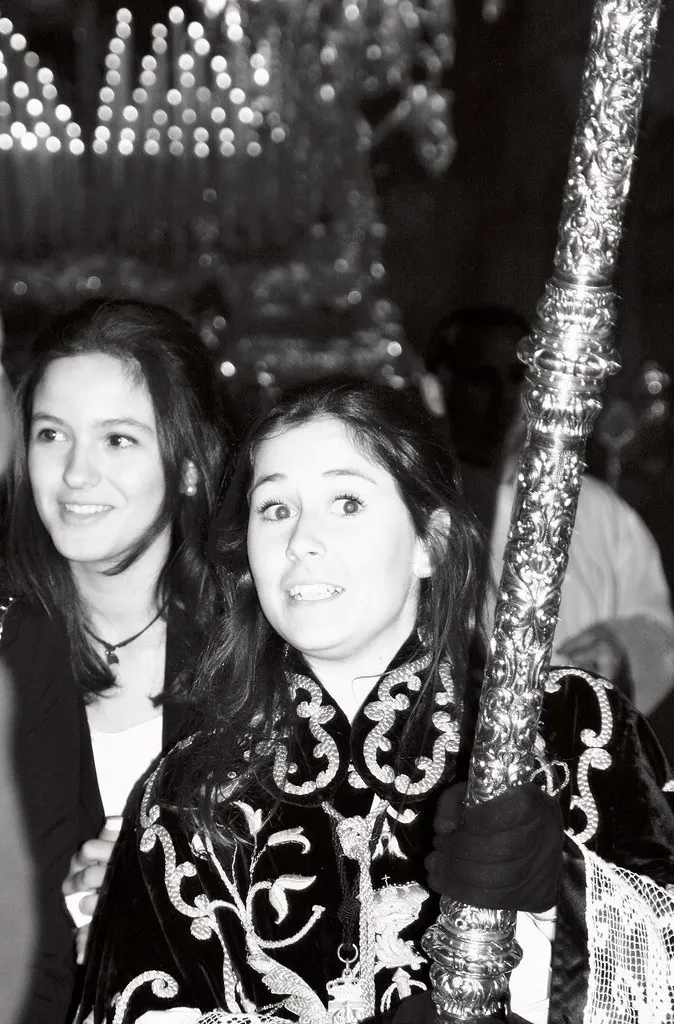
Holy Monday (March 30) is defined by El Cautivo, nicknamed "The Lord of Malaga." His departure from the Trinidad neighbourhood at 17:30 draws enormous crowds even before he reaches the official route — watching his exit from the Brotherhood House is more emotionally charged than seeing him on Larios. Holy Tuesday (March 31) belongs to La Sentencia, known for the sheer size of its heritage float, and Rescate, whose route along Álamos and Carretería is one of the most accessible stretches for spectators who want a close view.
Holy Wednesday (April 1) brings El Rico, famous for the historic release of a prisoner — a privilege granted by King Charles III. This moment happens at Plaza del Obispo before the procession enters the official route, and it is worth arriving early to witness it. Maundy Thursday (April 2) is the emotional peak of the week: Cristo de la Buena Muerte is carried by soldiers of the Spanish Legion, who sing "El Novio de la Muerte" (The Bridegroom of Death) as the trono moves. The combination of military precision, raw emotion, and the chilling song makes this the single most iconic moment of Malaga's Holy Week. Good Friday (April 3) features Servitas, a mournful dawn procession during which street lights are extinguished as the Virgen de los Dolores passes. Easter Sunday (April 5) closes with El Resucitado, which includes an institutional representation of all the city's brotherhoods.
📍 Best Places to See the Processions
The Tribuna de los Pobres offers the most famous free viewing position in the city. These stone steps sit at the end of Calle Carretería, where the tronos pass at close range before entering the official route. Arriving 2–3 hours before the scheduled passage of the brotherhood you want to see is the minimum — the steps fill completely for the major processions. The atmosphere here is raw and communal in a way that the grandstand area is not.
The Cathedral surroundings — specifically Plaza del Obispo and the Patio de los Naranjos — provide a monumental backdrop that turns any passing trono into a postcard. For El Rico on Wednesday, this is the spot to see the prisoner-release ceremony. The Alameda Principal allows you to see the floats in full width, with space to move, before they compress into Calle Larios. If you want perspective rather than proximity, the Alameda is easier to manage than the grandstand zone.
- Paid grandstand (Calle Larios): reserved seats €15–€40, booked months in advance, unobstructed sightlines
- Tribuna de los Pobres (end of Carretería): free, arrive 2–3 hours early, very close float passage
- Plaza del Obispo / Cathedral: free, ideal for El Rico prisoner release and late-night returns
- Alameda Principal: free walking zone, wide space, good for watching tronos before the Larios bottleneck
- Neighbourhood departures (Trinidad for El Cautivo, Capuchinos for Salesianos): free, most emotionally intense moments of the week
🎨 Official Poster and Novelties for 2026
The 2026 official poster was created by Martín España, an artist from Vélez-Málaga. His work presents a three-dimensional visual treatment of the Virgen de la Soledad de Mena — one of the most venerated images in the city — and was received with strong public approval when unveiled in early 2026. The poster is the traditional visual anchor of each year's Holy Week and is widely reproduced on merchandise, banners, and local media throughout March and April.
Among the organisational novelties for 2026, the Agrupación de Cofradías has designed alternative routes for several brotherhoods to improve fluidity in the most congested areas around Larios and Constitución. Tourist information points will also be expanded across the route to help visitors track schedules in real time. If you are attending for the first time, registering at one of these points on arrival is a practical first step — staff can advise on which brotherhoods are running late and which streets to avoid.
How Many People Participate in the Malaga Processions?
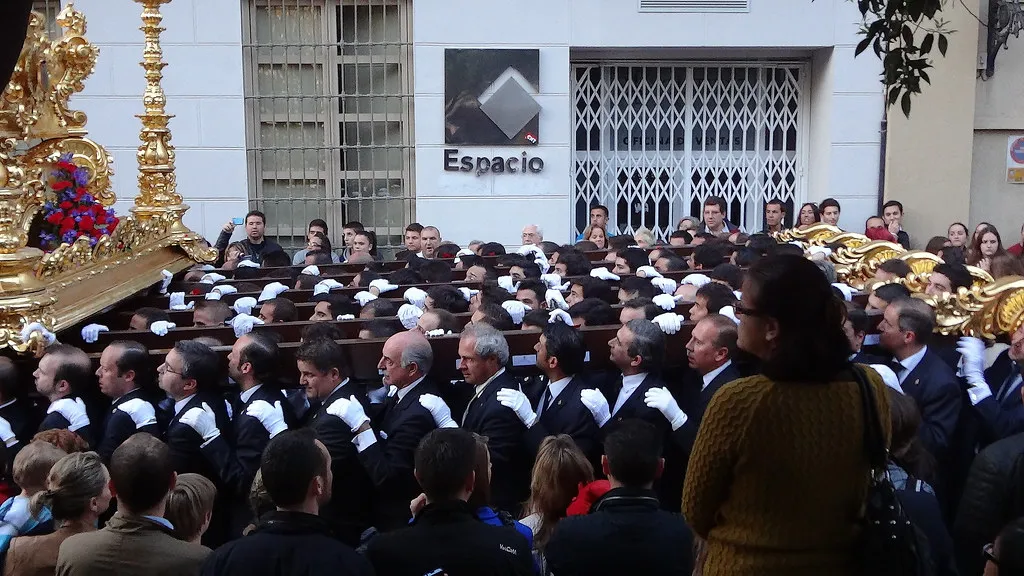
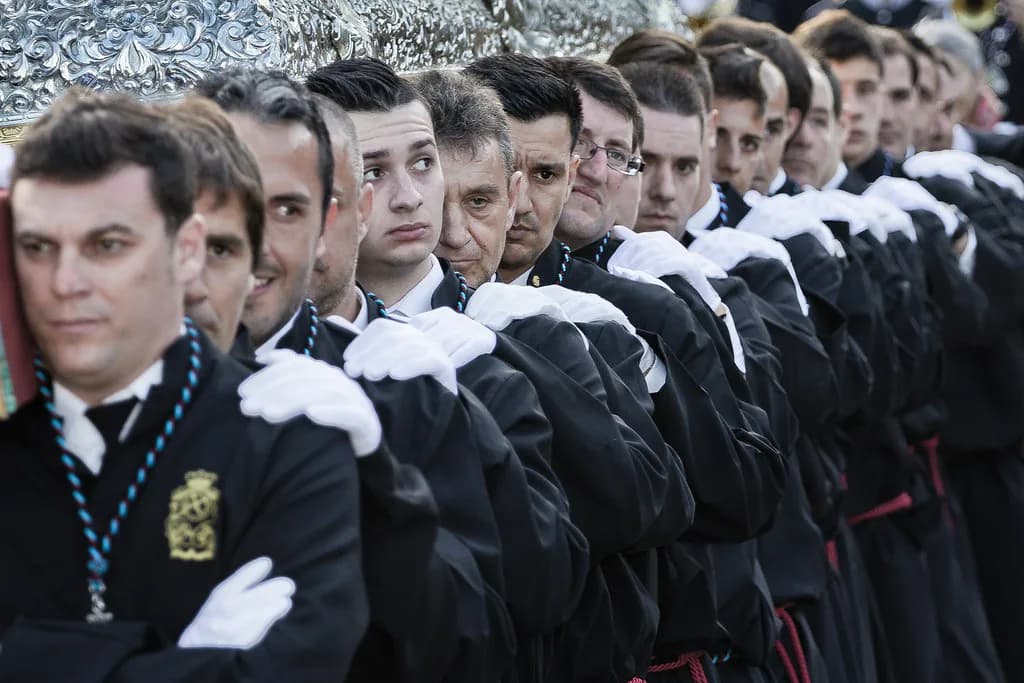
The scale of Malaga's Holy Week is difficult to grasp until you are in it. A total of 45 processions organised by the city's grouped brotherhoods take place across the seven days. Many individual tronos require more than 200 men and women — called portadores — to carry them on their shoulders. The larger floats weigh upwards of 5,000 kg and must be manoeuvred through streets that are only a few metres wider than the float itself. Watching a trono navigate a tight corner is an exercise in collective physical effort that consistently draws gasps from spectators.
Each procession also includes hundreds of nazarenos dressed in full-length robes and pointed hoods (capirotes), walking in silence or singing saetas — improvised flamenco-style devotional songs — from balconies above. Marching bands playing processional marches (marchas) accompany every brotherhood. On peak nights (Maundy Thursday and Good Friday), the city centre sees upwards of one million people on the streets.
🍤 What to Eat During Semana Santa
Torrijas are the essential Semana Santa sweet: thick slices of day-old bread soaked in milk, coated in egg, fried, and dusted with cinnamon sugar. Every bakery and many bars sell them throughout Holy Week. Pestiños — honey-dipped fried pastry flavoured with anise and sesame — are another traditional option that appears only during Lent and Holy Week, so the window to eat them is short.
The most authentic street snack in Malaga during these days is the limón cascarudo — sweet lemon wedges with a pinch of salt, sold by street vendors near the procession routes. It sounds simple but cuts through the heat and crowd fatigue effectively. For savoury fuel between processions, traditional taverns (tascas) serve potaje — chickpea and spinach stew — and fried fish or cod fritters, both of which are vigil-appropriate dishes tied to Lent tradition. The cofrade taverns around the historic centre, including Las Merchanas, Entre Varales, and Bar Nerva, decorate specifically for Holy Week and stock the seasonal sweets alongside local wine and tapas. Avoid the tourist-facing restaurants on Calle Larios itself during peak evenings — they are overpriced and understaffed during the procession rush.
💡 Useful Tips for Getting Around Malaga
Do not attempt to drive to the historic centre during Holy Week. Road closures on and around the official route begin at 15:00 most days and extend until after the last procession ends, which can be 03:00–05:00 on major nights. The Malaga Metro, EMT city buses, and Cercanías commuter trains are the only reliable options. Check the official transport apps before heading out each evening, as normal bus stops shift to temporary positions away from closed streets.
Download the free app "El Penitente" before arriving. It uses GPS to show you the real-time position of each brotherhood's cruz de guía (lead cross), so you can see exactly where each procession is on the route at any given moment. This is the single most practical tool for managing a multi-day schedule — it eliminates the guesswork of standing in the wrong spot waiting for a float that is still an hour away. The app is free and requires no registration.
The marble and cobblestone streets become genuinely slippery after candle wax accumulates across the evening hours. Wear rubber-soled shoes. Dress in layers — daytime temperatures in late March sit around 18–22°C but drop quickly after sunset when the sea breeze picks up, and many processions run until 03:00 or later. Keep children within arm's reach in the large crowd zones around Larios and Constitución, and look for the pedestrian crossing points set up by police if you need to cross the route.
🏡 Where to Stay for Semana Santa in Malaga
Accommodation within walking distance of the historic centre books out many months before March 29. The streets within 10 minutes of Calle Larios — including El Centro, La Malagueta, and Soho — give you the ability to return to your room between processions and avoid the transport chaos at the end of late-night events. Check where to stay for Semana Santa in Malaga for a full neighbourhood breakdown with distance-to-route comparisons.
If central accommodation is already sold out when you search, consider staying in Torremolinos or Fuengirola and using the Cercanías train to reach Malaga city centre. Both towns are 20–35 minutes by rail and continue running late-night services during Holy Week. This is a common local strategy that many first-time visitors overlook. Budget for the train (€2–€4 per journey) rather than taxis, which surge-price heavily on peak nights.
What to Pack
Packing for Holy Week in Malaga requires versatility. During the day, light cotton or linen clothing is comfortable in 18–22°C spring temperatures. Evening processions can run until 04:00 AM; temperatures drop quickly after sunset, so a medium-weight layer or trench coat is necessary. Locals tend to dress formally for the major Thursday and Friday events — smart-casual is appropriate if you want to blend in.
- Rubber-soled shoes with good grip — cobblestones and wax make smooth soles dangerous
- Light jacket or pashmina for late-night temperature drops
- High SPF sunscreen and polarised sunglasses for daytime processions
- Portable power bank — six to eight hours on the street drains phones completely
- "El Penitente" app downloaded and tested before arrival
Frequently Asked Questions
When is Holy Week in Malaga in 2026?
In 2026, Holy Week takes place from March 29 to April 5. The festivities begin on Palm Sunday and end on Easter Sunday. These dates change annually based on the lunar calendar cycle.
Is Semana Santa in Malaga free to watch?
Yes, you can watch all the processions for free from most street corners. Only the specific grandstand seats along the official route require a paid ticket. Arrive early at spots like Tribuna de los Pobres for the best free views.
What is the best month to visit Malaga?
May and June are generally considered the best months to visit Malaga. You will enjoy warm temperatures around 24°C / 75°F and lower hotel prices than in mid-summer. The sea is also warm enough for swimming by late June.
Malaga's Holy Week is one of the most logistically demanding and emotionally rewarding events in Spain. Knowing the Semana Santa in Malaga dates — March 29 to April 5 in 2026 — is only the starting point. The scale of 45 processions, the Cristo de la Buena Muerte carried by the Legion, the free steps at Tribuna de los Pobres, and the "El Penitente" app to track every cruz de guía in real time: these are the details that separate a well-planned visit from an overwhelming one. It ranks among the best fiestas in Spain for any traveler willing to engage with it seriously. Start your planning now.
Free guide: Europe's Festival Calendar
A month-by-month map of Europe's unmissable festivals — with the best dates to visit each and a local tip you won't find in the guidebooks.
You might also like

Continue reading
More guides you'll find useful


