
Is Semana Santa in Seville Worth It? (6 Things to Know)
Is visiting Seville during Holy Week worth the crowds? Discover the pros and cons, procession etiquette, must-try foods, and 2026 dates in this expert guide.
On this page
Is Semana Santa in Seville Worth It? (6 Things to Know)
Yes, but only if you value deep cultural immersion over personal space and quiet streets. For those who dislike intense crowds, the Feria de Abril offers a lighter festive atmosphere. This guide was last updated in June 2026 to reflect current prices and schedules.
See also: Semana Santa In Seville Guide Travel Guide.
Semana Santa is the most famous religious event in Spain, drawing millions of visitors to Andalusia. The city transforms into a stage for massive floats, solemn music, and ancient brotherhood traditions. While the spectacle is visually stunning, the logistical challenges can overwhelm unprepared travelers. We recommend reading this full review to decide if the trade-offs suit your travel style.
Free guide: Europe's Festival Calendar
A month-by-month map of Europe's unmissable festivals — with the best dates to visit each and a local tip you won't find in the guidebooks.
What Exactly is Semana Santa in Seville?
Semana Santa, or Holy Week, commemorates the passion and death of Jesus Christ through public processions. According to Semana Santa Wikipedia, these traditions date back to the 16th century. Over 60 brotherhoods, known as hermandades, participate by carrying elaborate floats through the narrow streets. The event officially begins on Palm Sunday and concludes on Easter Sunday. In 2026, Semana Santa runs from Palm Sunday, 29 March, through Easter Sunday, 5 April.
The hermandades are not parish committees run by the Church. They are independent lay associations — self-governing, self-financing, and fiercely rooted in their own neighborhoods. The Hermandad de Los Negritos, founded around 1393, is among the oldest still processing today. Its origins trace to Black former slaves from Africa, brought to Seville during the slave trade; Cardinal Gonzalo de Mena y Roelas founded the brotherhood, and it remains one of the most historically significant cofradías of the week. Watching these organizations process is watching a living institution, not a performance staged for tourists.
International visitors often feel immediate discomfort when seeing the pointed hoods worn by the Nazarenos. These garments bear a striking visual resemblance to the robes used by the KKK in America. However, these Spanish robes represent penance and humility, predating the American group by centuries. The tall hoods were designed to bring the wearer closer to the heavens during prayer.
The atmosphere in Seville during this time is a mix of mourning and celebration. Heavy scents of orange blossom and incense fill the air as the city stops for the floats. Most businesses in the historic center close or change their hours to accommodate the marching lines. Understanding this cultural weight is essential for enjoying the experience respectfully.
The Verdict: Is It Actually Worth the Crowds and Cost?
Yes, it is worth it for history buffs and those seeking authentic local culture. The sheer scale of the art and the emotional intensity of the crowds are unmatched in Europe. However, the financial cost and physical toll make it a poor choice for casual sightseers. You must be willing to stand for hours and navigate a city that feels completely full.
It is also worth noting that Semana Santa is equally moving for non-Catholic or non-religious visitors. The artistry of the pasos, the sound of the bands, and the spontaneous eruption of a saeta sung from a balcony overhead create moments that transcend religion. Many of the most devoted followers in the streets are people who simply grew up in this city and have watched the same procession every year since childhood.
Expect hotel prices to triple or quadruple compared to the standard spring rates in Seville. Most central restaurants require reservations weeks in advance, and simple walks take twice as long. If you can overlook these hurdles, you will witness one of the world's most powerful displays. The memory of a silent float passing at midnight is often the highlight of a traveler's life.
- Pros: What visitors usually love
- Incredible 17th-century Baroque religious art
- Deeply emotional and authentic local atmosphere
- Free access to most procession viewing areas
- The unique scent of orange blossoms mixed with incense
- World-class marching bands and sacred music
- The saeta — improvised flamenco lament sung a cappella from balconies
- Cons: What may disappoint
- Extremely high prices for basic accommodation
- Overwhelming crowds that block major streets
- Difficulty finding seating or open restaurants
- Long wait times for every activity
- Unpredictable weather can cancel major processions at any point
Understanding the Rituals: Pasos, Nazarenos, and Hermandades
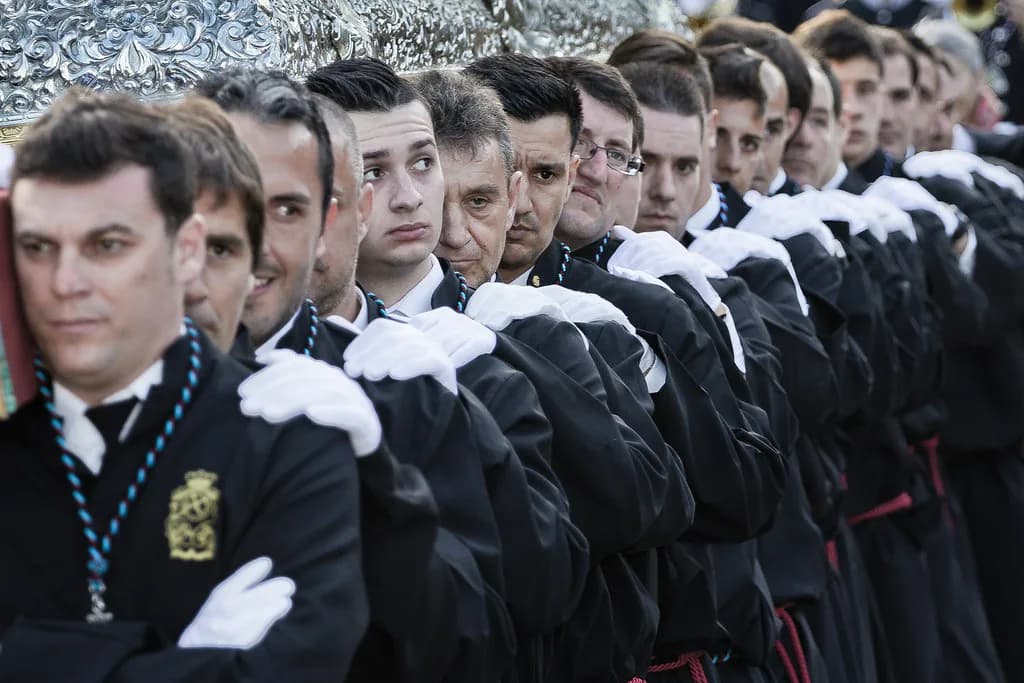
The centerpiece of every procession is the Paso, a massive wooden float carrying religious statues. These structures are often covered in gold or silver leaf and decorated with hundreds of candles. A team of 30 to 60 men, called costaleros, carry these floats entirely on their heads and shoulders. They move in a rhythmic sway that makes the statues appear to be walking — the paso itself can weigh several metric tons.
Watching the costaleros work is a highlight for many visitors to the city. You can often see their feet shuffling beneath the velvet curtains of the float. They take frequent breaks, and the moment the float is lifted back up is met with applause. This physical labor is considered a high honor and an act of religious devotion.
The Nazarenos walk in front of the floats, often carrying long wax candles. Some walk barefoot or in chains to show their commitment to penance during the week. The silence of these marchers contrasts sharply with the loud, brassy music of the bands. This juxtaposition creates a hauntingly beautiful scene that defines the Seville experience.
Standing in a single spot, watching a procession pass, it may take as little as 15 minutes or as long as nearly two hours to see all the participants go by. The La Macarena brotherhood alone has over 5,200 nazarenos. The procession as a whole — from parish church to cathedral and back — can last as long as 13 and a half hours for the largest brotherhoods.
Navigating the City: Procession Routes and Timing
The city center becomes a labyrinth of metal barriers and human bodies during the peak afternoon hours. Most processions follow an Official Route — the Carrera Oficial — that runs through Calle Sierpes and past the Seville Cathedral for a blessing. The earliest processions start around 13:00 each day; the city centre does not reach peak congestion until 16:00–17:00. Plan your monument sightseeing for the early morning before 13:00, then position yourself for processions in the afternoon and evening.
Crossing a procession line requires patience and an understanding of local social cues. Look for a gap between the Nazarenos and wait for a signal from a steward. Never attempt to walk through a line while the float itself is in motion. Locals are usually helpful if you politely ask for the best way to reach a destination.
The Official Seville Tourism - Semana Santa site provides daily maps and schedules. For 2026, download the official APP Sevilla before you arrive. The city added two new features this year: a real-time GPS tracker showing exactly where each hermandad is at any moment, and a crowd density traffic-light system that shows which areas are at capacity before you walk into them. The app is available on the App Store and Google Play (search "APP Sevilla") and is in Spanish only, but the main screens are straightforward to navigate.
For a guaranteed view along the Carrera Oficial, ticketed grandstand seats are available and sell out months in advance. Contact visitasevilla.es or the Consejo Superior de Hermandades to book. For a more intimate experience, find a spot on a narrower neighborhood street in Triana or the Macarena district and simply wait — the brotherhoods walk for hours and they will come to you.
The Madrugá: A Midnight Strategy for Success
The Madrugá is the most intense and famous night of the entire Holy Week. It begins late on Maundy Thursday night — in 2026 that is the night of 2 April — and runs deep into Good Friday morning. The city's most venerated brotherhoods, including La Macarena and El Gran Poder, take to the streets from around 01:00. For many Sevillanos, this is the night they have waited for all year. Entire families stay up. The streets fill with a particular silence, the kind that comes from thousands of people holding their breath at the same time.

One of the most atmospheric moments of the entire week is the passing of El Silencio, the oldest paso in Seville, founded in 1340. The city participates by turning off the streetlights on each street several minutes before El Silencio arrives, leaving only candlelight. A crowd of thousands watches in near-total darkness and complete silence as 850 nazarenos pass. Nothing prepares you for it.
Then a lone voice breaks from a balcony above. A saeta — an improvised flamenco lament, sung solo and a cappella — stops the procession mid-march. The band goes silent. The whole street turns upward. It is one of the few moments in modern city life where a single human voice stops a crowd of thousands. This is the soul of Semana Santa, and no daylight procession replicates it.
For a better experience of the Madrugá, head to the Macarena or Triana neighborhoods to watch the floats return home at dawn. The sunrise arrival of the Virgin of Macarena draws enormous crowds and spontaneous applause. Be prepared for a very long night — keep your belongings secure, stay hydrated, and wear your most comfortable walking shoes.
Traditional Foods to Eat During Holy Week
Holy Week has its own specific culinary traditions that you should not miss. The most famous treat is the torrija — slices of bread soaked in milk, sugar, and egg, fried in olive oil, and dusted with cinnamon, often finished with honey. You can find these in almost every bakery and cafe throughout the city during the week. They are the go-to sugar boost between long procession stints.
Pestiños are another local favorite consisting of deep-fried dough glazed with honey or sugar. Since many locals abstain from meat on Fridays, restaurants swap traditional pork dishes for creative fish plates. Expect bacalao in multiple forms — bacalao con tomate, croquetas de bacalao, bacalao frito — alongside espinacas con garbanzos and potaje de vigilia. These are not compromise dishes; they are the classics of Andalusian Lenten cooking.
Restaurants in the historic centre fill up fast on procession nights. From around 20:00 onward, tables are gone. Book dinner before you arrive in Seville, especially for Thursday and Friday evenings. If you want to eat well without the crowds, head to Triana: the neighborhood across the bridge has some of the most authentic tapas bars in the city, and during Holy Week it still offers a little breathing room compared to the cathedral center.
We recommend grabbing a quick cone of fried fish from a freiduría to eat while walking. This allows you to stay mobile and keep your spot for the next float. Always carry a bottle of water, as shops can be hard to reach in the crowds.
Essential Tips for First-Time Visitors
Watching the processions from the street is entirely free. The official ticketed chairs along the Carrera Oficial are sold privately and book out months ahead. For accommodation, expect to pay €300 or more per night for a basic hotel room in the city center. Look for accommodation options in Seville at least six months in advance — the best mid-range rooms disappear in autumn for the following spring.
Processions generally run from 13:00 until 03:00 daily. The Madrugá on Thursday night effectively runs through to Good Friday dawn without pause. Most major monuments — the Alcázar, the Cathedral — have restricted hours or temporary closures during the week; check before visiting. Rain can cause sudden cancellations of any procession at any point, since the pasos are centuries-old works of art that cannot be exposed to water.
We strongly recommend staying at least three nights to see the variety of processions across different days and neighborhoods. A day trip is stressful and often leaves visitors stuck in traffic outside the center. Staying overnight allows you to experience the quiet, early-morning atmosphere after the crowds thin. Palm Sunday and Maundy Thursday are the two days with the highest concentration of both processions and visitors; if crowd tolerance is a concern, Holy Monday and Holy Tuesday offer a more manageable experience with no less artistry on display.
Frequently Asked Questions
Should I visit Seville during Holy Week?
Yes, if you want to see Spain's most impressive cultural tradition. Be prepared for high costs and massive crowds. It is a unique experience that requires significant planning and patience.
How busy is Seville during Semana Santa?
The city is extremely crowded, with over a million visitors in the center. Walking through main plazas can take hours. Most streets are blocked by processions from afternoon until late at night.
What is the best city in Spain for Semana Santa?
Seville is widely considered the best city for the sheer scale of the event. However, Malaga offers a more accessible and slightly less crowded alternative. Both cities provide incredible religious and artistic displays.
Visiting Seville for more than one festival? See our complete guide to festivals and events in Seville.
Semana Santa in Seville is a bucket-list event that rewards the patient and the curious. While the crowds are daunting, the beauty of the Pasos and the music is unforgettable. You should book your accommodation in Seville at least six months in advance. Proper preparation will help you navigate the chaos and find the magic in the streets.
Whether you are religious or not, the artistry and devotion on display are deeply moving. Take time to try the torrijas and wander the quieter streets of Triana. Seville remains one of the most beautiful cities in the world during this holy time. We hope this guide helps you decide if you are ready for the challenge.
Free guide: Europe's Festival Calendar
A month-by-month map of Europe's unmissable festivals — with the best dates to visit each and a local tip you won't find in the guidebooks.
You might also like

Continue reading
More guides you'll find useful


