Feria de Abril Dates: 2026 & 2027 Schedule and Planning Guide
Plan your trip with the official Feria de Abril dates for 2026 and 2027. Includes the full event schedule, public caseta locations, and local tips for Seville.
On this page
Feria de Abril Dates: 2026 & 2027 Schedule and Planning Guide
The Feria de Abril in Seville typically begins two weeks after the conclusion of Holy Week. For 2026, the official dates are Tuesday, April 21 through Sunday, April 26. The 2027 fair is confirmed for April 13 to April 18. Last updated June 2026.
Visitors can expect warm afternoons and vibrant evening celebrations throughout the Los Remedios district. As one of the best festivals in Spain, it requires careful advance planning. The city transforms into a sea of colorful flamenco dresses and elegant horse-drawn carriages. Securing accommodation early is essential as hotels often reach full capacity months in advance.
The fairgrounds, known as the Real de la Feria, cover over 1.2 million square meters. More than one thousand individual tents, or casetas, line the streets of this temporary city. Understanding the schedule is the first step toward experiencing this unique cultural phenomenon. This guide provides the specific dates, daily programme, and logistical tips needed for a successful visit.
Free guide: Europe's Festival Calendar
A month-by-month map of Europe's unmissable festivals — with the best dates to visit each and a local tip you won't find in the guidebooks.
When is the Seville Fair? (2026 & 2027 Dates)
The timing of the fair depends entirely on the lunar calendar used for Easter. The 2026 Seville Fair runs from Tuesday, April 21 to Sunday, April 26. In 2027, the fair is scheduled from April 13 to April 18. Both editions follow the same rule: the fair opens two weeks after Semana Santa ends.
The transition from Semana Santa in Seville to the fair is a rapid cultural shift. Locals move from solemn religious processions to jubilant dancing and social gatherings within days. The dates occasionally slip into early May if Easter falls unusually late in the calendar year. Knowing the confirmed 2026 and 2027 windows lets you book flights and rooms before prices spike.
According to the Official Seville City Council, the fair is free to enter. You only pay for what you eat and drink inside. Bullfight tickets at the Plaza de Toros de la Maestranza are a separate purchase and sell out quickly.
Key Dates and the Official Fair Programme
The official programme kicks off on Monday, April 20, 2026, with the pescaíto frito dinner. This is a private event held inside individual casetas, where members gather family and close friends to eat fried fish and drink rebujito before the public opening. It is not accessible to tourists, but understanding it explains why Monday night feels unusually quiet around the fairgrounds even as the Real is already filling up with insiders.
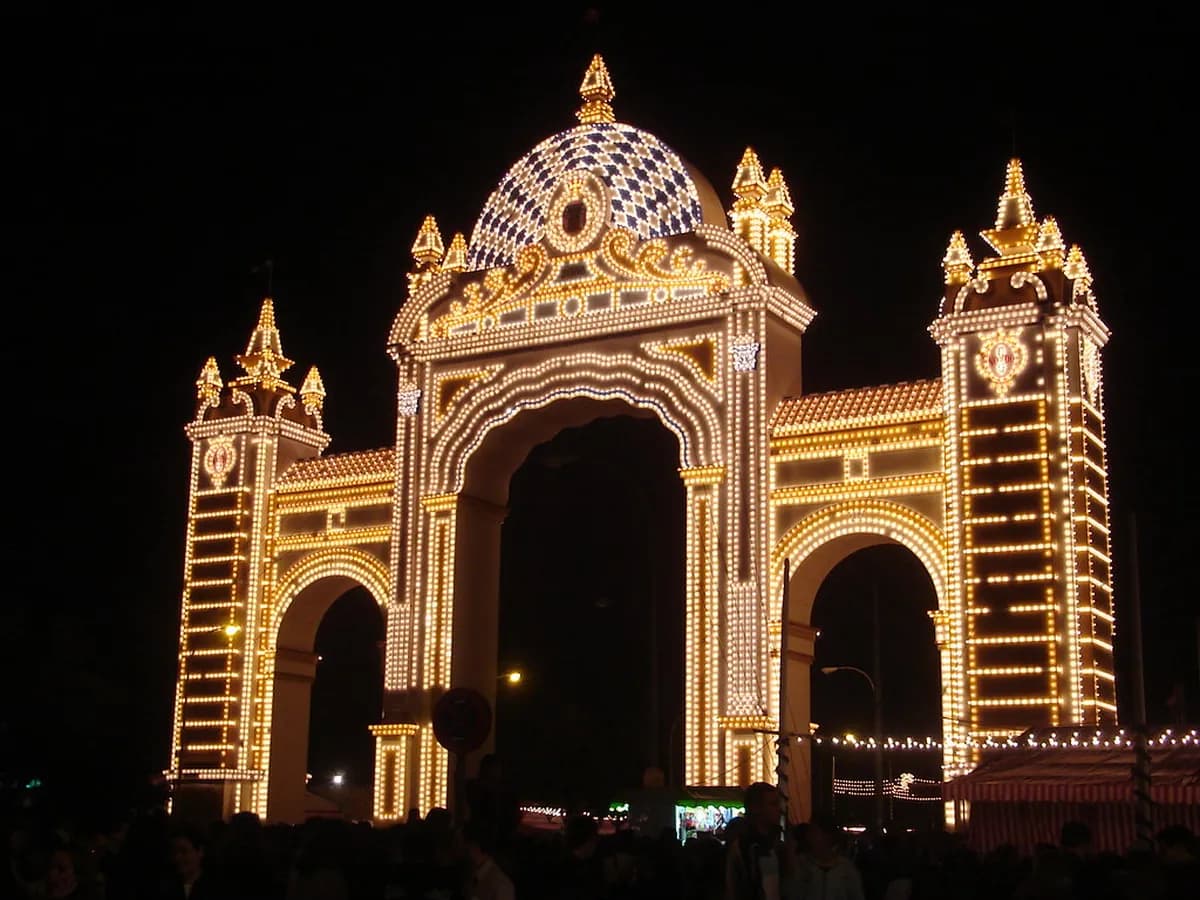
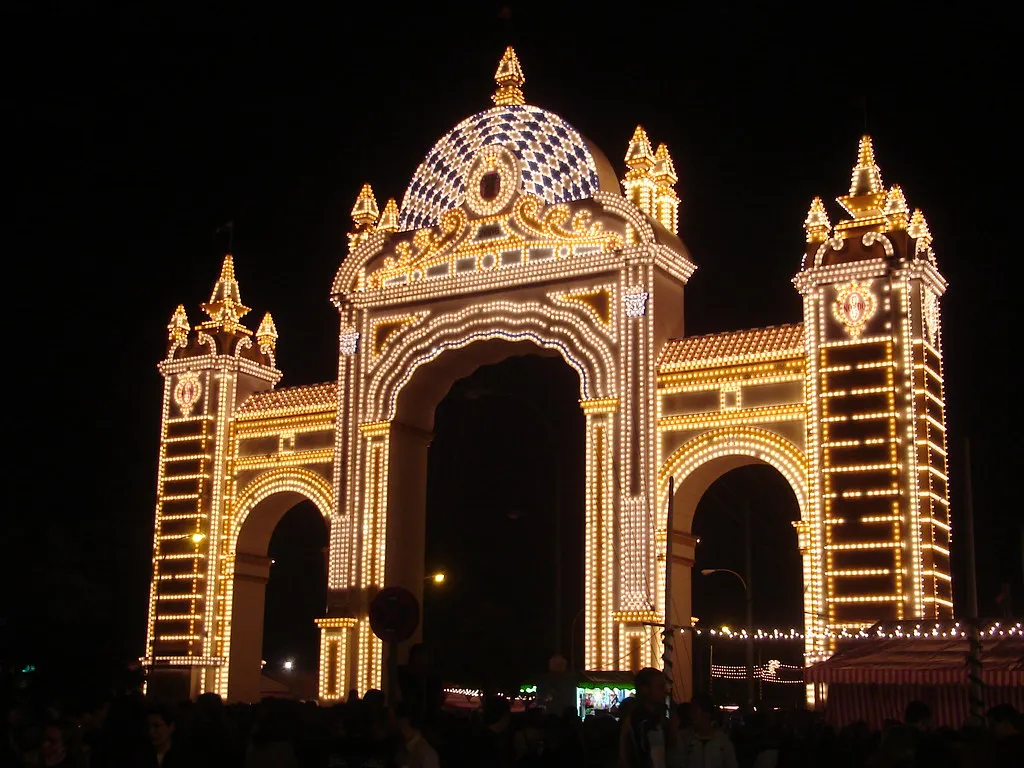
At midnight between Monday and Tuesday, the Alumbrao takes place: the city councillor throws the switch on the illuminated Portada, or main decorative gate, and over a million lightbulbs flood the Real with color. From that moment, public access opens and the fair is officially underway. The 2026 Portada was designed by Italian architect Davide Gambini and draws on the Seville Expo of 1929 and the Cenador de Carlos V at the Royal Alcázar.
The fair runs each day from around noon until 06:00 the following morning. The daily horse parade, known as the Paseo de Caballos, operates from 12:00 to 20:00. A fireworks display at midnight on Sunday, April 26 closes the 2026 edition. From 2026, the fair also adds 200 new casetas, bringing the total to over 1,200 tents.
The Real de la Feria: Location and Logistics
The Real de la Feria sits in the Los Remedios neighbourhood on the west bank of the Guadalquivir river, roughly 25 minutes on foot from the historic centre. It is a purpose-built temporary city assembled each spring on a 1.2-million-square-metre plot. The streets inside the Real are named after famous bullfighters, which is why caseta addresses use names like Calle Juan Belmonte or Calle Curro Romero rather than standard city streets.
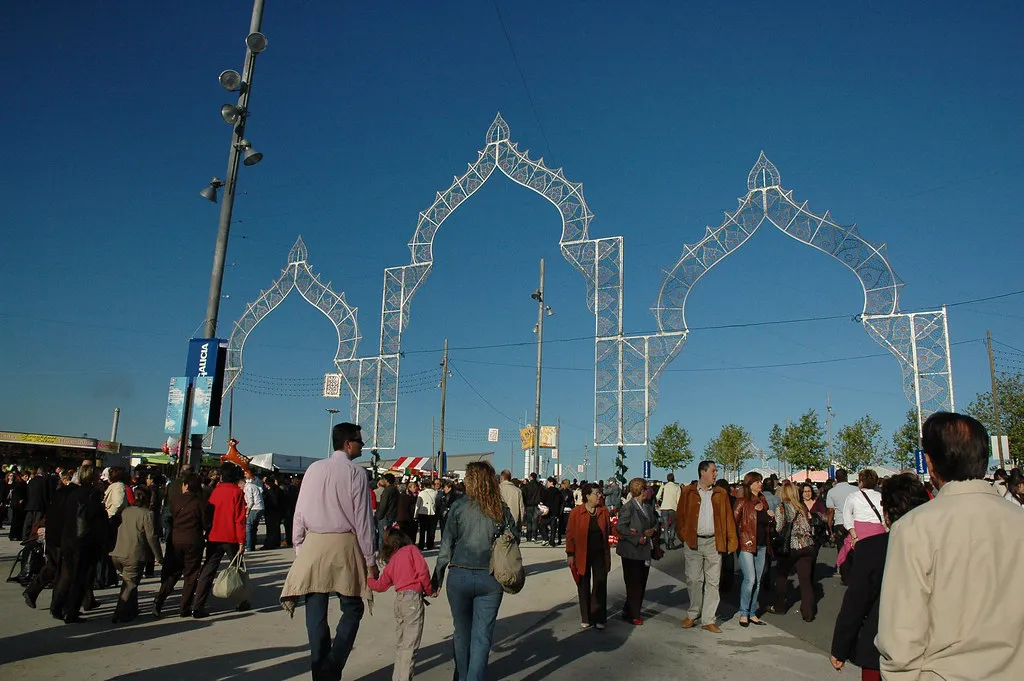
By public transport, the easiest option is the Especial Feria shuttle bus that departs from Prado de San Sebastián bus station. Standard lines 5, 6, 41, C1, and C2 also serve the fairgrounds. The nearest Metro station is Prado de San Sebastián, from which the shuttle takes around ten minutes. Taxis queue at a dedicated rank near the main gate but wait times stretch long after midnight.
There are few hotels within walking distance of the Real. The Monte Carmelo and Eurostars Guadalquivir are both about a 15-minute walk from the entrance. Most visitors stay in the city centre and commute, which is why booking a hotel near Prado de San Sebastián or Triana gives you easy access without the premium of staying directly in Los Remedios.
Casetas at Feria de Sevilla: Public vs. Private Access
Most of the 1,200-plus casetas are private, requiring an invitation from a member family or a company with a registered tent. This exclusivity can be confusing for first-time visitors. Private casetas are decorated, managed, and paid for entirely by their owners and typically passed down across generations. Entry is monitored by doormen who check for membership cards or personal invitations.
Public casetas are the practical solution for tourists. Each of Seville's six districts operates a free-entry tent, and there is one dedicated tourist caseta. These are managed by district associations, trade unions, and political parties. They close at 03:00 and typically play a mix of rumba and Sevillanas music throughout the night. Drinks inside public casetas cost roughly the same as private ones: Manzanilla sherry or a glass of rebujito runs between three and five euros.
The following public casetas have confirmed 2026 addresses in the Real de la Feria:
- Caseta Turismo de Sevilla (tourist caseta): Calle Pascual Márquez 225–229, near the Calle del Infierno funfair
- Distrito Casco Antiguo: Calle Antonio Bienvenida 97–101
- Distrito Este–Cerro–Amate: Calle Pascual Márquez 215–219
- Distrito Macarena–Macarena Norte: Calle Pascual Márquez 85–89
- Distrito Nervión–San Pablo–Santa Justa: Calle Costillares 22–26
- Distrito Sur–Bellavista–La Palmera: Calle Ignacio Sánchez Mejías 61–65
- Distrito Triana–Los Remedios: Calle Pascual Márquez 153–157
- Caseta Municipal: Calle Pepe Luis Vázquez 53
- Comisiones Obreras (trade union): Calle Pascual Márquez 81
- Partido Popular: Calle Pascual Márquez 66
- U.G.T.: Calle Antonio Bienvenida 13
Many hotels and the Seville tourist information office distribute invitations to the tourist caseta at no cost. If your hotel does not have them, ask at the nearest tourist office on arrival.
Showing off the Horses: The Paseo de Caballos
Every day between 12:00 and 20:00, riders and horse-drawn carriages circulate through the fairgrounds along a set circular route. The circuit runs along Calle Alfonso de Borbón y Orléans, Calle Juan Belmonte, Calle Curro Romero, Calle Ignacio Sánchez Mejías, Calle Rafael Gómez Ortega, and Calle Joselito El Gallo. Only the 1,400 carriages that hold prior municipal registration are permitted on the route during these hours.
The Sunday before the fair officially opens, the Real Club de Enganches de Andalucía organises a preliminary carriage exhibition at the Plaza de Toros de la Maestranza. This is one of the lesser-known events of the Feria week and offers a more intimate view of the intricately decorated carriages without the main-week crowds. The club was founded in 1985 specifically to revive a tradition of ornamental carriage-craft that was close to dying out.
Riders wear the traditional traje de corto: a fitted short jacket, wide-brimmed hat, and high boots. Women riding pillion are dressed in flamenco traje de flamenca and sit side-saddle behind the rider. Photographing the horse parade from the side streets rather than the main route gives you closer access and better light during the afternoon hours.
Seville Feria's Amusement Park: La Calle del Infierno
Running parallel to the caseta streets is La Calle del Infierno, the fair's built-in amusement park. Covering roughly 87,000 square metres, it contains around 400 rides, stalls, food stands, and entertainment attractions. The name translates roughly as "Hell Street" and refers to the raucous noise and energy that has historically defined it.
Families with young children typically visit La Calle del Infierno in the early afternoon, before the crowds peak and while the horse parade is still running nearby. Rides range from small carousels aimed at toddlers to large roller coasters for adults. Entry to the street itself is free; individual rides and stalls charge separately. Food stalls along the street sell the same pescaíto frito (fried fish) available inside the casetas, making it a good option if you have not secured entry to a public tent yet.
One detail that most guides omit: the city of Seville designates specific morning hours within La Calle del Infierno as a sensory-friendly session for children with autism or sensory sensitivities. The rides operate at reduced noise and light levels during these windows. Check the official Seville City Council programme for the confirmed hours in 2026, as the sessions vary by year.
Dress Code, Traditional Food, and What to Expect
The Feria de Abril has a strong visual identity built on two traditional outfits. Women wear the traje de flamenca, a figure-hugging polka-dot or floral dress with layered frills. Men wear the traje de corto when riding, or a jacket and tie as the everyday smart-casual standard. Tourists are not expected to arrive in full costume, but making an effort — a blazer, an elegant dress — is appreciated and practical, as the fair is genuinely formal in atmosphere.
If you want a flamenco dress without buying one outright, several rental shops near the fairground entrance offer daily hire starting around twenty to thirty euros. Safety pins are essential for adjusting a rented dress to fit and are the one item most guides forget to mention. Carry a handheld fan: the afternoon temperature regularly reaches 25–27°C inside the Real, and shade is scarce between the tents.
The two defining drinks of the fair are rebujito, a mixture of Manzanilla sherry and lemon-flavoured soda, and Manzanilla itself, a dry fino sherry from the Sanlúcar de Barrameda region. The defining food is pescaíto frito, portions of lightly battered and fried small fish. Both are served throughout the public casetas and food stalls. Most small casetas operate cash only, so carry small-denomination euro notes alongside your card.
Insider's Tips to Enjoy La Feria de Abril Like a Local
Arrive on Tuesday or Wednesday for your first visit rather than the opening night or the weekend. The opening night Alumbrao draws enormous crowds and the fairgrounds can feel chaotic without a plan. Mid-week days have a more local, family-oriented atmosphere, and public casetas are less packed. The weekend brings the biggest horse parades but also the longest queues at every entrance.
The Feria is a marathon, not a sprint. Most locals do not arrive before 13:00, eat a long lunch with family inside a caseta, take a siesta break, then return by 21:00 for the evening sessions that run until dawn. Trying to replicate this full arc in a single day is exhausting. Splitting your visit across two days — one afternoon for the horses and public casetas, one evening for dancing and the night atmosphere — is more sustainable.
Sevillanas is not a spectator sport at the Feria. Every caseta plays the music and most people on the floor are dancing it in couples or small groups. A basic sevillanas class in Seville costs around fifteen euros and takes ninety minutes. Going in knowing even the first of the four parts puts you in a completely different social position inside a tent. Check the Spain festival calendar to see what else aligns with your trip to Seville.
- Book accommodation at least six months in advance; prices double during fair week
- Bring cash in small denominations — many casetas do not accept cards
- Pack comfortable shoes; the albero ground is dusty yellow gravel that will coat footwear
- Carry a handheld fan and high-SPF sunscreen for afternoon sessions
- If wearing a rented flamenco dress, bring safety pins for fitting adjustments
Planning Your Trip: Accommodation and Transport
Finding a place to stay requires booking at least six months in advance. The best areas for Feria de Abril include Triana and the city centre, from which you can reach the fairgrounds by shuttle bus in under fifteen minutes. Prices for simple apartments can double or triple during the peak festival dates. Staying near Prado de San Sebastián bus station gives you the most efficient access to the Especial Feria shuttle.
The Especial Feria shuttle runs directly from Prado de San Sebastián to the fairground gates. City bus lines 5, 6, 41, C1, and C2 also serve the area. Taxis are available but have long queues at the fairground ranks after midnight. Walking from the historic centre across the Guadalquivir river takes approximately twenty-five minutes and is a pleasant option in the early afternoon before temperatures peak.
Frequently Asked Questions
What is the official date for Feria de Abril 2026?
The 2026 fair runs from April 21 to April 26. It begins with the lighting ceremony at midnight on Tuesday. The event concludes with a massive fireworks display on Sunday night.
Can tourists enter the casetas at the Seville Fair?
Yes, tourists can enter the designated public casetas. While private tents require an invitation, public ones are open to all. Look for the 'Caseta de los Distritos' or the municipal tourist tent.
Is the Seville Fair free to attend?
Entry to the fairgrounds and public tents is entirely free. You only pay for the food and drinks you consume inside. Some attractions at the funfair and bullfight tickets require separate purchases.
Visiting Seville for more than one festival? See our complete guide to festivals and events in Seville.
The Feria de Abril is a spectacular display of Andalusian pride and tradition. By following the official Feria de Abril dates, you can experience the city at its most vibrant. Remember to pace yourself and embrace the local customs of food and dance. Proper preparation ensures that your visit to Seville remains a highlight of your travels.
Whether you watch the horse parades or dance the night away, the fair is unforgettable. Check the Spain festival calendar for other events to pair with your trip. Seville welcomes everyone to join the celebration during this magical week in April. Plan ahead, dress elegantly, and enjoy the unique spirit of the Real.
Free guide: Europe's Festival Calendar
A month-by-month map of Europe's unmissable festivals — with the best dates to visit each and a local tip you won't find in the guidebooks.
You might also like


Continue reading
More guides you'll find useful