10 Essential Copenhagen Christmas Market Insights (2026)
Plan your trip with our guide to the best Copenhagen Christmas markets. Includes Tivoli Gardens tips, kayak parade dates, food prices, and crowd advice.
On this page
10 Essential Copenhagen Christmas Market Insights (2026)
Our editors have reviewed every neighborhood in the Danish capital to bring you this definitive guide for 2026. Copenhagen transforms into a winter wonderland where the scent of roasted almonds and mulled wine fills the crisp air. We believe the magic lies in 'hygge,' a uniquely Danish concept of coziness that defines the local Copenhagen christmas market season. Last updated April 2026, this guide reflects current prices and schedules for your holiday planning.
While many travelers visit in summer, the city truly shines when the lights twinkle against the early northern sunset. The markets usually open in mid-November and run through the end of December, with some extending into the new year. You will find a mix of grand amusement parks and intimate harbor-side stalls across the historic center. We have gathered the essential data on costs, timing, and locations to ensure your trip is seamless and festive.
Free guide: Europe's Festival Calendar
A month-by-month map of Europe's unmissable festivals — with the best dates to visit each and a local tip you won't find in the guidebooks.
Copenhagen is Buzzing All Year Around
Denmark's capital remains vibrant throughout the seasons, but winter offers a distinct, intimate charm that summer cannot replicate. The shorter days encourage locals to light candles and gather in heated outdoor cafes across the city. We suggest embracing the brisk weather by dressing in layers to navigate the cobblestone streets comfortably. Most major sights are within walking distance, making it easy to hop between festive hubs.
The city's infrastructure is perfectly designed for winter, with efficient public transport and well-maintained pedestrian zones. The festive atmosphere peaks in early December, when the streets fill with pine garlands and sparkling red hearts. You can expect the city to stay open late — Strøget, the main pedestrian shopping street, and the big department stores like Illum and Magasin du Nord go all-out with Christmas displays. This seasonal shift creates a warm contrast to the sleek, modern architecture the city is known for.
Food plays a central role in the winter experience, focusing on hearty flavors and sweet treats. Locals often gather for 'julefrokost,' a traditional Christmas lunch that lasts for several hours. We recommend trying the seasonal snacks available at the street stalls while you explore the markets. This is the best time to experience the authentic social fabric of Danish life.
The Magic of Christmas at Tivoli Gardens
Tivoli Gardens is the undisputed centrepiece of the Copenhagen christmas market season. The world's second-oldest amusement park transforms each November into a spectacle of 70,000 Christmas baubles, more than 1,000 decorated trees, and thousands of fairy lights strung across its rides and pavilions. Located directly across from Central Station at Vesterbrogade 3, it is the most accessible of all the markets. For 2026, the season runs from 14 November to 4 January, open daily from 11:00 to 22:00.
Entry costs 220 DKK (roughly €30 or $34 USD) for adults; a combined entrance and ride pass runs 379 DKK. The most cost-efficient option if you plan to visit other attractions is the Copenhagen City Card, which covers Tivoli entry alongside unlimited metro travel and access to 80+ museums — a single card replaces individual tickets at every stop. Buy it online before you arrive to avoid queues at the gate. Inside you will find permanent restaurants, the Tivoli Food Hall, an ice rink, and dozens of decorated market stalls that stay open well into the evening.
One practical tip: if you visit during the day and want to return after dark for the light shows, ask staff for a re-entry stamp before you leave. Evening is when Tivoli earns its reputation — the rides and gardens are lit up in a way that daytime cannot match. Friday evenings often feature special events or fireworks that draw larger crowds, so check the Tivoli Gardens Official Tickets page before choosing your date.
The Iconic Nyhavn Christmas Market
Nyhavn is Copenhagen's most photographed street at any time of year, and December makes it even more striking. Stalls run the length of the canal on the waterfront side, selling gløgg, woolly hats, and ornaments against a backdrop of 17th-century coloured townhouses and historic wooden ships. Entry is free and the market typically runs from 10:00 to 20:00, with shorter hours Monday to Thursday. The 2026 season is expected to close in the days before Christmas, in line with previous years (the 2025 season closed on 21 December); confirm the exact 2026 dates on the official site before booking late-December travel.
The best photograph of Nyhavn at Christmas is taken from the far side of the canal, looking back across the water toward the coloured facades and the market stalls. Cross the bridge at the harbour end and you will immediately see why this view appears on every guide to the city. For drinks, the outdoor restaurant terraces along the restaurant side of the canal are cosy — most provide blankets and patio heaters — but the food here is tourist-priced and lower quality than what you will find a ten-minute walk away in the Latin Quarter or Vesterbro. Stick to a gløgg at the stalls and save your appetite for elsewhere.
Nyhavn is five minutes on foot from Kongens Nytorv metro station. If you are arriving by metro, exit here and you will also pass the Kongens Nytorv market on the way. This pairing makes a natural one-hour loop that covers two of the city's five main markets without backtracking.
Traditional Vibes at Højbro Plads
Højbro Plads sits directly off the Strøget, Copenhagen's main pedestrian shopping street, making it the easiest market to fold into a day of city-centre browsing. The square fills with wooden market stalls selling handmade glass ornaments, quality knitwear, and artisan gifts that feel a step above the generic souvenir market. The food offering here is reliably good: look for crispy potato skewers with raclette, freshly roasted almonds, holiday churros, and bratwurst cooked over coals. For families, a Santa meet-and-greet runs Thursday through Sunday.

The 2026 market is expected to run from early November to around 21 December, following the usual pattern (the 2025 edition ran from 4 November to 21 December); check the official dates before finalising late-December plans. Opening hours are Monday to Wednesday 11:00–19:00, Thursday 11:00–20:00, Friday and Saturday 11:00–21:00, and Sunday 12:00–19:00. The extended Friday and Saturday evening hours are worth noting if you want the full atmospheric experience with the square lit up. A small lit carriage makes a good photo backdrop for those travelling with children.
Højbro Plads and the Hans Christian Andersen market at Nytorv are about five minutes apart on foot, so we recommend visiting both in the same afternoon before walking north to Nyhavn for a canal-side gløgg at sunset.
The Royal Kongens Nytorv Market
Kongens Nytorv is the grandest square in Copenhagen, framed by the Royal Theatre on one side and the Hotel d'Angleterre on another. During the festive season the centrepiece is a large track-style ice skating rink that encircles the King Christian V equestrian statue — this is something no other market in the city offers. The rink is open Monday to Sunday 10:00–21:00, closed on 24 and 25 December and 31 December to 1 January. Skating hire is available on-site.
The market stalls at Kongens Nytorv run Tuesday to Sunday from 15:00 on weekdays and 11:00 on weekends, closing at 20:00. They are fewer in number than at Højbro Plads or Nyhavn, but the quality is noticeably higher — Hotel d'Angleterre has its own stall, and Juno Bakery (one of the most respected bakeries in the city) is represented here. The giant icicle display across the front of Hotel d'Angleterre is among the best free light installations in Copenhagen; it is directly visible from the market and costs nothing to admire. Magasin du Nord next door adds a golden light display across its facades.
The market runs from 14 November to 4 January 2026. Because it is steps from Nyhavn and directly above the Kongens Nytorv metro hub, it is the easiest market to slot in between other stops on a city-centre circuit.
Hans Christian Andersen Market at Nytorv
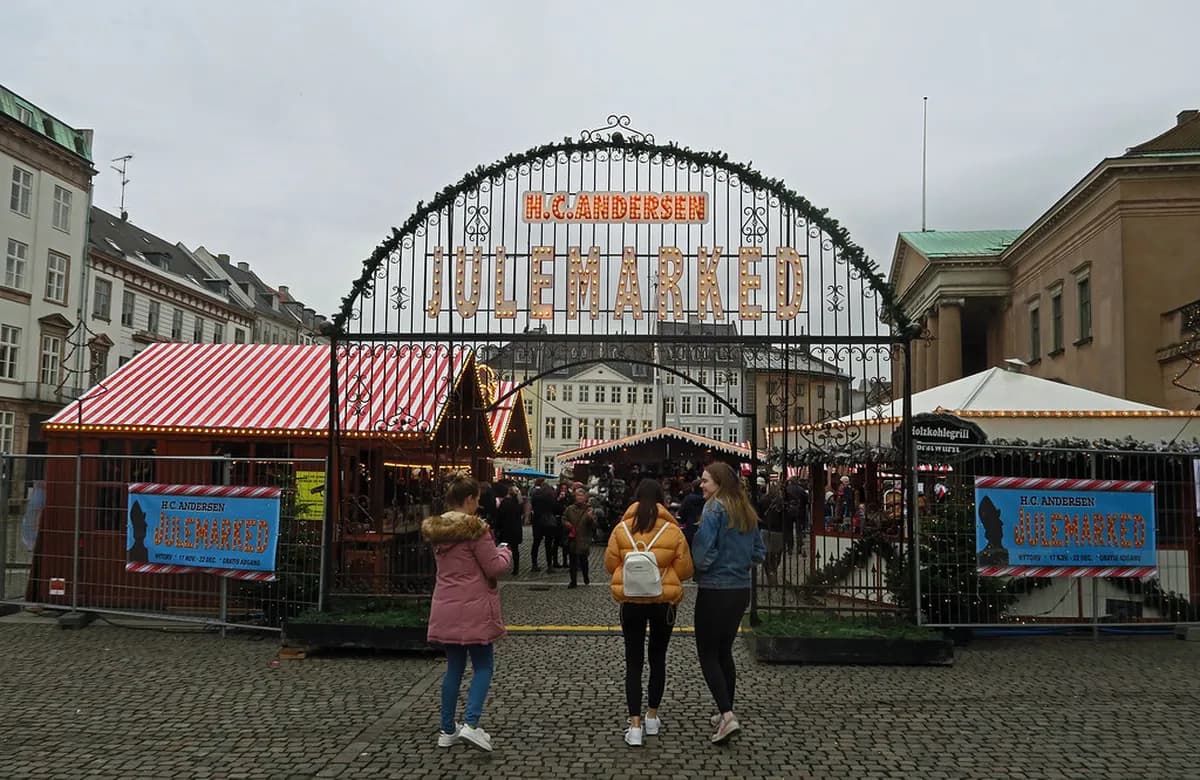
Named after Denmark's most famous author, this market spreads across two sides of a pedestrian area in the Strøget district at Nytorv. Each stall carries the name of one of Andersen's fairy tales — a charming detail that rewards slowing down to read the signs. The market runs from 14 November to 20 December, opening Monday to Thursday 11:00–19:00 and Friday to Saturday 11:00–21:00, with slightly shorter Sunday hours. It closes earlier than the others and does not run into late December, so plan accordingly.
The livelier half of the market has a large central Christmas tree with a light tunnel used as a photo prop, a small ice skating rink, a sizable bar playing festive music, and food stalls selling mulled wine, Irish coffees, potato twists, and pork sandwiches. The quieter half can feel sparse mid-week, but evening and weekend visits bring a full crowd. This is the best market in the city for families with small children who want to meet Santa: a Santa visit operates daily during the season.
At a five-minute walk from Højbro Plads and ten minutes from Nyhavn, the Hans Christian Andersen market slots naturally into a walking route that covers the central cluster of markets in a single afternoon. We suggest arriving here around 16:00 when the lights come on and the crowd builds but has not yet peaked.
The Floating Santa Lucia Kayak Parade
One of the most unique spectacles in Copenhagen is the Santa Lucia parade, which takes place on the water instead of the streets. On December 13th, hundreds of kayaks decorated with lights and greenery glide through the city's central canals. The paddlers sing traditional carols as they pass under the low stone bridges of the historic centre. We recommend finding a spot early, as the canal banks can get very crowded with spectators.
The parade usually begins around 17:00 when the sky is dark enough for the kayak lights to shine brightly. Nyhavn and the canals around Christianshavn offer the best vantage points for watching the procession. We suggest standing on the bridges to get a top-down view of the illuminated fleet as it passes by. This event is completely free to watch and provides some of the best photo opportunities of the season.
If you want to participate, some local kayak clubs offer rentals for experienced paddlers who want to join the fleet. The water is freezing at this time of year, so participants must wear appropriate dry suits and safety gear. Most visitors prefer to stay on land with a cup of hot gløgg to enjoy the music from a distance. It is a heartwarming community event that perfectly captures the spirit of a Copenhagen christmas market trip.
What to Eat and Drink at the Markets
Danish market food goes well beyond a generic hot chocolate. At every market you will find gløgg — a spiced mulled wine served warm, sometimes with a shot of aquavit if you ask — in a souvenir ceramic mug that typically costs 60–70 DKK (roughly €8 or $9). You keep the mug or return it for a 20 DKK deposit refund. Æbleskiver are the unmissable sweet: round, fluffy pancake puffs dusted with icing sugar and served with jam, sold at almost every stall for around 30–40 DKK for a portion of five.
Beyond the classics, look for these at specific markets. At Højbro Plads the bratwurst cooked over open coals is among the best in the city. At Tivoli the food hall offers sit-down meals and a wider range of seasonal dishes including flæskesteg (roast pork) and risalamande (cold rice pudding with cherry sauce, a traditional Danish Christmas dessert). Pebernødder — small spiced cookies — are sold by the bag and make good gifts. Rugbrød with smoked salmon or strong cheese appears at several stalls and provides a savory counterpoint to the sweet-heavy menu.
One practical note: most stalls now accept card payments, but a small amount of cash (200–300 DKK) is useful for the smallest vendors and for the gløgg mug deposit system at older-style stalls. Prices at the market food stalls are consistent; the main place to overpay is the sit-down restaurants along the Nyhavn waterfront, which we recommend skipping in favour of the stall food or a meal in the Latin Quarter.
Warm and Cosy vs. Chilly and Refreshing Experiences
Copenhagen in December is undeniably chilly, with temperatures often hovering just above freezing and occasional sleet or snow further into the month. We recommend balancing your time between the breezy outdoor stalls and the city's many heated indoor spaces. Many cafes provide wool blankets and outdoor heaters, but a proper indoor break is essential to maintain your energy across a full day of market-hopping. The Ny Carlsberg Glyptotek museum, directly next to Tivoli, has a lush heated winter garden — it offers free admission on Tuesdays and is one of the best warm escapes in the city centre.
The contrast between the cold air and a warm, candlelit interior is what the Danes call 'hyggelig.' Consider booking lunch at a basement restaurant in the Latin Quarter or Vesterbro; these neighbourhoods are within walking distance of the central markets and offer far better value than the tourist-facing canal restaurants. Skt. Peders Bageri, a few minutes from the Hans Christian Andersen market, is worth the queue for its cardamom buns — one of the city's best-known bakeries and a genuine local institution.
For what to wear: pack a heavy winter coat, thermal base layers, wool socks, waterproof boots, gloves, and a hat. Copenhagen is walkable — you may cover 15,000 steps on a full market day — so comfort matters more than style. The cobblestones on the streets around Nyhavn and Strøget can be icy in the evening, so grip-soled boots are preferable to fashion footwear.
How Many Days Do You Need to See Everything?
All five main city-centre markets — Tivoli, Nyhavn, Kongens Nytorv, Hans Christian Andersen, and Højbro Plads — can be visited in a single day. The two furthest apart (Tivoli and Nyhavn) are a 25–30 minute walk, and every other market falls on the route between them. Allocate one to two hours at Tivoli and 30–45 minutes at each of the others; with an early 11:00 start you can finish the circuit by mid-evening. If you have only one full day, this is the itinerary.
Four days is the sweet spot for a fuller experience. Day one handles the central market circuit. Day two can include the Christiania market in Freetown Christiania (reached on foot from Christianshavn metro, open mid-December only), a canal tour, and evening dining in Vesterbro. Day three is ideal for the Kronborg Castle market in Helsingør — a 45-minute train from Central Station — or the Bakken market in the deer park at Klampenborg, about 20 minutes on the S-train. Day four allows for museum visits, Danish design shopping on Strøget, and a final evening at Tivoli. Check Copenhagen christmas market dates before finalising any day trip plans, as Kronborg's market runs only during the first two weekends of December.
For those planning a wider Nordic tour, Copenhagen is a natural first stop before heading north. The train to Gothenburg takes under four hours, and connections to Stockholm or Oslo are straightforward by overnight rail. We cover what that looks like in our guide to the Gothenburg christmas market and the Stockholm christmas market — each city has distinct market traditions that complement the Danish approach.
Are the Copenhagen Christmas Markets Crowded?
Copenhagen's markets are popular but manageable compared to the major German Christmas markets. The city's compactness means crowds spread naturally across several squares rather than funnelling into one central point. Weekends are the busiest times — Saturday afternoons at Tivoli and Nyhavn attract families and day-trippers in large numbers. Visiting on a Tuesday or Wednesday before 16:00 gives you the same market experience with considerably more room to move.
If you must visit on a weekend, arrive at Tivoli when the gates open at 11:00. The late-afternoon to early-evening window between 16:00 and 18:00 is consistently the busiest period across all markets, as locals finish work and tourists head out for the evening. Tivoli in particular fills quickly on Friday nights when special events run. We suggest checking the Tivoli Gardens Official Tickets page for any scheduled fireworks or concerts that coincide with your visit.
Late November is the ideal time to visit: all markets are open, the city is decorated, but the crowds have not yet built to their December peak. The week before Christmas is among the busiest of the year as last-minute shoppers arrive. The first two weeks of December strike the best balance of festive atmosphere and manageable crowds. If you are sensitive to noise and tight spaces, the Højbro Plads and Hans Christian Andersen markets are consistently calmer than Nyhavn and Tivoli at equivalent times of day.
Frequently Asked Questions
Is the Copenhagen Christmas market worth it?
Yes, Copenhagen offers a unique 'hygge' atmosphere that is different from the larger German markets. The combination of historic harbor settings and the magical Tivoli Gardens makes it a top winter destination. We recommend it for anyone seeking a cozy and aesthetically pleasing holiday experience.
What date are Copenhagen Christmas markets?
Most markets open around November 15th and run through December 31st. Tivoli Gardens usually stays open until the first week of January. We suggest checking specific dates for smaller markets like Christiania, which only run for a few weeks.
Do you need tickets for Copenhagen Christmas markets?
Most street markets like Nyhavn and Højbro Plads are free to enter. However, Tivoli Gardens requires a paid entrance ticket starting at 155 DKK. Some specialized indoor markets at museums may also require a standard admission fee.
Visiting Copenhagen for more than one festival? See our complete guide to festivals and events in Copenhagen.
Copenhagen is a premier destination for those who want to experience a cozy, stylish, and traditional European Christmas. By balancing the major sights with local gems like the kayak parade, you can create a truly memorable winter itinerary. We hope this guide helps you navigate the markets and embrace the Danish spirit of hygge in 2026.
Don't forget to pack warm layers and a pair of comfortable walking shoes for the cobblestone streets. Whether you are sipping gløgg by the canal or riding the wooden coaster at Tivoli, the city's festive charm is sure to impress. Safe travels and enjoy the magical atmosphere of the Danish capital this holiday season.
Free guide: Europe's Festival Calendar
A month-by-month map of Europe's unmissable festivals — with the best dates to visit each and a local tip you won't find in the guidebooks.
You might also like


Continue reading
More guides you'll find useful


