
Nuremberg Christmas Market Dates: 8 Essential Planning Tips
Plan your trip with confirmed Nuremberg Christmas Market dates for 2026-2027. Includes opening hours, location maps, food guides, and transit tips.
On this page
Nuremberg Christmas Market Dates: 8 Essential Planning Tips
Planning your trip around the Nuremberg Christmas market dates is essential for a smooth Bavarian winter holiday. The best time to visit is during the first two weeks of December for smaller crowds. Late November and early December serve as the ideal shoulder window before the peak holiday rush. Last updated March 2026 to ensure the most accurate planning data for your upcoming journey.
Nuremberg hosts one of the oldest and most famous holiday events in the world. The city transforms into a festive wonderland with over 180 traditional wooden stalls. You will find unique handmade crafts and world-renowned culinary treats throughout the Old Town. This guide covers everything from confirmed dates to the best ways to navigate the crowds.
Free guide: Europe's Festival Calendar
A month-by-month map of Europe's unmissable festivals — with the best dates to visit each and a local tip you won't find in the guidebooks.
Confirmed Nuremberg Christmas Market Dates (2024-2026)
The market traditionally begins on the Friday before the first Sunday of Advent each year. For 2024, the festivities ran from November 29 through December 24 with a grand opening ceremony at 5:30 p.m. In 2025, the market opened on November 28 and concluded on Christmas Eve. The 2026 dates are confirmed: November 27 to December 24, 2026.
Standard daily hours are 10:00 a.m. to 9:00 p.m. Monday through Sunday, according to the Official Christkindlesmarkt Opening Hours. Christmas Eve is a shorter day, open from 10:00 a.m. to 2:00 p.m. only. The market closes early to allow vendors to travel home for the holiday. Note that the Original Regional Market and the Sister Cities Market both close a day earlier, on December 23.
Most visitors find that weekdays offer a much more relaxed atmosphere than busy Saturdays. Plan to arrive by 10:00 a.m. to browse the stalls before the lunch rush begins. Evening visits are beautiful for the lights but expect heavy foot traffic after 5:00 p.m. Hotel rates spike significantly during the second and third weekends, so mid-week bookings often cost 30–40% less.
The Ceremonial Opening and Christkind Prologue
The Nuremberg Christkindlesmarkt officially opens each year with a ceremony at the Hauptmarkt at 5:30 p.m. on the first day. The centerpiece of that ceremony is the Christkind Prologue, spoken by a local young woman dressed as an angel-like figure rooted in the Protestant Reformation. Martin Luther introduced the Christkind as a replacement for Saint Nicholas in the 16th century, and the tradition has survived intact in Nuremberg ever since.
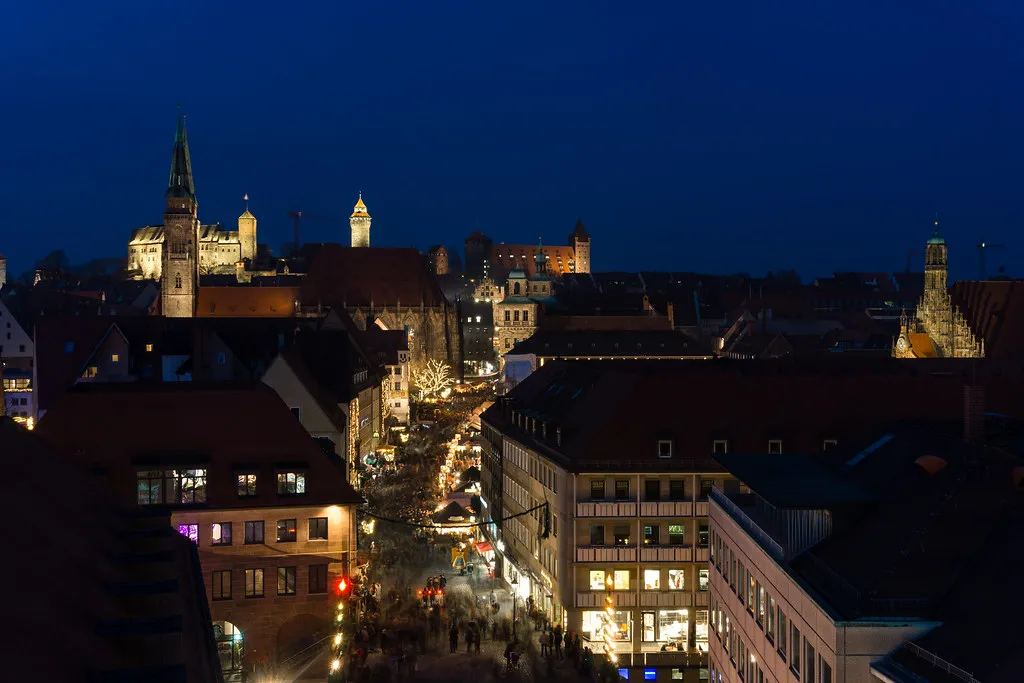
The Christkind is elected every two years from local women aged 16 to 19. She serves as the public face of the market for the full two-year term, appearing at the opening ceremony and special events throughout the season. If your 2026 visit coincides with her final season, you will witness one of the most anticipated transitions in German festive culture. The prologue itself is delivered from the balcony of the Frauenkirche overlooking the packed Hauptmarkt square.
Arriving early for the opening ceremony is worth the effort. The square fills quickly, and a spot near the fountain gives you a clear sightline to the balcony. Check the Nuremberg Tourism Official Site closer to the date for the exact 2026 program schedule. The ceremony is broadcast on local screens if the square is full when you arrive.
Major Nuremberg Christmas Market Locations
The main event takes place at the Hauptmarkt, the historic central square in front of the Frauenkirche. This area is home to over 180 red-and-white striped stalls selling handcrafted gifts, Lebkuchen, and seasonal drinks. Look for the Schöner Brunnen fountain at the edge of the square: local legend holds that rotating the golden brass ring clockwise grants a wish. It is a small ritual that takes ten seconds and costs nothing.
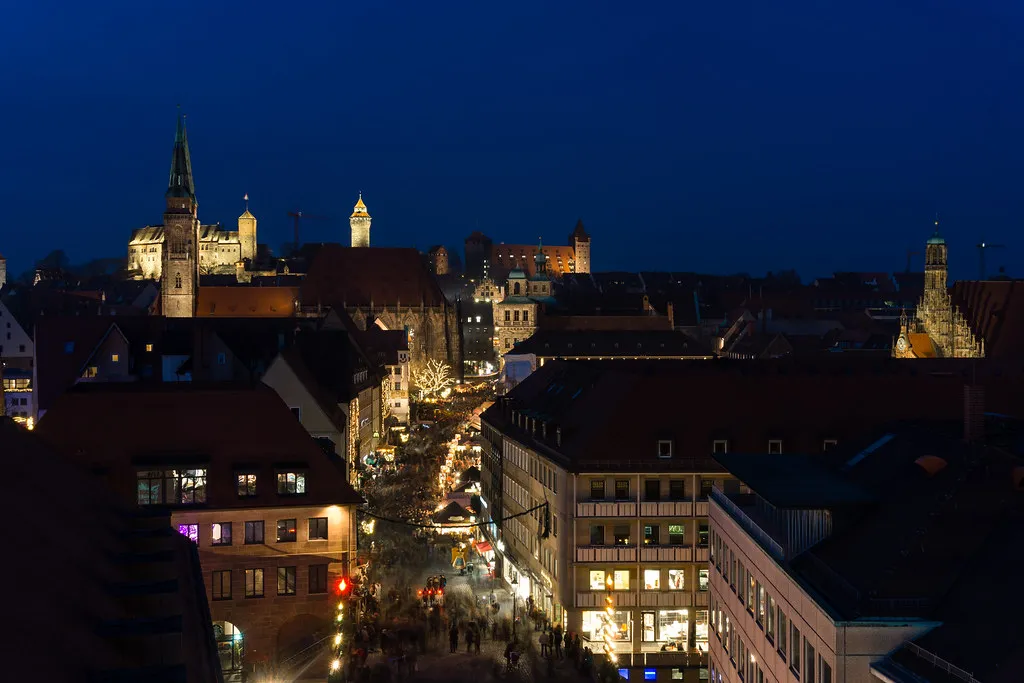
Just a short walk away, the Hans-Sachs-Platz hosts the Kinderweihnacht or Children's Christmas Market. This section features a nostalgic carousel, a mini Ferris wheel, a steam train, and hands-on cookie-baking and candle-making booths for kids. The Children's Market stays open until December 30, a full week longer than the other markets, making it the only option if you visit in the final days of the month.
The Markt der Partnerstädte at Rathausplatz, also called the Sister Cities Market, is one of the most underrated stops in the entire Nuremberg market circuit. Nuremberg's sister cities each operate their own booth — expect mulled wine with African spices from the Aného (Togo) stall, Nicaraguan coffee, Venetian masks, and ceramics from Nablus, Palestine. It draws on Nuremberg's medieval history as a long-distance trade hub, revived as a post-war initiative to rebuild international ties.
Do not miss the Feuerzangenbowle Village located below the Fleischbrücke bridge, right next to the Hauptmarkt 1 street. It features a punch bowl 2.5 metres wide and 3.4 metres tall that holds 9,000 liters of rum-soaked mulled wine. Heating that volume to the correct serving temperature takes a full 48 hours. The surrounding huts serve food and drinks, and this area often stays open later than the main Hauptmarkt stalls. You can read more about the Nuremberg Christmas market layout to plan your walking route efficiently.
Iconic Foods and Drinks to Try
Nuremberg is famous for its small bratwurst, which must be under 9 cm long, weigh no more than 25 grams, and be made within the city limits to carry the official designation. Order the "Drei im Weggla" to receive three sausages served in a crusty hard roll for around €4.00–5.00. Peter Lößel's booth at the market serves a version based on a recipe said to be over 700 years old. The aroma of grilled marjoram-spiced meat fills the air throughout the historic center.
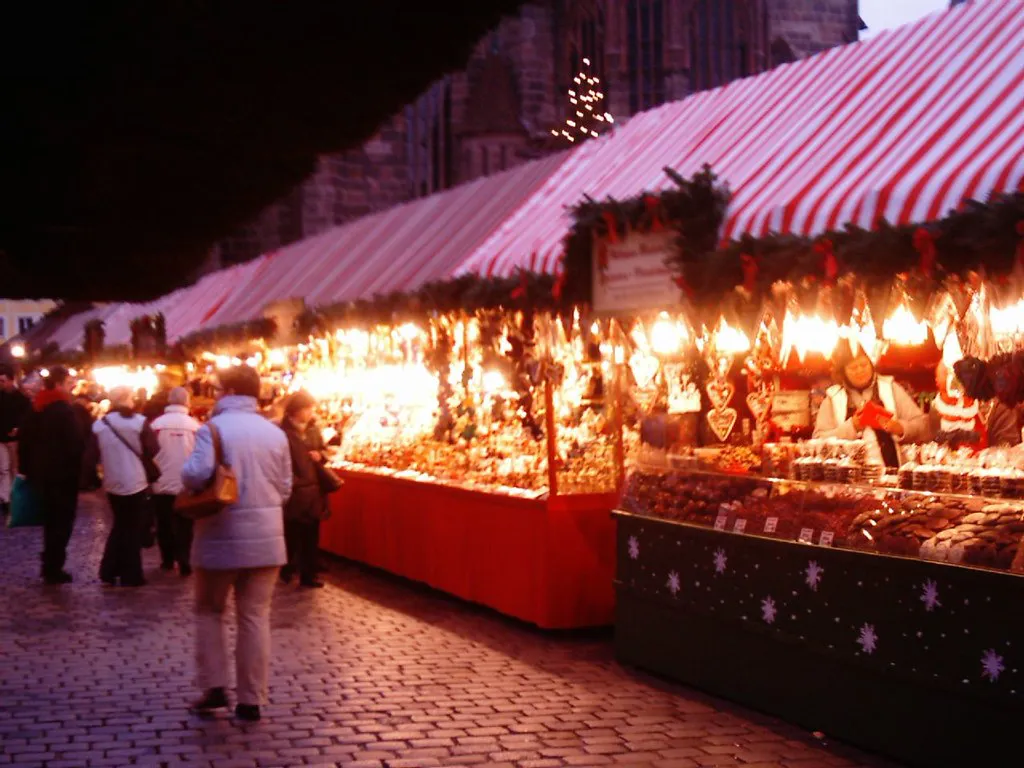
Gingerbread, or Lebkuchen, has been baked in Nuremberg since the 13th century. The Elisenlebkuchen is the premium variety, containing at least 25% nuts and less than 10% wheat flour — some local bakeries push nut content to 40%. Look for the "Original Nürnberger Lebkuchen" seal to confirm authenticity. Wolfgang Woitinek's booth and Wicklein, the oldest gingerbread bakery in town, are the most reliable sources.
Mulled wine is served in collectible ceramic mugs that change design every single year. You pay a "Pfand" deposit of €2–3 when you first order your drink; return the mug to get your money back, or keep it as a cheap souvenir. Try the Heidelbeere Glühwein — a version made with Italian wines and blueberry spicing — for a sweeter, fruitier alternative to the standard red. A mug of regular Glühwein starts at around €4; a version "mit Schuss" (with a shot of amaretto or rum) runs about €6.
For beer drinkers, the WinterWärmer brewed by Hausbrauerei Altstadthof is worth tracking down. It is Germany's first fully ecological brewery and their winter spiced beer is served with an orange wedge. If you want something non-alcoholic, the fresh-pressed apple cider available at the Original Regional Market stalls is a solid alternative.
Traditional Souvenirs and What to Buy
The Zwetschgenmännle, or Prune Men, are the most distinctively Nuremberg souvenir you will find at the market. These whimsical figures are handmade from dried prunes, nuts, and wire, shaped into chimney sweeps, musicians, and seasonal characters. The craft dates to the 18th century and is classified as Franconian folk art. Julian Scheller's booth, run by a fifth-generation artisan, is the best source for authentic examples.
Rauschgoldengel, the delicate gold foil angels made from thin brass foil, are the other Nuremberg-specific collectible. They appear in windows and on Christmas trees throughout the city and function as an unofficial symbol of the market. Glass baubles, wooden nutcrackers, and handmade straw stars are standard market fare across Germany — Nuremberg's version at the Christkindlesmarkt tends toward higher craft quality than generic tourist markets.
The annual Glühwein mug is arguably the most practical souvenir. Because the design changes every year, returning visitors often collect them over multiple trips. If you want one without paying for the drink, ask a stall vendor if they will sell an unused clean mug directly — some will, especially early in the season when stock is high.
For something more premium, Käthe Wohlfahrt operates a store in Nuremberg with an extensive selection of handcrafted German Christmas ornaments. It is on the pricier side, but the quality is consistent. Their flagship store in Rothenburg ob der Tauber, about an hour from Nuremberg, also has a full Christmas Museum — worth combining into a day trip if you have the time. You can find a wider range of locally produced goods at the Original Regional Market near St. Sebaldus Church.
Transport: How to Get to and Around Nuremberg
Nuremberg Airport (NUE) sits just north of the city. The U-Bahn Line U2 connects the airport directly to the Hauptbahnhof in 12 to 15 minutes, running every 10 minutes. A single ticket costs approximately €3.40 and can be purchased at station kiosks or via the VGN app. This is the quickest and cheapest airport transfer in Nuremberg.
If you fly into a larger international hub, high-speed ICE trains make the onward connection straightforward. From Munich (160 km), journey time is 1 to 1 hour 15 minutes. From Frankfurt (220 km), allow 2 to 2.5 hours. From Berlin, the ICE runs about 3 hours. Book train tickets at least three weeks in advance during the Christmas market season — prices can more than double as December approaches, and trains sell out on Friday and Sunday evenings. Check our guide to best Christmas markets in Germany for multi-city routing options.
Once inside the city walls, the historic center is compact and mostly pedestrianized during the market season. The Hauptmarkt, Hans-Sachs-Platz, Rathausplatz, and the Feuerzangenbowle Village are all within a 10-minute walk of each other. If you need to travel further, the tram and bus network is reliable. Staying within the Old Town or within a 15-minute walk of the Hauptbahnhof keeps logistics simple. Consult a guide on where to stay in Nuremberg to remain within walking distance of all five market areas.
Expert Tips for Avoiding the Crowds
Weekend evenings from 5:00 p.m. onward are consistently the most congested period at all Nuremberg Christmas markets. The combination of commuters arriving after work and the market's beautiful evening lighting draws the largest volumes on Friday and Saturday nights. Arriving before noon on any day of the week gives you access to the stalls without shoulder-to-shoulder foot traffic.
The early days of the season — the final days of November and the very first days of December — offer a noticeably quieter experience compared to mid-December. Hotel rates are also lower in that window. The trade-off is that a small number of stalls may not be fully operational in the opening days. By the second week of December, everything is running at full capacity but so are the crowds.
For the Feuerzangenbowle Village specifically, lunchtime on a weekday is the best slot to visit with a proper view of the giant bowl. By early evening it fills with standing groups. The Children's Market at Hans-Sachs-Platz is least crowded on weekday mornings; free merry-go-round rides for children are available on special designated days, so check the season program before you go.
- Arrive before noon to browse stalls without peak-hour crowds
- Book mid-week stays in late November for the lowest hotel rates
- Visit the Sister Cities Market on a weekday — it is consistently quieter than the Hauptmarkt
- Check the season program for the Christkind's personal appearance days, which draw extra visitors
Maximizing Your Visit with the NÜRNBERG CARD
The NÜRNBERG CARD + FÜRTH gives unlimited use of all public transit (U-Bahn, tram, bus) in Nuremberg and the neighboring city of Fürth, plus free or discounted entry to around 30 museums and attractions. It is available as a 48-hour or longer pass and can be purchased at the tourist information office near the Hauptbahnhof or at major hotels.
For Christmas market visitors whose primary goal is the markets themselves, the card's transit value is the main draw. If you are arriving by U-Bahn from the airport and plan to use the tram to reach the Germanisches Nationalmuseum, the Memorium Nuremberg Trials (a short U-Bahn ride to the Palace of Justice), or the Imperial Castle, the card pays for itself within one to two days of sightseeing. If you are staying in the Old Town and plan to walk everywhere, the museum discounts are the deciding factor.
The NÜRNBERG CARD is less compelling if you are on a pure market-focused trip of just one day. A single-trip U-Bahn ticket from the airport plus a day ticket for the transit system will likely cost less than the card for a short stay. Do the math based on how many museum entries you genuinely plan to use — the official tourism site lists every included attraction so you can check before you buy.
Frequently Asked Questions
Is the Nuremberg Christmas Market worth visiting?
Yes, it is widely considered one of the most authentic and traditional markets in Europe. The medieval setting and unique local foods like Lebkuchen create a truly special holiday atmosphere. It is a bucket-list destination for any Christmas enthusiast.
How long does the Nuremberg Christmas Market last?
The market typically lasts about four weeks, starting in late November and ending on December 24. This provides plenty of time to experience the festivities. Most visitors find that two full days are sufficient to see everything.
Is there more than one Christmas market in Nuremberg?
Nuremberg features several distinct market areas within the Old Town. These include the main Christkindlesmarkt, the Children's Market, and the international Sister Cities Market. Each offers a unique theme and different types of goods.
Nuremberg offers a timeless holiday experience that remains unmatched by most other European cities. By planning around the Nuremberg Christmas market dates, you ensure a stress-free and magical visit. Remember to book your accommodation early and pack plenty of warm layers for the Bavarian winter. Whether you come for the history or the bratwurst, this festive tradition will not disappoint.
The combination of medieval architecture and twinkling lights creates a unique atmosphere every December. Take time to explore the smaller side markets like the Rothenburg ob der Tauber market nearby. Enjoy your journey through one of Germany's most cherished cultural events this winter season. Safe travels as you discover the heart of Christmas in the historic streets of Nuremberg.
Free guide: Europe's Festival Calendar
A month-by-month map of Europe's unmissable festivals — with the best dates to visit each and a local tip you won't find in the guidebooks.
You might also like

Continue reading
More guides you'll find useful


