Cologne Carnival Dates Travel Guide
Cologne Carnival 2026 runs February 12 to 18, peaking with the Rosenmontag parade on the 16th. Get the day-by-day schedule, route, and the Kolle Alaaf rule.
On this page
Cologne Carnival Dates
Planning around the Cologne carnival dates is the first step toward experiencing Germany's most vibrant street party. Locals call this festive time the Fifth Season because it transforms the entire city for months. You will find millions of people dressed in colorful costumes dancing through the historic streets. This guide provides the essential schedule and tips to ensure your visit is absolutely unforgettable.
Part of our Best Carnivals In Europe series.
Free guide: Europe's Festival Calendar
A month-by-month map of Europe's unmissable festivals — with the best dates to visit each and a local tip you won't find in the guidebooks.
Cologne Carnival 2026 Schedule and Main Events
The Cologne Carnival 2026 runs from Thursday 12 February to Wednesday 18 February. The season technically opens on November 11 at exactly 11:11 AM every year, but the Straßenkarneval — the street carnival locals call the Crazy Days — is what draws over a million visitors to the city. Each of the six days carries its own distinct character and events.
Weiberfastnacht on Thursday 12 February is the official street opener. At 11:11 AM the opening ceremony takes place at Alter Markt, where Mayor Torsten Burmester hands the symbolic keys of the city to the Dreigestirn — Prince Niklas I, Peasant Clemens, and Virgin Aenne from Prinzen-Garde Köln 1906 e.V. Women traditionally run through the streets cutting off men's ties, a tradition born from a washerwomen's protest in Bonn's Beuel district in 1824. The Altstadt and Südstadt districts stay lively from early morning until past midnight.
Carnival Friday (13 February) sees the Sternmarsch, where neighbourhood associations converge from Heumarkt, Bollwerk, Laurenzplatz, and Eisenmarkt toward Alter Markt with sparklers. The stage program begins at 18:00 with the Dreigestirn in attendance. Carnival Saturday (14 February) centres on the Funkenbiwak at Neumarkt from 10:30 — organised by the Kölsche Funke rut-wieß vun 1823 e.V., the oldest carnival group in the city. Buy a Funkenstange and you get free Kölsch refills at the beer stands for the day.
Tulip Sunday (15 February) brings the Schull- un Veedelszöch, a school and neighbourhood parade of 8,000-plus participants watched by 250,000 spectators along almost the same route as Rose Monday. Rosenmontag on 16 February is the climax — Germany's largest carnival parade, starting from Chlodwigplatz at 10:00. On Veilchendienstag (17 February) the season winds down with the major neighbourhood parades and the Nubbelverbrennung at midnight. Ash Wednesday on 18 February closes the carnival and returns Cologne to normal life.
Events during Carnival ( Fasching )
The street carnival always starts on a Thursday with Weiberfastnacht. Women traditionally take control of the city and snip off men's ties. It is the official opening of the outdoor festivities at Alter Markt. Check the Cologne Tourism Karneval site for precise 2026 start times.
Rosenmontag is the absolute peak of the week with the largest parade. Millions of spectators line the route to see the floats. Over 300 tons of candy and flowers are thrown to the crowds. The parade lasts around 3.5 hours and features more than 11,500 participants.
- Weiberfastnacht (Women's Carnival Day): Thursday 12 February 2026, opening ceremony 11:11 AM at Alter Markt. Street parties and Dreigestirn appearances throughout the day.
- Sternmarsch (Star March): Friday 13 February 2026, groups converge on Alter Markt from 18:00 with stage program. Family-friendly highlight of Friday.
- Funkenbiwak: Saturday 14 February 2026, 10:30 AM at Neumarkt. Free Kölsch refills with a Funkenstange. Traditional Stippeföttche dance performed.
- Schull- un Veedelszöch (School and Neighbourhood Parade): Sunday 15 February 2026. Over 8,000 participants, 250,000 spectators. Best groups earn a spot in the Rosenmontag parade.
- Rosenmontag (Rose Monday Parade): Monday 16 February 2026, departs Chlodwigplatz 10:00 AM. 11,500 participants, 300+ tonnes of sweets and 300,000 flower bouquets thrown along the 8.5 km route.
- Veilchendienstag (Violet Tuesday): Tuesday 17 February 2026. Major neighbourhood parades from 13:00. Nubbelverbrennung (straw-effigy burning) begins around midnight at Agneskirche, Nippes, Südstadt, and Altstadt.
Rosenmontagszug Route and Viewing Tips
The 2026 Rosenmontagszug starts at Severinstraße and winds through Löwengasse, Weberstraße, Mathiasstraße, Mühlenbach, Hohe Pforte, Hohe Straße, Schildergasse, Neumarkt, Apostelnstraße, Rudolfplatz, Hohenzollernring, Friesenplatz, Zeughausstraße, Breite Straße, Glockengasse, Heumarkt, Alter Markt, Kardinal-Höffner-Platz, and Bahnhofsvorplatz before ending at Gregorius-Maurus-Straße. The route is 8.5 kilometres and the whole procession takes about 3.5 hours.
For free standing spots, the best positions are at the Südstadt entrance near Chlodwigplatz, around Neumarkt, and near the cathedral. Arriving two hours before the 10:00 AM start is not excessive — grandstand seats sell out months in advance via the Festkomitee Kölner Karneval. The disabled viewing stand at Hohenzollernring requires a prior application through the LVR. WDR television stands at Severinskirchplatz offer an excellent unobstructed sightline.
One practical tip almost no one mentions: bring an open umbrella or a small net bag held above your head to catch Kamelle (sweets) and Strüßjer (flower bouquets) as they are thrown from the floats. The shout that gets you more candy is just two words — "Kamelle!" for sweets, "Strüßjer!" for flowers. Many spectators collect carrier bags full of chocolate throughout the parade. Street closures along the route begin from early morning, so public transport is the only sensible way to arrive.
Neighborhood Parades: The Veedelszüge Experience
Beyond the main processions, Cologne's neighborhood parades — the Veedelszüge — offer a more intimate and arguably more authentic experience of the Cologne Carnival season. These parades are organised voluntarily by local associations, schools, and kindergartens. The crowds are smaller, the candy is still thrown, and children have a much better chance of catching something at the barriers.
The biggest Veedelszüge happen on Tuesday 17 February 2026. Südstadt Veedelszoch departs from Wormser Straße at 13:00 and passes through Vringsveedel and Severinstraße — one of the city's largest neighbourhood parades. The Nippes and Weidenpesch Veedelszoch starts from Rennbahnstraße at 13:00 and draws up to 200,000 spectators; the Nippeser Bürgerwehr 1903 e.V. has run this parade since 1914. The Ehrenfeld Veedelszoch leaves Lenauplatz at 13:45 with up to 5,000 participants and tends toward more alternative and artistic costumes. Sülz Veedelszoch begins from Gerolsteiner Straße at 13:00 and winds through Sülz, Klettenberg, and Lindenthal.
Saturday 14 February also has smaller district parades in Riehl, Raderthal, and Wahn. The Raderthal parade is nicknamed Cologne's smallest carnival parade — a genuinely local affair with just a few dozen floats. Families with young children often prefer these outer-district parades because they are less crowded, easier to navigate with a pushchair, and still deliver the full costumed, candy-throwing spectacle of the Rosenmontag parade in miniature.
Geisterzug: Cologne's Alternative Carnival Parade
The Geisterzug, or Ghost Parade, takes place on Saturday evening 7 February 2026 — one week before the official street carnival begins. It is the 35th-anniversary edition, born in 1991 as a political reaction when the Rosenmontagszug was cancelled due to the Gulf War. Organised by Ähzebär un Ko e.V., the parade has no fixed route; each year it highlights a different neighbourhood concern. In 2026 the theme is "Allerhühste Zick för en andere Wunnungspolitik" — High time for a different housing policy — and the route passes through Cologne-Nippes from Johannes-Giesberts-Park in Clouth-Quartier toward Hornstraße in Neuehrenfeld.
The rules here differ sharply from every other carnival event. No Kamelle or Strüßjer are thrown. Vehicles and electric music are banned; only drums and samba groups provide the rhythm. Anyone can join the march spontaneously without registration. Costumes lean toward darker themes — ghosts, vampires, zombies, skeletons, witches. After the parade, a 35th-anniversary party at the outdoor venue Odonien charges a 5 EUR entrance fee. The Geisterzug attracts a diverse crowd of locals who want political satire and street-art energy rather than the mainstream carnival spectacle.
The atmosphere feels more mysterious and rebellious than the main Rosenmontag event. There is no candy thrown during this parade. It ends with a large party in a local venue. Loud drums and torches create a haunting rhythm for the marchers that is unlike anything else in the carnival calendar.
Carnival – known as the 'fifth season'
The season officially begins on November 11th at exactly 11:11 AM. Small celebrations occur throughout the winter months in local pubs. Activity peaks during the six days of the street carnival in February. Consult the Cologne Carnival site for the specific seasonal countdown.
The Dreigestirn consists of the Prince, the Peasant, and the Maiden. These three figures represent the city and lead many official events. They are treated like celebrities and visit hundreds of parties each year. Seeing them in person is a highlight for many dedicated carnival fans.
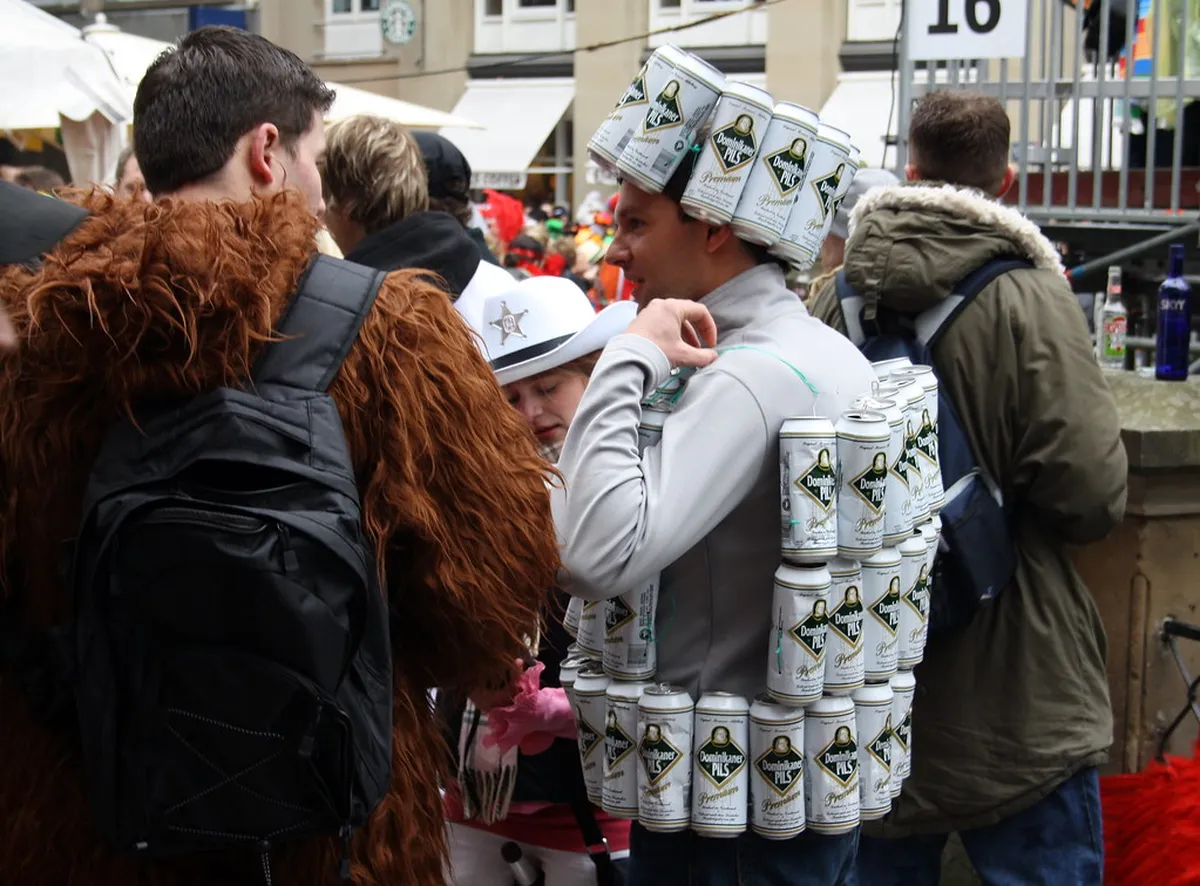
Life in Cologne slows down significantly during the peak festival days. Many businesses close so that employees can participate in the fun. The 2026 carnival motto is "ALAAF — Mer dun et för Kölle," which translates roughly as "Alaaf — We do it for Cologne." The city greeting during this time is Kölle Alaaf — derived from the medieval toast "Al ab," meaning Cologne above all — and you will hear it thousands of times throughout your visit.
A brief history of carnival in Germany
The roots of the festival date back to ancient Roman winter celebrations. Medieval citizens used the days before Lent to feast and enjoy life before the fasting season began. The name Carnival itself comes from the Latin "carne vale" — farewell to meat. You can find similar historical roots in the Basel Carnival guide for comparison.
In 1823, the establishment of a formal carnival committee transformed the celebrations into the organised event we know today. The same year, the Roten Funken — the oldest carnival association, still running the Funkenbiwak — was founded. Prussian authorities once tried to ban the celebrations due to their rowdiness. Locals responded by forming these organised societies to protect their traditions, and those societies still manage the modern festival and the major parades.
Today, the carnival is a symbol of the city's unique cultural identity. It brings together people from all walks of life for a shared experience. The tradition has survived wars and social changes over many centuries. Understanding the past makes the modern party feel much more meaningful.
Cologne Carnival Lingo You Need to Know
The single most important rule for first-timers: never say "Helau" in Cologne. That greeting belongs to Mainz and Düsseldorf, and locals notice. The correct chant is "Kölle Alaaf!" — shout it back whenever you hear it and you will fit in immediately. This is not a minor etiquette point; it is the clearest signal that you understand the culture.
A few more words that change how the parade feels. "Kamelle!" is the shout that gets you sweets from float participants. "Strüßjer!" gets you a flower bouquet. "Bützje" (or "Bützchen") means a small kiss on the cheek — a carnival greeting tradition between strangers, though consent still matters. The costumed partygoers are called "Jecken" (singular: Jeck). The local beer is Kölsch, always served in a slim 200 ml glass called a Stange, and the Köbe — the beer waiter — will keep refilling it until you cover your glass with a coaster.
Knowing these five words — Kölle Alaaf, Kamelle, Strüßjer, Bützje, and Jecken — gets you through most social moments at the carnival without the awkwardness of being an obvious outsider. No competitor guide bundles these into a single place, but locals consider them the bare minimum for any visitor planning to do more than watch from the sidelines.
Where to Stay in Cologne during Karneval
Hotel prices in Cologne can double or triple during the carnival week, and most properties near the city centre sell out months in advance. Book by September at the very latest for the best rates. The key decision is whether you want to be inside the party zone or slightly outside it.
Staying in the Altstadt (Old Town) puts you within walking distance of the parade route and every street party, but the entire neighbourhood becomes a round-the-clock party zone. Sleep before 03:00 is unlikely on Thursday, Friday, Saturday, and Monday nights. Eden Hotel Früh am Dom, Dorint Hotel am Heumarkt, and Hilton Cologne are in this zone. Luxury options include the Maritim Hotel Köln. The Südstadt neighbourhood, a short walk from the Schull- un Veedelszöch and Rosenmontagszug start point, offers a slightly more local atmosphere at the Mercure Hotel Severinshof Köln City.
For a quieter base with easy access, the Belgian Quarter (Belgisches Viertel) is a strong option — plenty of restaurants, walkable to the party zones, but a notch calmer overnight. Across the Rhine in Deutz, the Hyatt Regency Cologne provides a Rhine view and quick tram access. Budget travellers should look at a&o Köln Dom (100 metres from the cathedral) and Station — Hostel for Backpackers. Motel One Mediapark sits about 20 minutes' walk from the Altstadt and is well regarded for clean, affordable rooms during peak periods. Avoid driving: many streets along the Rosenmontagszug route are closed to traffic from early morning on parade days.
Practical Tips for Cologne Carnival
A costume is not optional if you want to feel part of the event rather than a spectator. February in Cologne is cold — average daytime temperatures hover between 2°C and 7°C with a real chance of rain. Layer warm clothing under your costume and wear waterproof boots. Comfortable shoes are non-negotiable because you will be standing and walking for most of the day.
Carry cash. Street food stalls — selling Reibekuchen (fried potato pancakes), Frikadelle (meatballs), and sausages — rarely take cards. A glass ban applies in the city centre; drink from plastic or tin containers. Large bags trigger security checks and slow you down. Public transport runs 24 hours during carnival days and is the only realistic way to reach the parade routes. Check the Crazy Days website for the latest street closure maps before each event day.
Bar cover fees of around 5 EUR are standard on Salzgasse and Mauthgasse — the two busiest pub strips in the Old Town — and these streets get loud and crowded after 21:00. For a more relaxed evening, neighbourhood bars a few streets back from the Old Town fill up with locals and have a friendlier atmosphere. Fischmarkt square is a good street-party spot with actual toilets nearby (about 1 EUR per visit, but worth it over the alternative). The Sitzungen at Lachende Kölnarena run for more than six hours and allow you to bring your own food and drink — an excellent budget move if you want a full carnival show indoors.
Frequently Asked Questions
What are the exact Cologne carnival dates for 2026?
The main street carnival for 2026 runs from February 12th to February 18th. Weiberfastnacht starts the party on Thursday, while the massive Rosenmontag parade happens on February 16th. You should also check the Venice Carnival dates if you plan a multi-city European festival tour.
Is the Cologne Carnival family-friendly for international visitors?
Yes, the carnival is very family-friendly, especially during the daytime parades. Neighborhood events called Veedelszüge offer a calmer experience for children. Parents should avoid the late-night bar scenes in the city center which can become very crowded and rowdy.
How long does the main Rosenmontag parade last?
The main parade typically lasts between three and four hours from start to finish. It covers a route of about 8.5 kilometers through the heart of the city. Spectators should arrive at least two hours early to secure a good viewing spot along the barriers.
Visiting Cologne for more than one festival? See our complete guide to festivals and events in Cologne.
Experiencing the Cologne carnival dates in person is a bucket-list event for many travelers. The combination of history, humor, and community spirit creates a unique atmosphere. By planning your dates and costumes early, you can join the locals in their favorite tradition. Get ready to shout Kölle Alaaf and enjoy the magic of the Fifth Season.
Free guide: Europe's Festival Calendar
A month-by-month map of Europe's unmissable festivals — with the best dates to visit each and a local tip you won't find in the guidebooks.
You might also like



Continue reading
More guides you'll find useful