Binche Carnival Guide: Belgium's UNESCO Celebration
Plan your Binche carnival guide visit with dates, Gille traditions, orange-throwing rules, and practical tips for Belgium's UNESCO street festival.
On this page
Binche Carnival Guide
Few carnivals in Europe feel as genuinely surreal as the Carnival of Binche in Belgium. Hundreds of identically masked men roam the streets of this small Wallonian town from before dawn, wearing wax faces, linen suits stuffed with hay, and bells that ring with every step. UNESCO added it to its list of Masterpieces of the Oral and Intangible Heritage of Humanity in 2003, recognising a tradition that has barely changed since the 14th century. This guide to the best carnivals in Europe shows how the Binche Carnival stands in a class of its own.
The three-day festival falls on the Sunday, Monday, and Tuesday before Ash Wednesday each year. In 2026, that means the Carnival of Binche runs from 15 to 17 February. Planning ahead is essential: hotels fill up fast and the streets of Binche become one of the most crowded places in Belgium on Shrove Tuesday. Read on for everything you need to know before you go.
Free guide: Europe's Festival Calendar
A month-by-month map of Europe's unmissable festivals — with the best dates to visit each and a local tip you won't find in the guidebooks.
What Makes the Binche Carnival Unique
The Carnival of Binche is one of the oldest surviving street carnivals on the continent. Its first written records date to the 14th century, and almost nothing about its costumes, music, or rituals has changed since. That living continuity is exactly why UNESCO honoured it in 2003 as an Intangible Cultural Heritage of Humanity. For visitors, it feels less like a staged performance and more like stepping inside a centuries-old tradition that the whole town takes seriously.
What separates Binche from other European carnivals is the sheer uniformity of its central characters. Unlike Venice or Nice, where costumes vary wildly, every Gille in Binche wears the same wax mask, the same hay-filled linen suit, and the same wooden clogs. That anonymous sameness gives the early-morning streets an eerie, dreamlike quality that no photograph fully captures. Belgium has always had a taste for surrealism, and the Binche Carnival is its most ancient expression.
The other distinguishing feature is the orange throwing on the final afternoon. Gilles carry baskets of oranges and toss them into the crowd as symbols of good fortune. Catching one is considered lucky, but throwing it back at a Gille is a serious social offence. Knowing this small rule before you arrive makes the whole experience feel far more rewarding.
The Gilles: Binche Carnival's Central Characters
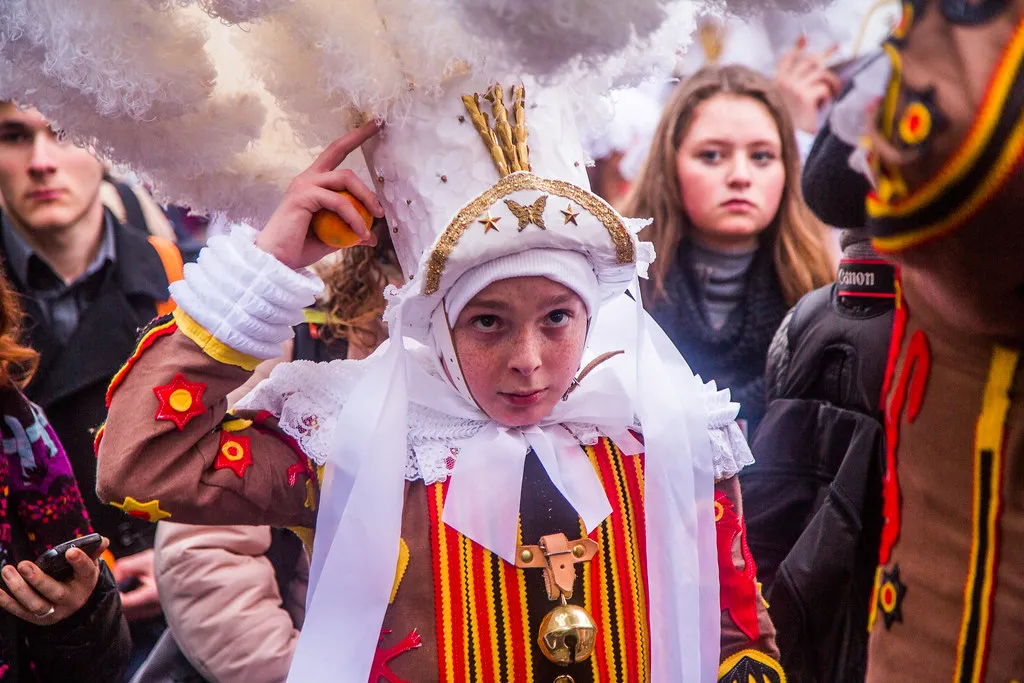
The Gilles are the undisputed stars of the Carnival of Binche. Every Gille is male, starting from as young as three years old, and participation is considered a lifelong commitment. Months before the festival, families prepare the elaborate costume together, stuffing the linen suit with hay to create the iconic hunched silhouette. The honour is taken so seriously that the ostrich-feathered hat alone can cost thousands of euros.
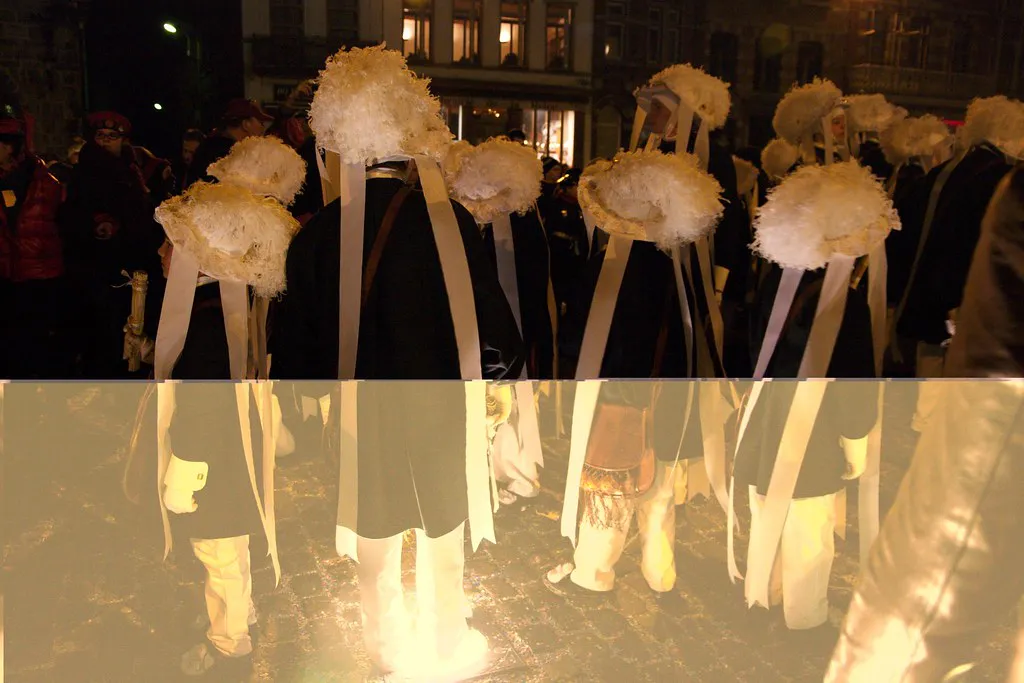
During the early morning of Shrove Tuesday, each Gille wears a wax mask depicting a pale face with round green glasses, sideburns, and a moustache in the style of Napoleon III. The mask is accompanied by a belt of bells called the apertintaille and a bundle of willow twigs meant to ward off evil spirits. Later in the afternoon, the mask comes off and is replaced by the spectacular white ostrich-feathered hat, standing 1.5 metres tall and weighing around 3 kg. That moment of transformation is one of the most dramatic sights in all of European carnival culture.
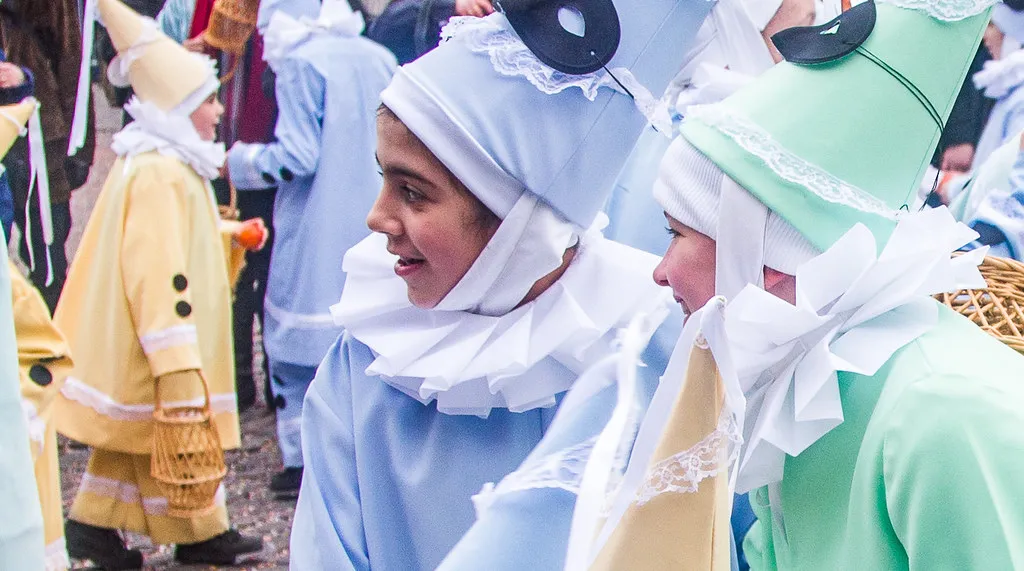
The Gilles do not perform alone. They are joined by Paysans and Paysannes, Harlequins, and Pierrots, each playing a distinct role in the procession. Paysannes, the female equivalent of a Gille, wear blue costumes and take on key organisational roles throughout the three days. Together, these four character types make up the societies that parade through Binche from Sunday to Tuesday.
- Gilles
- Costume: hay-stuffed linen suit in red, black, and yellow
- Mask: wax face with green glasses and moustache
- Hat: white ostrich plumes, 1.5m tall, ~3kg
- Access: male residents of Binche only, any age
- Paysannes
- Costume: blue dress without hay or mask
- Role: organisational support and accompaniment
- Gender: female participants only
- Pierrots and Harlequins
- Costumes: colourful suits in classic commedia dell'arte style
- Role: join processions on all three days
- Open to: both men and women of Binche
The Three Days of Carnaval de Binche
The Carnival of Binche spreads across three days, each with its own distinct character and schedule. Shrove Sunday is the most colourful and creative day, when all 13 societies parade through the streets in elaborate, secret costumes they have been working on for months. The outfits draw inspiration from current events, famous characters, and local themes, making this day a vivid snapshot of Belgian popular culture. The procession begins at 3 pm and is accompanied by violas and drums that echo through the medieval streets.
Shrove Monday takes on a gentler, more intimate atmosphere focused on the children of Binche. Youth organisations move from café to café in costume, and by mid-morning the confetti battles begin inside cafés and even inside the Church on Place Derbaix, which is transformed into a piano bar for the occasion. The day closes with red Bengal fires on the main square and fireworks lighting up the sky. It is a quieter, more local day that rewards visitors who want to experience the carnival away from the biggest crowds.
Shrove Tuesday is the climax of everything. The elaborate dressing ritual begins before dawn in each participating family home, with family members helping the Gille into his costume by lamplight. At 7 am, the societies gather for a breakfast of champagne and oysters — a tradition that even the youngest Gilles take part in. By 8:30 am, all the Gilles assemble at the Grand Place alongside the Paysans and Paysannes, Harlequins, and Pierrots, where the mayor formally receives them and presents medals.
The Grand Procession and Orange Throwing
At 3 pm on Shrove Tuesday, the grand procession begins and more than 1,000 Gilles take to the streets dancing to traditional tunes played on violas and drums. This is the moment when the wax masks come off and the towering ostrich-feathered hats emerge for the first time. The sight of over a thousand identically dressed figures in full feathered regalia moving through the medieval streets of Binche is something that stays with you long after the day ends. Those who arrive early enough to claim a good spot along the route will feel the drumbeat in their chest as the Gilles shuffle-dance past.
During the procession, the Gilles carry baskets of oranges and throw them into the crowd. An orange from a Gille is a token of good luck, and spectators scramble to catch them. The key rule to remember: never throw an orange back at a Gille — it is considered a deep insult. Spectators who receive oranges often end up tossing them playfully among themselves, which can result in some spirited — and occasionally window-threatening — exchanges.
The festival's final act is the rondeau, when the Gilles form a massive circle on the Grand Place and dance together as a collective. Fireworks then fill the sky above Binche at around 9 pm, officially closing the three-day celebration. Dancing and music continue in the streets and bars well into the early hours, and many visitors stay the night rather than attempt the journey home in the small hours. For anyone who has attended Cologne Carnival or other European winter festivals, the finale of Binche feels uniquely intimate and rooted in genuine local pride.
Why the Gille Costume Looks the Way It Does
The origins of the Gille costume have been debated for centuries, and no single explanation fully satisfies historians. The most widely accepted theory links the Gille's wax mask — with its Napoleon III-style moustache and round green glasses — to a mid-19th-century tradition of mocking authority figures through carnival anonymity. The Napoleon III moustache dates the mask's current form to the 1850s or 1860s, though some elements of the costume are almost certainly far older.
The wooden clogs serve a specific ritual purpose: the Gilles stamp the ground as they shuffle-dance through the streets, a gesture rooted in agrarian tradition meant to wake the earth and encourage a fertile growing season. The bundle of willow twigs carried in the left hand is equally symbolic, believed to ward off evil spirits as the Gilles move from house to house collecting fellow society members before dawn. These are not decorative props — each element of the costume carries meaning that the people of Binche take seriously even today.
The hay stuffed inside the linen suit creates the costume's distinctive silhouette: hunched at the back, puffed at the front. This is deliberate — it makes all Gilles look identical regardless of age or body size, reinforcing the anonymity that defines the early-morning streets of Binche. A cultural footnote: Hergé immortalised the Gille in Tintin and the Picaros, where Gille-inspired revellers conceal a plot to overthrow a fictional South American dictator, showing how recognisable the costume had become internationally by the 1970s.
What to Eat and Drink at the Binche Carnival
The Gilles get champagne and oysters. Spectators get the full range of Wallonian street food, and the combination of cold February air and warm carnival food is part of the experience. Temporary food stands cluster around the Grand Place and along the procession route from Sunday through Tuesday.
Belgian frites are the default fuel on all three days. Binche's fry stalls serve them with local sauces including the mayonnaise-forward andalouse and mustard-heavy samouraï. Gaufres de Liège — dense, chewy waffles studded with pearl sugar — are sold warm and eaten without toppings, very different from the tourist waffles sold in Brussels. If you spot a stall selling boulets à la liégeoise, the Wallonian meatball braised in brown beer and syrup, it is worth the stop.
Local bars around the Grand Place stay open from early morning through late Tuesday night, with temporary bars appearing on side streets for all three days. Mulled wine and hot chocolate from street stalls are the practical choice for spectators standing in the cold watching the 3 pm procession. Budget roughly €3–5 for street food and €3–4 per drink at outdoor stalls.
Practical Info: Getting There and Where to Stay
Binche is a small town in French-speaking Wallonia, located roughly 60 km south of Brussels and about 20 km east of Mons. Regular train services connect Binche to both cities, and extra trains are added during the carnival period to handle the surge in visitors. Driving is possible but challenging: parking fills up early, so plan to arrive well before 7 am on Mardi Gras if you come by car. Taking the train from Brussels or Mons and walking into town is the most stress-free approach for first-time visitors.
Accommodation in and around Binche is extremely limited and books out months in advance for the carnival weekend. Most experienced visitors base themselves in Mons or Charleroi, where the hotel supply is larger, and commute in on the day. If you want to stay in Binche itself, search for rooms no later than autumn of the previous year. Check the official Carnival of Binche website for any updates to the programme, transport timetables, or changes due to weather.
One thing all visitors should keep in mind: the ostrich-feathered hats worn by the Gilles are extremely valuable and fragile. If rain is forecast, the procession timings or outdoor elements may be adjusted to protect them. Always confirm the day's schedule through the official site before heading out. Weather in Belgium in mid-February can be cold and damp, so dress in warm, waterproof layers.
First-Timer Tips for the Binche Carnival
Arriving before 7 am on Shrove Tuesday gives you the best chance of seeing the societies assemble and the champagne breakfast in the streets. The early-morning hours, when masked Gilles shuffle through dark lanes to the sound of solo drummers, are considered the most atmospheric part of the entire festival. Most guides and travel articles focus only on the 3 pm procession, so arriving early is the one move that genuinely separates your experience from the average visitor's. Bring a flask of hot coffee — February mornings in Wallonia are cold.
Wear clothes you do not mind getting covered in confetti and, on Shrove Tuesday, in orange juice if a toss goes wide. Old shoes are also a good idea, since the streets get slippery with fallen orange peel by late afternoon. Position yourself along the main procession route rather than in the Grand Place itself, where the crowd can become very dense after midday. Side streets give better views of the Gilles at close range as they dance past.
If you cannot attend the carnival itself, the International Carnival and Mask Museum in Binche is open year-round and houses hundreds of costumes and masks from carnivals across the globe. It provides excellent context for the Gille costume and its symbolism, and the Binche collection is among the most detailed anywhere. Combining a museum visit with a quiet walk along the 14th-century ramparts that still encircle the town centre makes for a rewarding half-day even outside carnival season. Plan to add the most beautiful carnivals in Europe to your shortlist to decide which festival to attend next.
- Arrive early on Shrove Tuesday
- When: before 7am for the pre-dawn assembly
- Why: the masked street scenes are the most atmospheric moment
- Tip: dress warmly for sub-zero February mornings
- Follow the orange etiquette
- Do: accept oranges with a smile
- Do not: throw an orange back at a Gille
- Why: returning an orange is considered a serious insult
- Book accommodation months ahead
- Best base: Mons or Charleroi if Binche hotels are full
- Transport: extra trains run from both cities during carnival
- Book by: autumn of the year before for Binche itself
- Check the official site for schedule changes
- Risk: rain can delay or adjust outdoor elements
- Resource: carnavaldebinche.be for live updates
- Hat risk: ostrich-feathered hats are priceless and weather-sensitive
- Visit the Mask Museum if you miss the carnival
- Location: Binche town centre, open year-round
- Collection: costumes and masks from global carnivals
- Bonus: combine with a walk along the medieval ramparts
Frequently Asked Questions
When is Carnaval Binche 2026?
The Carnival of Binche 2026 runs from 15 to 17 February, covering Shrove Sunday, Shrove Monday, and Mardi Gras. The main procession and orange throwing take place on Tuesday 17 February from 3 pm. Save the date to your calendar well in advance, as hotels and trains fill up quickly.
Is the Binche Carnival worth attending for first-time visitors?
Absolutely. The Binche Carnival is a UNESCO-recognised event with a 700-year history that no other European festival replicates. The early-morning masked streets and the afternoon procession of over 1,000 Gilles in ostrich-feathered hats are unlike anything you will see elsewhere. Arrive early on Shrove Tuesday for the full experience.
What should I know about the orange throwing at Binche Carnival?
Gilles throw oranges into the crowd as symbols of good luck during the 3 pm procession on Shrove Tuesday. Catching one is considered fortunate, but never throw an orange back at a Gille — it is regarded as a deep insult. Spectators often end up tossing oranges among themselves, so expect some lively exchanges in the crowd.
How do I get to Binche for the Carnival?
Binche is about 60 km south of Brussels and 20 km from Mons. Extra trains run during the carnival period, making the train the easiest option. Driving is possible but parking fills up very early. Base yourself in Mons or Charleroi if Binche carnival dates accommodation is already sold out.
What can I visit in Binche outside of the carnival?
The International Carnival and Mask Museum in Binche is open year-round and displays hundreds of costumes and masks from carnivals around the world, including an extensive Gille collection. The town's 14th-century ramparts are among the best-preserved in Belgium and make for a scenic walk any time of year.
The Carnival of Binche is one of those rare events that genuinely lives up to its reputation. Few places in Europe offer this level of sustained, unbroken tradition, where the same costumes, rituals, and music have endured for seven centuries. Whether you arrive for the eerie pre-dawn assembly or the thunderous 3 pm procession, the experience is hard to forget.
Planning ahead is the single most important thing you can do: book accommodation early, confirm the schedule on the official site, and arrive before the crowds. Accept every orange you are offered, never throw one back, and dress for cold Belgian winter weather. If you love cultural festivals, the Binche Carnival belongs near the top of your European itinerary — and our guide to the most beautiful carnivals in Europe can help you plan what to see next.
Free guide: Europe's Festival Calendar
A month-by-month map of Europe's unmissable festivals — with the best dates to visit each and a local tip you won't find in the guidebooks.
You might also like



Continue reading
More guides you'll find useful