Dresden Christmas Market Dates 2026: Full Schedule & Guide
Find official 2026 Dresden Christmas market dates, opening hours, and locations. Plan your trip with tips on the Striezelmarkt, medieval markets, and local Stollen.
On this page
Dresden Christmas Market Dates 2026: Full Schedule & Visitor Guide
Last updated June 2026. Dresden is home to over eleven separate Christmas markets running simultaneously across its historic center. The city is widely credited with giving the world the very concept of the Christmas market, with the first recorded permit dating to 1434.
Dresden is home to some of the best Christmas markets in Germany and Europe. The combination of the ancient Striezelmarkt, a medieval jousting yard, and modern riverside markets creates an experience no single-market city can match. Planning your visit around specific Dresden Christmas market dates ensures you catch the events and markets that suit your priorities.
This guide covers the 2026 season dates, opening hours, the five main markets with their distinct characters, traditional Erzgebirge crafts, and the broader Saxony region for those wanting a day trip beyond the city center.
Free guide: Europe's Festival Calendar
A month-by-month map of Europe's unmissable festivals — with the best dates to visit each and a local tip you won't find in the guidebooks.
2026 Dresden Christmas Market Dates and Opening Hours
The main Dresden Christmas market season for 2026 is expected to run from late November through December 24, 2026 (the 2025/2026 edition ran from November 26 to December 24); check the official tourism page below for confirmed opening dates. Most markets open daily at 10:00 and close at 21:00. On Christmas Eve, all stalls close early at 14:00 so vendors and staff can head home for the holiday.
Check the Dresden Official Tourism - Christmas Season page for any last-minute schedule changes. The official Dresden Christmas market page also publishes individual market opening dates, since some markets like the Stallhof Medieval Market extend into early January with a break over Christmas Day.
| Market | Location | Opens | Closes | Hours |
|---|---|---|---|---|
| Striezelmarkt | Altmarkt | 26 Nov | 24 Dec | 10:00–21:00 (14:00 on 24 Dec) |
| Medieval Stallhof | Stallhof / Royal Palace | 29 Nov | 6 Jan (with breaks) | 11:00–21:00 |
| Neumarkt (Romantic) | Neumarkt Square | 30 Nov | 8 Jan | 10:00–21:00 |
| Augustusmarkt | Hauptstraße (north bank) | 26 Nov | 24 Dec | 10:00–22:00 |
| Frauenkirche Market | Neumarkt / Münzgasse | 26 Nov | 24 Dec | 10:00–21:00 |
The opening and closing days in the table above reflect the most recent confirmed (2025/2026) edition; the 2026/2027 markets follow the same pattern — opening in late November and closing on the fixed Christmas Eve, New Year, and Epiphany dates — so confirm the exact 2026 opening days on the official tourism page before you book. The Stallhof Medieval Market has the most unusual calendar: it closes on December 24, 25, 26, and January 1, then reopens for its post-Christmas run through January 6 (Epiphany). If you are visiting in late December or early January, the Neumarkt and Stallhof are your best active options. Arrive at opening time on any weekday to browse the stalls with minimal crowds — the real rush builds from around 16:00 onward and peaks on weekend afternoons.
The Striezelmarkt: Visiting Germany's Oldest Christmas Market
The Striezelmarkt dates back to 1434 and is among the oldest continuously running Christmas markets in the world. It occupies the Altmarkt square in the heart of the old city, with over 240 stalls selling regional crafts, seasonal food, and decorations. The market is named after the Striezel, the original Saxon term for what is now known as Dresdner Christstollen — a dense, butter-rich fruit bread dusted in icing sugar that has been baked in Dresden for over 500 years.
The market's centerpiece is a wooden Christmas pyramid standing 14.62 meters tall, which entered the Guinness World Records in 1999. The rotating tiers, driven by the heat of candles, depict nativity scenes and Saxon folk motifs. Families should gather near the fairy-tale advent house daily at 16:00 to see Santa open one door of the giant calendar and greet children with small gifts — a ritual that has run without interruption for decades.
The Striezelmarkt is also where you will find craftsmen demonstrating traditional skills in workshop huts: glass blowers, lace makers, and wood carvers working in public. The scent of roasted almonds, Glühwein, and fresh-baked Stollen fills the entire square. Glühwein prices in 2026 typically run from €4.50 to €6.00 per mug, plus a €3.00 Pfand (deposit) for the ceramic mug — keep it as a souvenir or return it for your money back.
For the lightest crowds, plan your Striezelmarkt visit on a Tuesday or Wednesday evening before December 10. Weekend afternoons from December 12 onward bring very heavy foot traffic, and queues at popular food stalls can stretch 15–20 minutes. The market is entirely outdoors on flat cobblestones, and while it is accessible in a wheelchair, the evening crowds on Altmarkt can make navigation difficult.
Top Themed Markets: From Medieval Stallhof to Romantic Neumarkt
The Stallhof Medieval Market occupies the Royal Palace's former jousting courtyard, just meters from the Striezelmarkt but in an entirely different world. There are no electric lights, no plastic, and no recorded music. Over 40 craftsmen work with late medieval tools — hatters, stone carvers, and leather workers — all in period costume. The market's most talked-about feature is its public bath house: wooden tubs heated from beneath by fire, where guests can soak in warm water while watching the market around them. It is a genuinely strange and memorable experience that no other German Christmas market offers.
The Augustusmarkt stretches 500 meters along the Hauptstraße on the north bank of the Elbe. Its visual identity is defined by long rows of white and gold pointed pagodas, giving it a more international and spacious feel than the traditional wooden huts of the Altmarkt. It stays open until 22:00 most nights, making it the best option for late-evening browsing. A historic Ferris wheel and a Nicolaushaus children's area round out the offering.
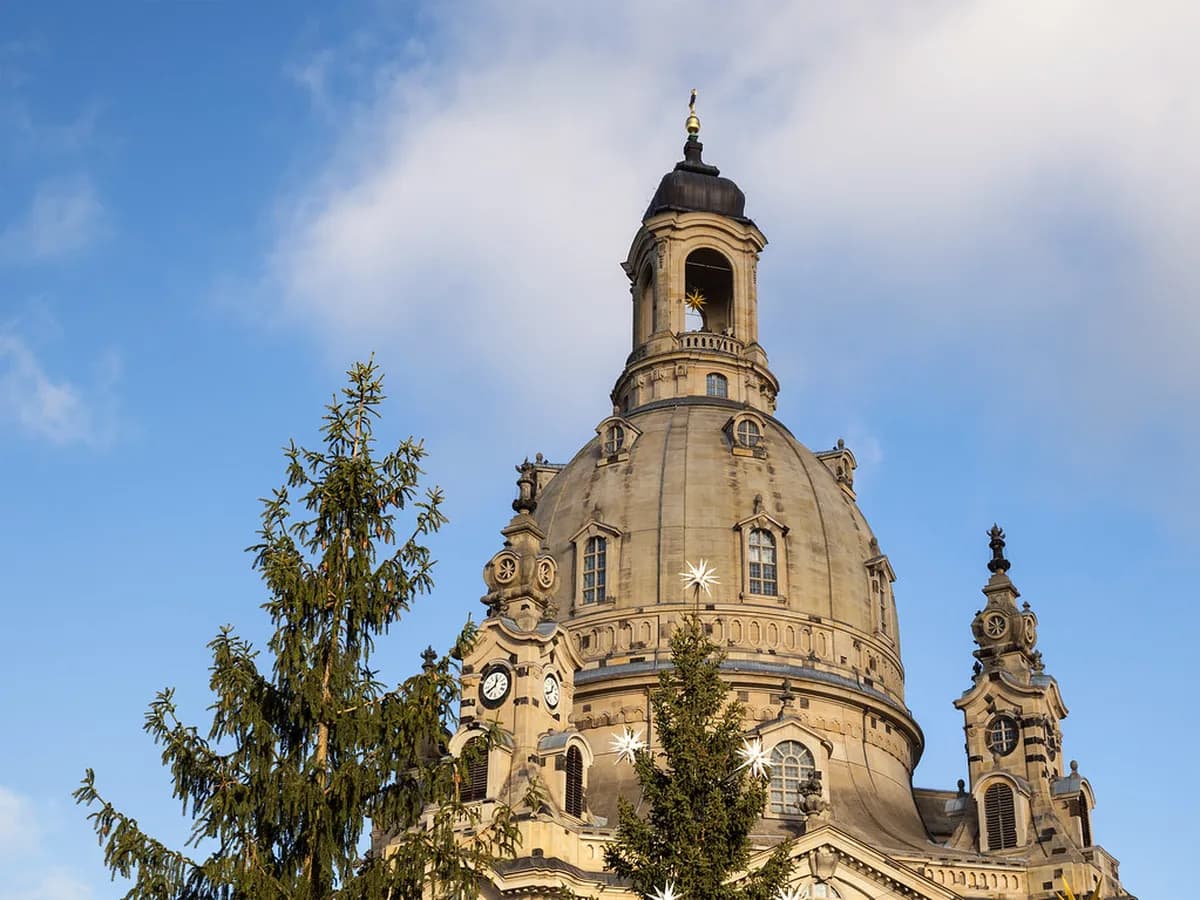
The Neumarkt Romantic Market sits in the shadow of the Frauenkirche, Dresden's reconstructed baroque landmark. Its atmosphere is quieter and more upscale than the Striezelmarkt: artisans from regional guilds sell high-quality lace, pottery, and glassware, and church choirs perform regularly. The Neumarkt also has one of the longer seasons in the city, typically running into early January (it ran until January 8 in the 2025/2026 edition); confirm the 2026/2027 closing date on the official tourism page. The Frauenkirche Market on Münzgasse is smaller but features its own Santa visit at 16:00 daily and focuses on locally made handicrafts.
Erzgebirge Crafts: What to Buy and What Each Piece Means
The Erzgebirge — Ore Mountains — region south of Dresden has produced wooden Christmas decorations since the 15th century, when miners carved figures by candlelight during long winter months. These crafts are sold at every Dresden market but are most concentrated at the Striezelmarkt and Neumarkt. Understanding what you are looking at helps you choose something meaningful rather than a generic souvenir.
The Nussknacker (nutcracker) is the most internationally recognised figure: a uniformed soldier or king with a lever jaw used to crack nuts. Genuine Erzgebirge nutcrackers are hand-painted and hand-assembled from turned linden wood; expect to pay €30–€120 depending on size and maker. The Räuchermann (incense smoker) is a hollow figure — often a miner, baker, or chimney sweep — whose removable torso holds a small incense cone. When lit, smoke rises through the figure's open mouth. They are quieter and more traditionally Saxon than nutcrackers; prices start around €15.
The Schwibbogen (candle arch or Christmas arch) is a semicircular wooden structure holding multiple candles or LED lights, with carved figures of miners and angels in the foreground. These arches were originally placed in miners' windows to signal that the tunnels were safe. A small Schwibbogen costs €20–€50; large traditional versions can run well over €200. The Striezelmarkt's record-breaking pyramid is essentially a monumental public version of this same craft tradition, scaled to 14.62 meters.
When buying any Erzgebirge piece, look for the "Herkunftszeichen Erzgebirge" authenticity mark — a small label confirming the item was made in the Ore Mountains region, not imported. Stalls without this mark may still sell attractive decorations, but they are not traditional Saxon handicrafts.
Traditional Foods: Dresdner Christstollen and the Stollenfest
Dresdner Christstollen is the food most closely associated with the city's Christmas season. The protected-designation cake is made according to a guild recipe that traces back to 1474 — butter, candied citrus peel, raisins, and marzipan inside a dense enriched dough, rolled and folded so the shape evokes the swaddled Christ child. A standard whole Stollen (about 1 kg) costs €15–€25 at market stalls. Look for the official Dresdner Stollen seal — a white paper ring stamped with the city's coat of arms — which confirms authenticity and local production.
The Stollenfest (Stollen Festival) takes place on the second Saturday of December and is one of the market season's biggest public events. A giant Stollen weighing several tonnes is paraded through the Altmarkt on a horse-drawn carriage before the Stollen Queen ceremonially cuts it. Slices are sold to visitors with proceeds going to charity. The parade draws large crowds, so position yourself along the route by 10:30 if you want a clear sightline.
Beyond Stollen, the markets serve Pulsnitzer Pfefferkuchen (a dense regional gingerbread), Bratwurst grilled over charcoal, Eierschecke (a layered Saxon cheesecake unique to the Dresden region), and roasted chestnuts. Glühwein comes in multiple variants at different stalls — the Augustusmarkt tends to stock more unusual regional Glühwein styles alongside its international offerings. Consider where to stay for the Dresden Christmas market when booking, as central hotels near the Altmarkt fill up months before the season opens.
Beyond the City: Christmas Spirit in Radebeul and Saxony
Radebeul sits less than 10 kilometers northwest of Dresden city center and is reachable by S-Bahn in under 20 minutes. Its main Christmas draw is the Wackerbarth Castle Saxon Manufactory Christmas, held on the second Advent weekend. The baroque palace and its gardens become a showcase for around 75 Saxon manufacturers and artisans — glassworks, porcelain studios, and textile makers who rarely appear at the larger urban markets. The setting, illuminated in the castle grounds at dusk, is considerably more intimate than anything in central Dresden.
Leipzig is around 90 minutes by regional train and offers its own historic Christmas market on the Market Square, running annually since 1767. The city's biggest attraction during Advent is the world's largest free-standing advent calendar displayed on the Old City Hall facade. Traditional trumpeters play from the balcony daily, and stalls sell Ore Mountain decorations, Saxon gingerbread, and mulled wine. Combining a Dresden weekend with a half-day Leipzig trip is straightforward via Deutsche Bahn's direct trains from Dresden Hauptbahnhof.
For those seeking the Erzgebirge crafts at their source rather than at the Dresden markets, the towns of Annaberg-Buchholz and Seiffen in the Ore Mountains are the production centers. Seiffen in particular is known as the "toy village" and runs its own smaller Christmas market where you can watch nutcrackers and smokers being turned and painted in the workshops themselves. The drive from Dresden takes around 75 minutes; there is no direct train.
Essential Planning Tips: Food, Souvenirs, and Crowds
The single most effective crowd management tip is to visit the Striezelmarkt on weeknights rather than weekends. Saturday afternoons between December 6 and December 20 are the peak of the peak — Altmarkt becomes difficult to navigate comfortably. A Tuesday or Wednesday visit gives you the same food, the same crafts, and the same lights with roughly half the people.
Book accommodation well in advance. Hotels within walking distance of the Altmarkt — particularly in the Altstadt and along Prager Straße — sell out before October for prime December dates. Staying in the Neustadt neighborhood across the Elbe adds a 10–15 minute walk but puts you closer to the Augustusmarkt and offers quieter streets and more affordable rates.
Getting between markets on foot takes 10–15 minutes for most combinations. The Altmarkt (Striezelmarkt) to Stallhof is a 3-minute walk through the palace complex. Augustusmarkt on the north bank requires crossing the Augustus Bridge. Dresden's trams stop at Altmarkt and Postplatz, giving direct access to most market locations. A day pass on the DVB network costs around €8.50 for adults and covers all zones in the city center.
Check the Nuremberg's holiday stalls guide if you are combining a Saxon and Bavarian Christmas market trip — the two cities are under two hours apart by direct train, and pairing them across a long weekend is a common itinerary. Similarly, compare notes against the broader Germany market guide to see how Dresden's markets compare on size and crowd levels.
Frequently Asked Questions
When does the Dresden Christmas market start in 2026?
The Dresden Christmas market is expected to open in late November 2026 (the 2025/2026 edition opened on November 26); check the official Dresden tourism page for the confirmed 2026 date. It remains open daily until December 24. Most stalls operate from 10 AM to 9 PM during this period.
Is the Dresden Christmas market open after Christmas?
Most markets, including the Striezelmarkt, close on December 24 at 2 PM. However, the Augustusmarkt often stays open until early January. Check the Berlin's holiday scene if you need post-Christmas options.
What is the best Christmas market in Dresden for families?
The Striezelmarkt is the best choice for families. It features a daily visit from Santa at 4 PM and a dedicated children's area. Kids will love the giant pyramid and fairy-tale forest.
Related: Dresden festival calendar.
Dresden offers a holiday experience that rivals Munich's traditional markets in scale and beauty. The combination of the historic Striezelmarkt and themed squares creates a unique atmosphere. Plan your visit for a weeknight in early December for the best balance.
Make sure to book your accommodation and transport well before the season starts. Dresden remains a top destination for those seeking authentic German holiday traditions. The city's magic will leave you with lasting memories of a Saxon winter.
Free guide: Europe's Festival Calendar
A month-by-month map of Europe's unmissable festivals — with the best dates to visit each and a local tip you won't find in the guidebooks.
You might also like

Continue reading
More guides you'll find useful