10 Best Hamburg Christmas Markets and Visiting Guide (2026)
Discover the magic of Hamburg's Christmas markets. From the Flying Santa at Rathausmarkt to Santa Pauli, plan your 2026 trip with our expert guide.
On this page
10 Best Hamburg Christmas Markets and Visiting Guide
Hamburg transforms into a northern winter wonderland with over twenty distinct holiday markets scattered across its historic districts. This maritime city combines traditional Hanseatic crafts with uniquely unconventional themes — including a Scandinavian-flavored maritime quarter and the only adult-themed Christmas market in Germany. This guide covers the ten markets worth prioritising, a walking route linking the central ones, and a comparison table to help you decide which fits your group. All information has been updated for the 2026 season.
While many travelers prioritise the best Christmas markets in Germany like Nuremberg, Hamburg offers a refreshing coastal variety. The city combines classic wooden huts with unconventional themes, such as the adult-oriented festivities found near the Reeperbahn. We recommend dedicating at least two to three days to fully explore the diverse neighbourhoods and their respective holiday traditions. Expect to find high-quality maritime crafts and unique northern delicacies that you won't encounter in southern German regions. Christmas markets are only one season of Hamburg's full festival calendar, which runs year-round with cultural, music, and harbour celebrations.
Free guide: Europe's Festival Calendar
A month-by-month map of Europe's unmissable festivals — with the best dates to visit each and a local tip you won't find in the guidebooks.
Hamburg Christmas Markets at a Glance
Hamburg has at least 22 Christmas markets across the city, ranging from flagship city-centre spectacles to intimate neighbourhood gatherings. Most open in the last week of November and run until December 23rd or 30th; a handful close earlier for Advent reasons, so check the Hamburg Tourismus official website before you go. General hours are 11:00–21:00 daily, with some markets extending to 22:00 on Fridays and Saturdays.
Entry to every outdoor market is free. Glühwein costs €4.50–€6.00 per mug plus a €3–€4 Pfand (deposit) you can reclaim or put towards a souvenir mug. Carry cash: many smaller artisanal stalls don't accept cards. The HVV public transport network connects all major venues; a 9-Uhr-Tageskarte (9 AM day ticket) covers unlimited travel for roughly €8 and pays for itself after two journeys.
Use the table below to pick the right market for your group before diving into the full descriptions.
| Market | Vibe | Best For | Crowd Level |
|---|---|---|---|
| Rathausmarkt (Roncalli) | Grand & Traditional | First-timers, photos | Very high evenings |
| Santa Pauli | Adult, edgy | Groups of friends, night owls | Extremely high after 20:00 |
| Jungfernstieg (White Magic) | Elegant, lakeside | Couples, gift shopping | High but walkable |
| Fleetinsel | Maritime, quiet | Escaping the crowds | Low–medium |
| St. Petri | Charming, family | Young children | Low–medium |
| Ottensen | Local, artisan | Foodies, unique gifts | Medium evenings |
| Winterwald | Cosy, atmospheric | After-dark atmosphere | High evenings |
| Spitalerstraße | Modern, lit-up | Shoppers, light displays | High, but linear |
| Gänsemarkt | Refined, literary | Feuerzangenbowle fans | Low–medium |
| HafenCity | Modern, harbour | Architecture lovers, skating | Low–medium |
Historical Rathausmarkt (Roncalli) Christmas Market
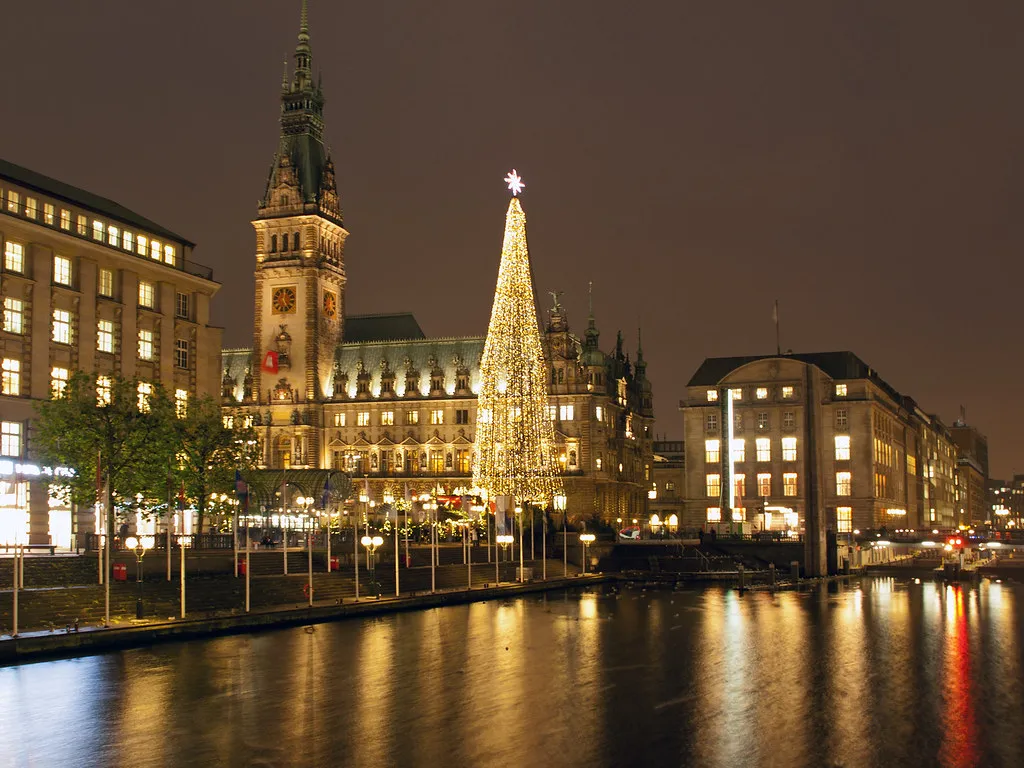
The Rathausmarkt is Hamburg's flagship market and the one no visitor should miss. Around 80 wooden stalls line the central square in front of the city's neo-Renaissance town hall, selling handmade toys, Christmas decorations, and bratwurst alongside spiced wine. The backdrop of 19th-century architecture gives it an authentically festive quality that modern markets struggle to replicate.
The signature attraction is the Flying Santa. Three times each evening — at 16:00, 18:00 and 20:00 — Santa Claus crosses the market square in his illuminated sleigh and pauses to recite a seasonal address before continuing his flight. Arrive at least 30 minutes early and position yourself near the large central Christmas tree for the clearest view. A vintage carousel operates alongside the stalls.
The market is open daily from 11:00 to 21:00, extending to 22:00 on Fridays and Saturdays. It is most visually striking after dark, when thousands of coloured bulbs and a towering light-wrapped "tree" — technically a pole with radiating strings of white lights — make the square glow.
Santa Pauli: The Reeperbahn's Adult Christmas Market
Santa Pauli describes itself as "Hamburg's horniest Christmas Market" — a billing it earns. Located in the heart of the St. Pauli entertainment district, it is the only explicitly adult-themed Christmas market in Germany. Neon signs, large electronic billboards, and stage shows create an atmosphere that is loud, brash, and entirely intentional.
Alongside traditional food and Glühwein stalls, the market sells adult gifts and novelty items that would not appear anywhere else on a Christmas market circuit. A big stage hosts live music and performances, and the PA system keeps energy levels high even between acts. It opens from approximately 16:00 and runs until midnight or later — definitely a late-evening destination rather than an afternoon stop.
Groups of friends tend to enjoy it most. Solo travelers can feel overwhelmed by the density of the crowd after 20:00. If the St. Pauli scene appeals, combine the market with a walk along Reeperbahn before or after.
Jungfernstieg: White Magic on the Alster Lake
The Jungfernstieg market — known officially as Weißer Zauber or "White Magic" — stretches along the Binnenalster lakeshore and is one of the most visually striking Christmas markets in northern Germany. All stalls are set inside uniform white pagoda tents rather than the traditional wooden huts found elsewhere, creating a cooler, more design-conscious atmosphere.
The items for sale lean toward the stylish and the handcrafted, and prices reflect that. A short boat ride around the Inner Alster is usually available in the evenings, and the view across the water — with the illuminated buildings of the city reflected in the lake and a large Christmas tree glowing on a small island — is genuinely beautiful. Stalls open daily from 11:00 to 21:00.
Take the U-Bahn or S-Bahn to Jungfernstieg station for direct access. Gänsemarkt market is only a block away if you want to combine both in one circuit.
Fleetinsel: A Maritime Holiday Atmosphere
Fleetinsel is the smallest market on this list, tucked between two canals near the harbour. It is primarily a drinks-focused market — expect Glühwein, feuerzangenbowle (the flaming rum-sugar punch also found at Gänsemarkt), and hot cider — with a modest selection of food stalls. A historic sailing ship moored alongside the market provides the maritime backdrop that gives Fleetinsel its character.
This is the market to visit when you want a quieter mug of spiced wine away from the city-centre crowds. Crowd levels stay low-to-medium even on weekend evenings. Opening hours mirror the city-centre standard of 11:00 to 21:00.
St. Petri: Traditional Charm by the Cathedral
Set in the courtyard of St. Petri Church, one of Hamburg's oldest churches, this small market punches above its size for families with young children. The signature feature is a series of old-fashioned animated dioramas depicting fairy-tale scenes — Red Riding Hood, Hansel and Gretel, and others — in which hand-crafted dolls make slow, looping movements inside glass cases. They look archaic, but toddlers genuinely stop and stare.
The stall selection is modest: a handful of craft vendors, the obligatory Glühwein tent, and some Christmas decoration sellers. The market's real draw is its atmosphere — a genuine courtyard enclosed by the church's stone walls, scented with pine branches, and insulated from the street noise outside. Entry is free and weekday mornings are the calmest time to visit.
Ottensen: A Family-Friendly Neighbourhood Favourite
Ottensen sits in the Altona district west of the city centre and is widely regarded as Hamburg's most authentic market for locals. Around 50 red wooden huts sell international crafts, organic food, and neighbourhood-made gifts to a crowd that skews resident rather than tourist. The vibe is convivial and unhurried.
The food here is notably more diverse than at the central markets. Past vendors have included empanadas, Estonian gingerbread, and Swiss raclette alongside the standard bratwurst and Glühwein. It is the best market in Hamburg for eating well while browsing. The market runs daily from 11:00 to 21:00 and is a 10-minute walk from Altona S-Bahn station (S1, S3).
Winterwald: The Urban Forest Experience
Winterwald translates as "winter forest," and the market earns the name. Located on Gerhart-Hauptmann-Platz in the shopping district near the Hauptbahnhof, it recreates a dense woodland setting in the middle of the city using tall fir trees, rustic pine-decorated stalls, and white fairy lights. Of all the central markets, it creates the strongest sense of Christmas atmosphere independent of weather or crowds.
The market is at its best after dark, when the lighting transforms the space into something genuinely enchanting. A central forest bar serves hot drinks to a mix of locals and visitors. Most stalls open at 10:00 and close at 21:00, making it one of the few markets suited to an early visit before the main crowd arrives. It also sits directly on the walking route between Hauptbahnhof and Rathausmarkt, making it easy to include without a detour.
Spitalerstraße: Modern Lights and Holiday Shopping
Spitalerstraße market stretches the length of a single pedestrianised shopping street running east from the Hauptbahnhof. The organisers have invested heavily in overhead lighting: the street is covered in a dense canopy of illuminated shapes that makes evening visits feel theatrical. Stalls are styled to resemble traditional brick Hanseatic buildings, which creates a coherent aesthetic even though the setting is a modern retail corridor.
Food options include Currywurst (€6–€8) and kale with sausage (Grünkohl mit Pinkel, a Hamburg winter staple). Shopping stalls carry a mix of handmade items and branded Christmas gifts; the surrounding stores offer the full range of major retail brands if you want to combine market browsing with serious gift shopping. This is the most convenient market for anyone arriving by train.
Gänsemarkt: Feuerzangenbowle and a Refined Atmosphere
Gänsemarkt is a block from Jungfernstieg and arranged prettily around a small square near the Opera House. The market is architecturally modest — standard gingerbread-house stalls, a small merry-go-round, honey products, and beeswax candles — but it has one genuine draw that separates it from similar-sized markets: feuerzangenbowle.
Feuerzangenbowle is Hamburg's most dramatic hot drink. A large block of rum-soaked sugar is placed over a copper cauldron of hot spiced wine, set alight, and allowed to melt and drip into the wine below. The flame turns blue and the show draws a crowd. The resulting drink is sweeter and stronger than standard Glühwein. While you can find feuerzangenbowle at Fleetinsel and occasionally elsewhere, Gänsemarkt is the market most associated with it and the best place to experience it deliberately. Open daily 11:00–21:00.
HafenCity: Harbour Views and an Ice Rink
HafenCity is Hamburg's newest urban district, built on former dockland south of the city centre. The Christmas market here is smaller than the central ones but benefits from spectacular surroundings: the Elbphilharmonie concert hall rises behind the stalls, and the Elbe waterfront extends on the other side. It is the least crowded major market in the city, which is either a drawback or a selling point depending on your preference.
An ice rink typically operates at the market, costing around €5 for a session plus skate rental. The "winter lounge" (a large heated tent) and a small selection of food stalls keep the market operational even in bad weather. Visit in late afternoon to catch the sunset over the Elbe before the market lights take effect. Take the U4 to HafenCity Universität or the U3 to Baumwall.
The Scandinavian God Jul Markets
One of Hamburg's most distinctive holiday offerings is the cluster of four Scandinavian church markets on Ditmar-Koel-Straße near the harbour. The Danish, Swedish, Norwegian, and Finnish churches each host their own market, collectively marketed as "God Jul." These reflect Hamburg's centuries-long maritime trading relationship with Scandinavia and feel more like community gatherings than commercial events.
The Swedish market is notable for its Glögg — mulled wine served with raisins and almonds — while the Finnish market emphasises premium licorice and northern berry jams. The Danish and Norwegian stalls tend toward knitwear and traditional wooden crafts. Entry typically involves a small donation of €1–€2 to support the church communities. These four markets are within a few minutes' walk of each other.
The critical caveat: God Jul markets run only for two or three weekends in November, not through December. They are Advent markets rather than Christmas markets in the strict sense. Check the Hamburg Tourismus official calendar well in advance. If you miss the God Jul window, the Fleetinsel and Jungfernstieg markets both carry some Nordic-influenced stalls, though the selection is smaller and the atmosphere is different.
Essential Tips for Navigating Hamburg's 20+ Markets
Dress for coastal conditions. Hamburg in December is cold, damp, and often windy. Waterproof shoes are not optional — the cobbled squares around the Rathaus hold water — and layers are essential because you will alternate between outdoor stalls and warm indoor spaces. The wind off the Elbe can push the felt temperature 4–5°C below the official forecast, especially near Fleetinsel and HafenCity.
Weekday afternoons between 14:00 and 17:00 offer the best balance of atmosphere (the markets are lit and atmospheric) and manageable crowd density. Saturday evenings at Rathausmarkt and Santa Pauli become extremely dense and are genuinely uncomfortable for anyone who dislikes crowds. Smaller markets like Ottensen and St. Petri are pleasant at any time of day.
For those combining sightseeing with markets, the Hamburg Card covers unlimited HVV public transport plus discounts at major museums. A 2-day card costs roughly €36. See the German Christmas Market Food Guide for what to order at each type of stall. Consider visiting the Lübeck Christmas market as a day trip — it is 45 minutes by regional train and offers a UNESCO medieval backdrop entirely different from Hamburg's urban character.
How to Plan Your Hamburg Christmas Market Itinerary
The five central markets can be linked in a single afternoon and evening walk starting from Hamburg Hauptbahnhof. Exit the station's west side and you immediately reach Spitalerstraße. Follow the pedestrian street west until it meets Mönckebergstraße — Winterwald appears within 50 metres. Continue along Mönckebergstraße and you will see St. Petri Church to your left with its small courtyard market. Keep heading roughly west to reach Rathausmarkt, Hamburg's flagship. From there, it is a short walk north to the lakeside Jungfernstieg, and one more block northwest to Gänsemarkt. This entire route takes 20–30 minutes of walking (excluding time at each market) and requires no public transport.
For a two-day itinerary, reserve Day 1 for the central walk above and add a late-evening trip to Santa Pauli on the Reeperbahn (U3 to St. Pauli). On Day 2, visit Ottensen in the morning (S1/S3 to Altona), then take the U4 to HafenCity in the afternoon for harbour views and ice skating, finishing at Fleetinsel before dinner.
Book accommodation early if you plan to visit in the second or third week of December. Hotels near the Alster and the Rathaus fill months in advance. The St. Georg and Neustadt districts offer the best access to the central markets, with multiple S-Bahn and U-Bahn connections to the outer markets. If you plan to continue south after Hamburg, the Berlin Christmas market scene and eventually the Frankfurt Christmas market complete a logical Northern–Central Germany holiday arc.
Frequently Asked Questions
Is Hamburg good for Christmas markets?
Hamburg is an exceptional destination for Christmas markets because it offers over 20 diverse locations. The city combines traditional Hanseatic charm with unique maritime and adult-themed markets that you won't find elsewhere in Germany. We highly recommend it for travelers seeking variety and a coastal holiday atmosphere.
What date are the Christmas markets in Hamburg?
Most Hamburg Christmas markets open in the last week of November and run until December 23rd or 30th. Some specific markets, like the one at Jungfernstieg, often extend into early January. Always check the official city calendar for the exact 2026 dates before booking.
What is the biggest Christmas market in Hamburg?
The Historical Christmas Market at the Rathausmarkt is the largest and most popular in the city. It features over 80 vendors and the famous Flying Santa show three times daily. Because of its size and central location, it attracts the most visitors each season.
Hamburg offers a holiday experience that is both deeply traditional and refreshingly modern. From the nostalgic carousels at the City Hall to the neon lights of St. Pauli, the city caters to every type of traveler. The walking route linking the five central markets makes it possible to see the highlights in a single afternoon, while the Scandinavian God Jul markets and neighbourhood favourites like Ottensen reward a longer stay. Plan for coastal weather, carry cash, and arrive before 16:00 on weekdays to experience the Flying Santa without the weekend crush.
Free guide: Europe's Festival Calendar
A month-by-month map of Europe's unmissable festivals — with the best dates to visit each and a local tip you won't find in the guidebooks.
You might also like


Continue reading
More guides you'll find useful