10 Essential Things to Know About the Budapest Christmas Market
Plan your Budapest Christmas market trip with 2026-2027 dates, food prices, hidden local markets, and tips for combining your visit with Zagreb.
On this page
10 Essential Things to Know About the Budapest Christmas Market
The best time to visit the Budapest Christmas market is from mid-November to late December. Last updated May 2026. Most travelers find that the peak festive atmosphere arrives during the first two weeks of December. The city transforms into a winter wonderland with multiple fairs spread across the historic center.
See also: Best Budapest Christmas Market Dates & Locations.
Budapest has two main official markets — Vörösmarty Square and St. Stephen's Basilica — plus a growing network of neighbourhood fairs, an illuminated pedestrian street, ice rinks, and thermal baths that make December visits genuinely full-day affairs. Planning ahead is essential for finding the best places to stay near the squares. Many visitors choose to combine this trip with a wider sweep of the best Christmas markets in Central Europe.
This guide covers everything from exact opening hours and food prices to hidden local markets, getting around by tram and metro, and how to extend the trip to Zagreb or Bratislava. Expect a mix of traditional Hungarian crafts, spectacular light shows, and some of the most affordable mulled wine in Central Europe.
Free guide: Europe's Festival Calendar
A month-by-month map of Europe's unmissable festivals — with the best dates to visit each and a local tip you won't find in the guidebooks.
Dates and Opening Hours for the Budapest Christmas Market
The main fairs typically open in the second half of November and run through December 31. Vörösmarty Square usually begins its festivities around November 17th. The St. Stephen's Basilica market follows a day or two later and continues until January 1st. The Obuda market and the Fisherman's Bastion market open later, from December 1st through December 23rd.
The Basilica market follows a strict weekly schedule: Monday to Thursday 11:00–22:00, Friday and Saturday 11:00–23:00, and Sunday 11:00–22:00. Vörösmarty Square stalls generally keep similar hours with the largest food vendors staying open until 22:00 on weekdays and 23:00 on weekends. Evening visits are best for the light shows but require navigating large crowds, so a late afternoon arrival lets you settle in before the main rush.
Official information is available on the Official site of Budapest Tourist Office. Most markets are free to enter — no tickets are required to browse the stalls. Crowds are noticeably thinner on weekday afternoons in late November, which is the sweet spot for budget-conscious visitors who want full access without peak-season hotel rates.
Vörösmarty Square: The Most Iconic Holiday Fair
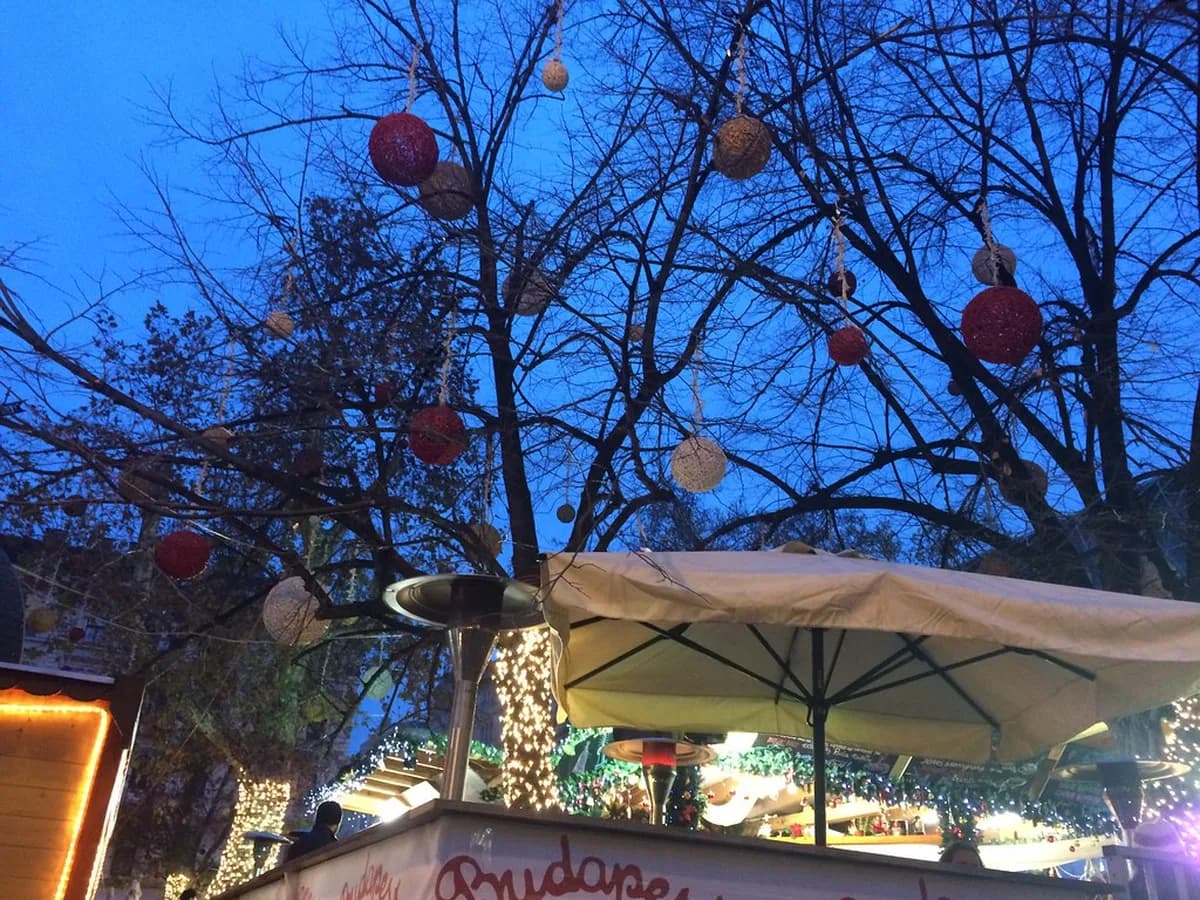
Vörösmarty Square hosts the oldest and most famous market in the city, located at the end of Váci Street in the heart of District V. The square is easily accessible via the historic M1 metro line or by Tram 2 to Széchenyi István tér. Traditional wooden stalls here focus heavily on high-quality Hungarian handicrafts — hand-painted ceramics, leatherwork, embroidered linens, and paprika sets make popular gifts.
The large food stalls here sell a wide variety of Hungarian cuisine from sprawling open counters. Be aware that prices in the central square run high: a single dish like rolled pork shoulder costs around 20 EUR, and the crowds on weekend evenings are dense enough to make reaching a stall genuinely difficult. Visiting before 17:00 makes navigation much easier and the queues shorter.
The Gerbeaud Coffee House provides a stunning backdrop for the market stalls, with its famous Advent calendar displayed across the café windows. Live folk music performances take place on the central stage most afternoons. Fashion Street (Deák Ferenc utca), which begins right where the square ends, is worth a detour: the entire pedestrian street is draped in cascading lights from rooftop to pavement, and a giant lit tree glows at its centre. It costs nothing to walk through and makes for excellent evening photos.
St. Stephen's Basilica: Europe's Most Beautiful Advent Feast
The Advent Feast at the Basilica has been voted Europe's best Christmas market multiple times, and the setting explains why. Wooden stalls draped in white garland and lights fill the square in front of the church, continuing down the side street. A tall decorated Christmas tree dominates the centre, and falling snowflakes are projected across the Basilica's facade throughout the evening.
The 5-minute projection show runs every half hour after sunset. Different versions cycle through the season — nativity scenes, nutcracker motifs, and abstract winter designs — so two visits on separate evenings will not look identical. Note that unlike previous years, an ice rink may or may not be set up around the tree depending on the season; check locally before visiting specifically for skating. The square layout is more spacious than Vörösmarty, making it easier to browse without feeling crushed.
We recommend visiting the Basilica's interior during the day for a quiet break — organ concerts are regularly held inside during the holiday weeks, and the interior is genuinely beautiful. A ticket to the dome terrace adds a panoramic view of the city. The market entrance points often have security bag checks, so build a few extra minutes into your arrival time.
Obuda and Local Markets Outside the City Center
The Obuda Christmas market offers the most authentically local atmosphere in the city. It sits in the charming Main Square (Fő tér) of the Old Buda neighbourhood, about 30 minutes from the city centre by public transit. The trade-off for the commute is real: prices here are significantly lower than at the Basilica or Vörösmarty, and the crowd is made up largely of Budapest residents rather than tour groups.
The centre of the square holds a small ice skating rink that is free to use — though you must bring your own skates. Market stalls, the rink, and the surrounding buildings are all draped in lights, and a lit reindeer-and-sleigh display sits beside the Christmas tree. Raclette scraped onto toast, waffles, and churros appear here alongside the standard chimney cakes and sausages, giving the food lineup more variety than the central markets. The deposit cup system is used here (500 HUF, about €1.30), and the cups are a decent souvenir to take home.
The Fisherman's Bastion Market is another strong alternative. It runs from December 1st in the square just behind the main Fisherman's Bastion entrance, next to Matthias Church on the Buda side. About 15 stalls sell crafts and gifts, with one food and drink stand. A concert stage with a posted weekly schedule means weekend evenings bring live performances — and the view across the Danube to the illuminated Parliament is one of the best in the city. We recommend arriving at dusk specifically to catch both the lights and the panorama.
For day trips outside Budapest, consider the Szentendre Christmas market about 22 km north, where the entire historic town centre converts into an open-air fair. The Eger Christmas market is a longer but rewarding excursion, with baroque architecture as its backdrop.
Market Comparison: Which One Is Right for You?
| Market | Location | Crowd Level | Price Level | Best For |
|---|---|---|---|---|
| Vörösmarty Square | City Centre (M1) | Very High | High | Crafts, iconic atmosphere |
| St. Stephen's Basilica | City Centre (walk from M1/M3) | High | High | Light shows, photography |
| Obuda (Fő tér) | 30 min by transit | Low–Medium | Local prices | Authentic feel, free ice rink |
| Fisherman's Bastion | Buda side (Dec 1–23) | Medium | Medium | Panoramic views, concerts |
| Fashion Street | Adjacent to Vörösmarty | High | Free to walk | Light displays, photography |
Budget travelers will get the most value from Obuda, where a full meal and a mulled wine can run under 15 EUR. Those visiting for the visual spectacle should prioritise the Basilica in the evening. Anyone combining markets in one day can walk from Vörösmarty to Fashion Street to the Basilica in under 20 minutes — a natural half-day loop.
What to Eat and Drink: Traditional Festive Flavors
No visit is complete without trying a Kürtőskalács (chimney cake) — sweet dough cylinders rolled in cinnamon, walnuts, or chocolate and cooked over an open flame. Lángos is the most popular savory option, a deep-fried flatbread usually topped with garlic, sour cream, and cheese. Roasted potatoes, smoked sausages, pulled pork sandwiches, and at Obuda, raclette and waffles round out the options. Expect to pay 1,500–2,500 HUF for a quality snack at any stall.
For drinks, mulled wine (forralt bor) is available in red and white varieties, often served in fruit-infused versions such as plum or blueberry. Look for Krampampuli for a stronger spiced punch with dried fruits. Hot chocolate at the Budapest markets is notably rich — thick and creamy, closer to melted chocolate than cocoa powder. Non-alcoholic apple cider is widely available for children and designated drivers.
Budapest uses a sustainable cup deposit system at most markets. The deposit is 500 HUF (approximately €1.30) per reusable cup. You can return the cup to any stall for the cash back, or keep it as a souvenir. Always look for posted price lists before ordering at the large central food stalls — the tourist-facing counters without visible pricing can be significantly more expensive than the stalls that display their menu clearly.
Ice Rink and Winter Fun for Everyone
The Városligeti Ice Skating Rink in City Park is the largest and most atmospheric rink in Budapest. Set against the backdrop of Vajdahunyad Castle — a complex of towers, a moat, and a drawbridge that feels genuinely fairy-tale — it is worth visiting even for non-skaters. The castle grounds are free to walk through, and the rink lighting at night is spectacular.
Pricing in 2026: adults pay 3,000 HUF (approximately €8), students and seniors pay 2,000 HUF. Skate rental is an additional 3,000 HUF. Family packages are available at the ticket desk. General hours run Monday to Friday 09:00–12:15 and 17:00–20:15, Saturday and Sunday 10:00–13:15 and 16:00–20:15 (Sunday until 19:15). The rink closes for a few hours each afternoon, so plan around those gaps.
City Park is about 20 minutes north of the main markets and sits just a few minutes from the Széchenyi Thermal Baths. Combining both in one afternoon is one of the best practical decisions in a Budapest December itinerary — skate in the cold air, then walk over to soak in 34°C outdoor thermal pools before heading back to the evening markets. The Obuda market also has a small free rink in its central square, usable if you bring your own skates.
Holiday Concerts and Cultural Events
Budapest layers cultural programming across the market season. The St. Stephen's Basilica interior hosts regular organ concerts throughout Advent, usually on Sunday afternoons and some weekday evenings. Check the schedule posted at the church entrance, as these events are free or low-cost and offer a warm, quiet contrast to the outdoor bustle.
The Fisherman's Bastion market posts a concert schedule on a board beside its stage, with live performances on most weekend evenings. The Obuda market has a small stage with folk music and seasonal entertainment. Advent concerts also take place at the Liszt Academy of Music (Liszt Ferenc tér), which programmes a full December series of classical performances — booking ahead is recommended as these sell out quickly.
The city's thermal baths occasionally run evening or themed Advent sessions; the Széchenyi Baths in particular sometimes schedule evening events during December. It is worth checking their calendar at the time of booking. For families, several Budapest churches hold free Nativity concerts on December 23rd and 24th, with programmes listed on local event sites closer to the date.
Practical Tips for Getting Around Budapest
Budapest's public transit network is efficient and covers all the main market locations. For the central markets, take Metro M1, M2, or M3 to Deák F. tér, or Tram 2 along the Danube to Széchenyi István tér. For Obuda, take HÉV suburban rail line H5 northbound to Aquincum or Árpád híd — journey time from the centre is about 25–30 minutes. The Fisherman's Bastion is best reached via Bus 16 or 16A from Clark Ádám tér, or on foot across the Chain Bridge.
Hungary's official currency is the forint (HUF), but euros are accepted at many market stalls. At approximately 390–400 HUF per euro in 2026, the exchange rate makes Budapest notably affordable for Western European visitors. Almost all market stalls accept credit cards, though some smaller craft vendors prefer cash — carrying 5,000–10,000 HUF is a sensible buffer. The Christmas markets are free to enter. There are no public bathrooms inside the markets; use the facilities in nearby cafes or the larger department stores before entering.
From the airport, Bus 100E costs 2,200 HUF and runs directly to Deák F. tér in around 35–40 minutes. Rideshare apps operate in Budapest and can be cheaper than taxis for the airport run with luggage. If you plan to take the metro and trams extensively over several days, a 72-hour or 96-hour transit pass pays off quickly.
Christmas Cruise Budapest With Dinner & Live Music
Seeing the illuminated Parliament from the Danube is a highlight of any winter visit. A Budapest Dinner Cruise offers a warm, unhurried way to see the sights from the water. The 180-minute dinner cruise costs approximately €150 per person and includes four courses and live music. Advanced booking for mid-December slots is essential — they sell out weeks ahead.
Budget-conscious travelers prefer the 60-minute mulled wine cruise at around €19, which includes unlimited wine and covers the main illuminated landmarks along both banks. Boats are well-heated, but the outdoor deck sections provide the best vantage points for photography. Both options depart from the Vigadó tér pier near the central markets, making it easy to sequence a cruise after an early evening at Vörösmarty Square.
How to Fit Zagreb Into Your Europe in December Itinerary
Budapest's position in Central Europe makes it an ideal anchor for a multi-city Christmas market route. From Budapest you can reach Bratislava by train in about 2.5 hours, then continue west to Vienna in another hour, south to Ljubljana in around 2.5 hours, and finish at the Zagreb Christmas market — one of the most awarded in Europe. The full loop fits comfortably into 8–10 days with one or two nights per city.
Zagreb specifically is worth highlighting because it hosts what has been named the best Christmas market in Europe by the European Christmas Market Awards on multiple occasions. Direct trains from Budapest to Zagreb run in about 6–7 hours; a bus can take a similar time but is cheaper. Alternatively, flying Budapest–Zagreb takes under an hour, and fares are often very low with regional carriers in December. The Zagreb market is free to enter and the pricing for food and drinks is lower than Budapest's central markets, making it a natural complement at the end of a Central Europe swing.
Those focused purely on Hungary can do a shorter circuit: Budapest as the base, with day trips to the Szentendre Christmas market by HÉV rail, and the Eger Christmas market by direct train from Budapest Keleti (about 1 hour 45 minutes). Both offer smaller, more relaxed markets with lower prices than the capital.
Frequently Asked Questions
Is the Christmas market in Budapest worth it?
Yes, it is widely considered one of the best in Europe. The combination of traditional food, light shows, and affordable prices makes it a top winter destination. You will find a more authentic atmosphere here than in many Western European cities.
What date is the Christmas market in Budapest?
The markets usually run from mid-November until the end of December. Vörösmarty Square often opens around November 17th. The Basilica market typically continues until January 1st to accommodate New Year visitors.
Which is the best Christmas market in Budapest?
St. Stephen's Basilica is often cited as the best for its atmosphere and light shows. However, Vörösmarty Square is the most iconic for traditional crafts. For a local feel, the Obuda market is the superior choice.
Visiting Budapest for more than one festival? See our complete guide to festivals and events in Budapest.
Budapest offers one of the most vibrant holiday experiences in Central Europe. Whether you visit the Basilica for the light shows, Obuda for a local crowd and a free skate, or Fisherman's Bastion for the castle panorama, the festive spirit is palpable everywhere. Remember to bring warm layers, prepare for the 500 HUF cup deposits, and plan your transit route before heading to Obuda or City Park.
Plan your trip between late November and mid-December for the best balance of crowd levels and festive energy. The city is also a great starting point for visiting the Prague Christmas market or the Krakow Christmas market. Check the Official site of Budapest Tourist Office for the latest event updates and concert schedules.
Free guide: Europe's Festival Calendar
A month-by-month map of Europe's unmissable festivals — with the best dates to visit each and a local tip you won't find in the guidebooks.
You might also like

Continue reading
More guides you'll find useful