
Bruges Vs Brussels Christmas Market Travel Guide
Bruges vs Brussels Christmas market compared — atmosphere, market size, skating, and practical tips to help you pick the right Belgian city for 2026.
On this page
Bruges vs Brussels Christmas Market: Our Honest Pick
Belgium packs two very different Christmas experiences into a country the size of a pocket square. Bruges offers candlelit canals and medieval cobblestones; Brussels delivers a sprawling city market with over 250 chalets. Both run from late November through early January 2026, so the real question is which one matches your style. If you are short on time, pick Bruges for the atmosphere and Brussels for the market scale.
Free guide: Europe's Festival Calendar
A month-by-month map of Europe's unmissable festivals — with the best dates to visit each and a local tip you won't find in the guidebooks.
Quick Decision: Bruges or Brussels?
Both markets are free to enter and within an hour of each other by direct train. Bruges suits a relaxed one-day trip; Brussels rewards those who can stay two nights to cover its spread-out squares. The comparison below captures the key decision criteria at a glance.
- Pick Bruges if atmosphere is your priority: canal-side medieval setting, compact and walkable in one day, quieter and more intimate stalls
- Pick Brussels if market size wins: 250-plus chalets across five squares, iconic Grand Place light show, livelier nightlife after the stalls close
- Do both if you have 2–3 days: one night in Bruges, one in Brussels, easy one-hour train between cities, best of Belgian Christmas in one trip
| Bruges (Winter Glow) | Brussels (Winter Wonders) | |
|---|---|---|
| Market dates 2026 | 21 Nov – 4 Jan | 28 Nov – 4 Jan |
| Opening hours | Sun–Thu 11:00–20:00; Fri–Sat 11:00–21:00 | Mon–Sun 12:00–22:00 |
| Number of chalets | 150+ at Grote Markt hub | 250+ across five squares |
| Market spread | Two compact hubs, 5-min walk apart | 2km trail linking five squares |
| Atmosphere | Intimate, candlelit, fairy-tale | Grand, buzzy, cosmopolitan |
| Ice skating cost | €8 per person (under 4 free); €7.50 groups | €10 over 16 / €5 under 16 / €25 family |
| Time needed | 1 full day (overnight recommended) | 2 days to cover all squares |
| Pick if... | Romance, families, first-timers | Scale, culture, nightlife |
How to Get to the Belgian Christmas Markets
Getting to Belgium is straightforward from most of western Europe. From London, the Eurostar from St Pancras International reaches Brussels-Midi in just 1 hour 53 minutes — and onward Intercity trains to Bruges depart up to four times an hour, taking about one hour. That makes a two-city Belgium trip entirely feasible in three days without a car.
From Paris, the Thalys or direct IC trains reach Brussels in around 1 hour 20 minutes. Bruges from Paris takes approximately 2 hours 30 minutes via Brussels. From Amsterdam, direct trains to Brussels take about 1 hour 50 minutes, with onward connection to Bruges adding another hour. All onward train tickets from Brussels to Bruges are available through SNCB, Belgium's national rail operator.
One practical point: Bruges does not have its own high-speed rail terminal or airport. All international arrivals pass through Brussels first, making Brussels the natural first stop if you are combining both cities. From Brussels-Midi, the walk to Brussels Central (the closest station to Grand Place) is one stop on any local train. In Bruges, the Christmas market squares are a 10-minute walk from Bruges train station.
Bruges Christmas Market: Winter Glow
The Bruges market, branded Winter Glow, transforms the entire medieval center into a single festive walk. Two main hubs anchor the experience: the Grote Markt under the Belfry and the artisan-focused Simon Stevinplein just five minutes away. Over 150 wooden chalets fill the main square, selling Belgian beer, chocolates, waffles, and mulled wine. The 2026 event runs from 21 November through 4 January, with regular hours of 11:00 to 20:00 Sunday through Thursday, extending to 21:00 on Fridays and Saturdays.
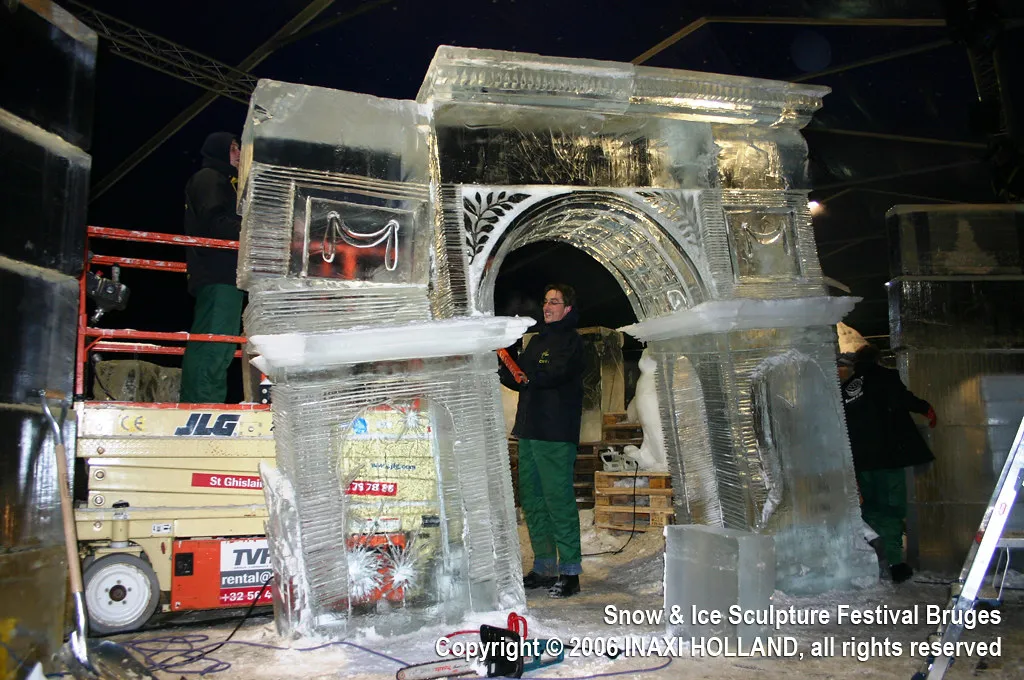
The standout addition that Brussels cannot match is the Machina Lumina light trail — a 3.5km immersive route now in its seventh year, featuring 10 interactive light installations best experienced after dark. Book tickets in advance via the the trail page on the Winter Glow website, as slots fill quickly on weekends. The trail is free to walk past but ticketed for the full interactive experience.
Simon Stevinplein, a five-minute walk from Grote Markt, is the quieter craft hub: wood-carved toys, traditional Belgian lace, and regional foods from local makers. Many stallholders here make their products by hand, and the square's tree-lined edges and canal-adjacent cafés make it a slower, more personal browse than the busier main square.
Brussels Christmas Market: Winter Wonders
Brussels' Winter Wonders is one of Europe's largest Christmas events, linking Grand Place, Place Sainte-Catherine, Marché aux Poissons, Place de la Bourse, and Place de la Monnaie into a 2km festive trail. Over 250 wooden chalets sell everything from artisan gifts to tartiflette and maple-glazed poutine from the Canadian stalls at Sainte-Catherine. The market runs from 28 November 2025 through 4 January 2026, open daily from 12:00 to 22:00, with shorter hours on Christmas Eve and New Year's Eve (closing at 18:00).
The headline spectacle is the Grand Place light show, projected onto the UNESCO-listed guild halls every 30 minutes on weekends and hourly on weekdays. Arriving early evening — around 17:00 — lets you catch the first show and then work through the market squares as the crowds thin. The covered ice rink at Place de Brouckère costs €10 for those over 16, €5 for under 16s, and €25 for a family of two adults and two children. Unusually, the rink is covered by a transparent roof, making it a viable wet-weather activity. Advance booking is not available — just turn up on the day.
Place de la Monnaie is the quietest of the five squares: the National Opera's choir performs live here throughout the season, and heated dome bars make it a good stop for a break. Place de la Bourse, framed by the newly restored former Stock Exchange building, is the most photogenic stop for locals. The Brussels City Museum on the Grand Place is also worth a quick visit for context on the city's history.
Things to Do Near the Markets
Both cities offer enough beyond the market stalls to fill a full day. In Bruges, horse-drawn carriage rides depart from the western side of the Markt Square near Sint-Amandsstraat, with Wednesday morning departures from Burg Square. A canal boat tour adds a different perspective: all five embarkation points in the city center follow the same route at the same price, so board from whichever is closest. The Belfry climb (366 steps, UNESCO-listed) gives the best winter panorama over the rooftops. Ice skating is available at King Albert I Park or Minnewater Lake for €8 per person, with under-4s skating free.
In Brussels, the Galeries Royales Saint-Hubert — a glass-roofed shopping arcade a short walk from the markets — is beautifully decorated for Christmas and worth visiting even without buying anything. Santa's workshop near St. Catherine's Church runs story-time sessions and craft workshops for children, with live shows on Wednesdays from 15:00 to 19:00. The Grand Place light show is free with no booking required; for a bird's-eye view, the City Hall Tower evening experience gives a 360-degree panorama of the show.
Brussels also runs Winter Pop, a family-focused event across three neighborhoods (Marolles, Square Ambiorix, and Laeken) on three weekends during the season, with performances by local artists from 12:00 to 22:00. This is the event that most day-trip guides skip, but it is worth factoring in if you are traveling with children.
What to Eat at the Belgian Christmas Markets
Belgian Christmas market food is genuinely worth planning around. At the top of the list: Liège waffles, which are warm, chewy, and caramelised at the edges from pearl sugar — different from the flat Brussels waffle sold in tourist shops. Belgian hot chocolate is equally serious; ask for "moitié-moitié" (half milk, half cream) for the richest version, or look for the small bar beside the Ferris wheel in Brussels, which serves hot chocolate with amaretto. Belgian fries served in paper cones with seasonal sauces (truffle mayo, mustard-beer dip) are best bought from stalls with queues of locals.
For drinks, jenever — a juniper-based spirit and Belgium's precursor to gin — is sold at most market stalls and is best served neat over ice. The markets also stock a wide range of seasonal Belgian beers, including abbey ales and winter warmers brewed specifically for Christmas. Artisan chocolate and pralines are the most popular gift purchase; the tip here is to sample a four-truffle flight before committing to a box.
One food note specific to Bruges: the market at Grote Markt leans toward Belgian classics, while Simon Stevinplein has more gourmet regional food from local producers. In Brussels, the widest international food variety is at Place Sainte-Catherine, where the Canadian stalls serve maple syrup, ice wine, and poutine alongside the standard Belgian fare. Carry some cash — not all vendors at either market accept card payments.
Where to Stay Near the Christmas Markets
Accommodation fills fast at both cities during the market season. In Brussels, budget options start around €70 per night at Hotel Campanile Brussels (note: 15 minutes from Grand Place by bike). Mid-range stays like Novotel Brussels City Centre run from about €120 and sit between the Bourse and Sainte-Catherine markets with an indoor pool. At the luxury end, Hotel Amigo Brussels starts at €420 per night, placed between Grand Place and Manneken Pis. Staying within a 10-minute walk of the Grand Place is worth a small premium given the five-square spread of the market.
In Bruges, canal-side rooms are the prize booking. Budget travelers can use ibis budget Brugge Centrum Station from €60–€80 per night, a short walk from the market square. Hotel Augustyn Brugge offers double rooms from €87 with family rooms and kitchenettes available. Hotel Dukes' Palace — a former Burgundian aristocratic residence — starts at €232 for a superior room and includes a spa with a salt wall built from 10,000-year-old Himalayan stone. If possible, request a canal-facing room at any Bruges hotel; the view after dark during December is the city at its best.
When to Go (and How to Beat the Crowds)
Bruges is significantly more overtouristed than Brussels relative to its size. The city receives roughly 8 million visitors a year in a city of 112,000 people; Brussels, with 1.3 million inhabitants and 6 million annual visitors, absorbs tourism more easily. During Christmas market season, day-trip crowds pack Bruges between 10:00 and 18:00. The most useful single tip: spend at least one night in Bruges rather than visiting as a day trip. Arriving the evening before means you explore the market squares when they are quiet, and the canal-lit streets at night are the version of Bruges worth seeing.
If your dates are fixed and you cannot stay overnight, Tuesday and Wednesday see the lowest footfall of any weekday. Start with the Belfry at opening time, take a canal cruise over lunch when queue times are highest for the stalls, and reserve Simon Stevinplein for the afternoon when tour groups have moved on. The Winter Glow light trail is best after 19:00 regardless of the day — the installations are interactive and the experience loses nothing in a smaller crowd.
In Brussels, the market is spread across five squares over 2km, which naturally dilutes crowd density compared to Bruges' two compact hubs. The busiest period is the Grand Place light show window (17:00–19:00 on weekends); arriving just before the show and moving to Place de la Bourse or Place de la Monnaie immediately after lets you see the spectacle without the post-show crush. Weekday mornings from 12:00 are the quietest window across all five squares.
Pick Bruges If...
Bruges rewards a specific kind of traveler — one who values atmosphere over scale and is happy to slow down. First-time visitors to a European Christmas market almost always prefer Bruges, because the medieval city wraps the market stalls in a genuine sense of place that purpose-built event spaces cannot replicate. The official Winter Glow program also packs in enough variety — light trail, ice skating, carriage rides — to fill a full day without feeling rushed.
- Romance and canals are your priority: medieval streets lit for Christmas, gondola-style canal boat rides, less crowded than Brussels evenings
- You want a do-it-all day trip or short overnight: 10-minute walk from train station, two compact market hubs close together, manageable in one full day
- You are visiting Christmas markets for the first time: iconic European setting, smaller scale is less overwhelming, strong visual backdrop
- You are traveling with young families: ice skating at €8 per person, under-4s skate free, compact layout easy with a pushchair
Pick Brussels If...
Brussels is the better pick when market scale and variety matter more than medieval charm. The city's five linked market squares each have a different character — from the opera choir performances at Place de la Monnaie to the alpine-style curling track at Place de Brouckère — so two days still leaves things undiscovered. Arriving via Eurostar also makes Brussels the natural first stop: the trip from London St Pancras takes just 1 hour 53 minutes, and onward trains to Bruges depart Brussels-Midi up to four times an hour.
- The Grand Place light show is on your list: free show every 30 minutes on weekends, projected onto UNESCO guild halls, best after dark around 17:00–18:00
- You want nightlife after the market closes: bars in Sainte-Catherine open past midnight, more variety than Bruges' 22:00 closings, clubs like C12 and Fuse nearby
- You are arriving by Eurostar from London: direct train takes 1 hour 53 minutes, Brussels is the natural gateway city, easy train onward to Bruges
- Your group wants maximum food variety: 250-plus stalls across five squares, Canadian, French, Belgian food zones, Ferris wheel views over the market
The Bottom Line
In our view, Bruges wins on atmosphere and Brussels wins on scale — and the good news is that the two cities are only an hour apart by train. For the average first-time visitor to Belgian Christmas markets, Bruges is the stronger single-city pick: the medieval setting, the 3.5km light trail, and the intimate canal backdrop create a coherent experience that feels purpose-built for December. Brussels is better suited to repeat visitors or those who want a bigger, more urban Christmas experience with proper nightlife.
If you can spare 2–3 days, the obvious play is to combine both: one night in Bruges for the atmosphere, then travel to Brussels for the market scale and the Grand Place show. Check our guide to Vienna vs Budapest Christmas markets if you are weighing other Central European options for the same trip. Whichever city you choose, both markets run free entry from late November through early January 2026 — just book accommodation early, especially in Bruges where canalside rooms sell out fast.
Frequently Asked Questions
Which city in Belgium has the best Christmas markets?
Bruges wins on atmosphere with its candlelit canals and medieval setting; Brussels wins on scale with 250-plus chalets across five linked squares. For a first visit, Bruges is the stronger single-city pick. If you have 2–3 days, combining both is the best approach.
Is it better to go to Brussels or Bruges for Christmas?
Go to Bruges if you want an intimate, fairy-tale Christmas atmosphere and a compact day-trip format. Go to Brussels if you want the largest market variety, the Grand Place light show, and nightlife after the stalls close. Both markets run from late November to early January.
How long do you need at each Christmas market?
Bruges is manageable in one full day, though an overnight stay lets you explore the 3.5km Winter Glow light trail after dark. Brussels needs at least two days to cover all five market squares. See our days-needed guide for a detailed breakdown.
Are the Brussels and Bruges Christmas markets free?
Both markets are free to enter. Paid extras include ice skating (€8 per person in Bruges; €10 for over-16s in Brussels), the Bruges Winter Glow light trail, and the Belfry climb. Most food and drink stalls accept cards, though carrying some cash is wise for smaller vendors.
Can you do both Bruges and Brussels in one trip?
Yes — a direct Intercity train connects Brussels-Midi to Bruges in about one hour, with services running up to four times an hour. A 2–3 day itinerary covering one night in each city is the most popular approach and easily arranged without a car.
Related in Belgium: Best Christmas Markets in Belgium and the Netherlands. See also: festivals and events in Bruges.
Belgium offers two genuinely different Christmas market experiences within easy reach of each other. Bruges delivers the fairy-tale medieval canal setting that most people picture when they imagine a European Christmas market; Brussels delivers the scale, the Grand Place spectacle, and the late-night energy. Both are compelling — and the hour-long train ride between them means you really do not have to choose just one.
Free guide: Europe's Festival Calendar
A month-by-month map of Europe's unmissable festivals — with the best dates to visit each and a local tip you won't find in the guidebooks.
You might also like


Continue reading
More guides you'll find useful


