Notting Hill Carnival Guide 2026
Your complete Notting Hill Carnival guide: 2026 dates, parade route, schedule, food tips, and first-timer advice for London's biggest free street party.
On this page
Your Complete Notting Hill Carnival Guide
Every August bank holiday, the streets of west London transform into one of the world's great street parties. Notting Hill Carnival draws around two million people over two days, making it Europe's largest annual street festival. Whether you're a first-timer or a returning regular, knowing what to expect makes the whole experience far more enjoyable. Our guide to Europe's best cultural festivals covers the continent's top events, but Carnival deserves its own deep dive.
Free guide: Europe's Festival Calendar
A month-by-month map of Europe's unmissable festivals — with the best dates to visit each and a local tip you won't find in the guidebooks.
What Is Notting Hill Carnival?
Notting Hill Carnival is a huge, free street celebration rooted in London's Caribbean community. It began in 1966, though a predecessor event was organised earlier by Claudia Jones in response to racial tensions facing the Windrush Generation. Today it is the world's second largest carnival after Rio de Janeiro, and the undisputed champion of European street parties. The event celebrates Caribbean culture through music, costume, food, and dance that spills across entire neighbourhoods.
At its heart, Carnival is about community and joyful resistance — a tradition that has grown bolder with every passing decade. Spectacular Mas ('masquerade') bands march in elaborate, hand-crafted costumes that take months to build. Dozens of sound systems line the streets, pumping out everything from calypso and reggae to soca and dancehall. Attending even once tends to leave a permanent mark on how you think about street festivals.
Entry to the main carnival area is completely free, which is part of what makes it so democratic and accessible. The official Notting Hill Carnival website is the best place to monitor announcements as the event approaches. Only the Saturday evening Panorama Steel Band Competition requires a ticket. Everything else — the parade, the sound systems, the food stalls — is open to all.
Notting Hill Carnival 2026 Dates and Schedule
Carnival runs across three days in 2026, centred on the August bank holiday weekend. The Saturday evening event is a ticketed warm-up, while Sunday and Monday are the main free days. Both parade days draw enormous crowds, but they have very different characters and energy levels. Planning which day suits you best is one of the smartest moves a first-timer can make.
On both Sunday 30 August and Bank holiday Monday 31 August, a 72-second silence is observed at 3pm. This silence honours the 72 people lost in the 2017 Grenfell Tower fire, which happened just a short distance away, as well as Kelso Cochrane — a young Antiguan carpenter whose racially motivated murder in Notting Hill in 1959 became one of the original catalysts for Carnival itself. It is a powerful and moving moment in the middle of an otherwise jubilant celebration. Arriving before 3pm lets you experience this solemn tribute alongside the festivities.
- Saturday 29 August 2026 (4pm–11pm)
- Event: Panorama Steel Band Competition
- Venue: Emslie Horniman's Pleasance Park, near Trellick Tower
- Tickets: Required — check nhcarnival.org
- Best for: Steel pan fans and a calmer warm-up night
- Sunday 30 August 2026 (from 6am)
- Opens: J'Ouvert procession at sunrise, 6am
- Ceremony: Official opening at 10am, children's parade follows
- Fun Mas: Brightly coloured paints and powder thrown at willing spectators
- Sound systems: Noon until 7pm at Pleasance Park and Powis Square
- Best for: Families and a slightly less intense atmosphere
- Monday 31 August 2026 (from 10.30am)
- Opens: Main costume parade at 10.30am
- Sound systems: Around 40 pumping from midday
- Energy: Loudest, most crowded, most spectacular day
- Best for: The full carnival experience
Parade Route and How to Get There
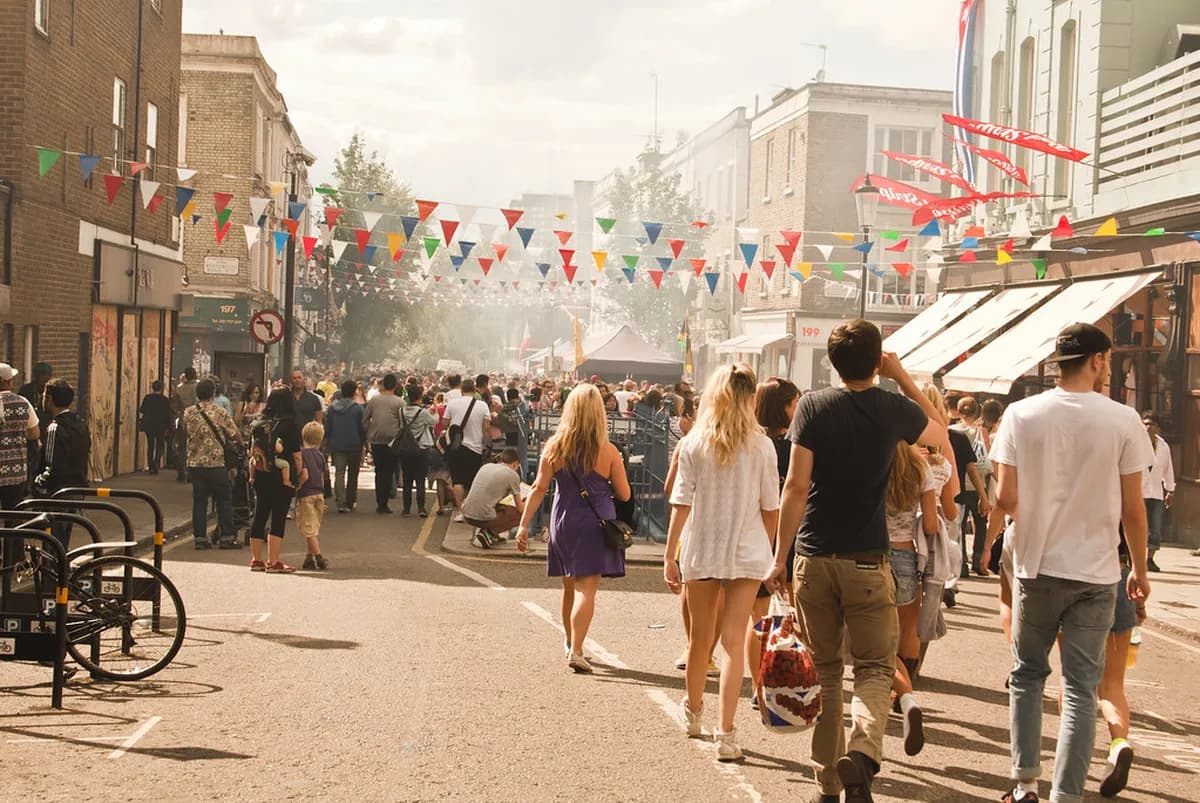
The parade route stretches over three miles through the streets of Notting Hill, Ladbroke Grove, and Westbourne Park. It begins near Westbourne Park station, winds down to Westbourne Grove, and loops back up toward Ladbroke Grove. Vast sections of W10 and W11 are pedestrianised over the weekend to handle the sheer volume of people. Downloading the Notting Hill Carnival map before you leave helps you plan where to position yourself.
Multiple Tube stations are within walking distance of the carnival area. The Central line serves Queensway, Notting Hill Gate, and Holland Park; the Circle and Hammersmith & City lines stop at Westbourne Park, Ladbroke Grove, and Latimer Road. However, TfL regularly closes stations near the carnival due to overcrowding, so always have a backup plan and check updates on the day. If buses are your preferred option, note that many routes are diverted and some terminate early near the perimeter.
Cycling or walking from a nearby neighbourhood is often the smoothest option once you know the route. Driving anywhere close is not realistic — the road closures extend well beyond the immediate parade streets. Meeting friends should happen well outside the Notting Hill area before you enter the crowd. Mobile signal becomes genuinely unreliable once you're surrounded by two million people, so agree a meeting point in advance and don't rely on being able to call anyone once you're inside.
Taking Kids to Notting Hill Carnival 2026
Sunday is the family day at Carnival, and it is noticeably calmer than Monday — though it still gets very busy. The children's parade takes place after the official 10am opening ceremony, with younger performers dancing through the streets in elaborate costumes. Sunday also features the Fun Mas procession, when brightly coloured powder and paint are thrown at willing spectators, which children tend to love. Keep them dressed in something you don't mind getting splattered.
Keeping children close is essential once the streets fill. Dressing them in bright, distinctive colours makes them easier to spot in a crowd and adds to the celebratory atmosphere. Pack snacks to avoid long food queues, and carry water rather than relying on finding a stall quickly. Biodegradable glitter, sequins, and feathers are Carnival staples — getting children involved in the costume side of things tends to make the whole day more memorable for everyone.
Agree a clear meeting point near a landmark outside the core carnival area before you go in. Phone signal is unreliable inside the event, so verbal arrangements made beforehand are more reliable than texts. If a child does become separated, uniformed stewards are positioned throughout the area and are the fastest route to help. Arriving by 10am gives families the best chance of finding a good position before the parade crowds build.
Carnival Parades and Performances
The Notting Hill Carnival parade is driven by over 50 Mas bands whose costumes represent months of craft work. Each band moves through the streets with its own musicians, sometimes drawing thousands of followers behind them. The sheer scale of the colour and pageantry is something photographs genuinely struggle to capture. Check the 2026 participants list on the official site as the event approaches for the full lineup.
Sunday begins with J'Ouvert — a pre-dawn procession in Ladbroke Grove that starts around 6am — featuring steel bands and African drummers. The word J'Ouvert comes from the French 'jour ouvert,' meaning 'opening of the day,' and the sunrise setting makes it genuinely atmospheric. The Fun Mas parade follows later on Sunday, when brightly coloured powder and paint are thrown at willing spectators. Live stages at Emslie Horniman's Pleasance Park and Powis Square run from noon until 7pm on both days.
Around 30 to 40 sound systems line the side streets, each playing a different genre — from house to calypso to dancehall. Wandering between sound systems is one of the great pleasures of Carnival; every street has its own musical microclimate. The Panorama Steel Band Competition on Saturday evening is the most prestigious steel pan event outside the Caribbean. Five bands each perform a 10-minute piece entirely from memory, with no sheet music allowed — the standard is extraordinary.
Food, Drink, and Toilets
More than 300 food and drink stalls are spread around the carnival area, with Caribbean cuisine taking centre stage. Expect jerk chicken, curry goat, ackee and saltfish, Jamaican patties, and richly spiced rice dishes at almost every turn. Vegetarian and vegan options have grown significantly in recent years, so there is plenty for non-meat eaters too. Queues at popular stalls can run long, so plan to eat before the main parade peaks around midday.
Bring a mix of cash and a contactless card. Many stalls still prefer cash, and local ATMs near the carnival can run out of money or have very long queues during peak hours. Four free drinking water points are spread around the area — on Alderson Street, Kensington Park Road (at the junction with Arundel Gardens and outside Kensington Temple Church), and Shrewsbury Road at the junction with St. Stephen's Gardens. Staying hydrated matters, especially if you are dancing or spending long stretches in direct sun.
Porta-toilets are positioned throughout the carnival area, but queues can be extremely long, especially on Monday. Some local residents take advantage of the situation by charging for use of their facilities — it happens every year and is worth factoring into your plans. Carrying your own tissue and hand sanitiser is a small step that experienced Carnival-goers swear by. Think carefully before that third drink; toilet logistics are one of the few genuine discomforts of an otherwise exceptional day.
First-Timer Tips for Notting Hill Carnival
Arriving by 10am on either day gives you the best chance of finding a good position before the streets fill completely. Sunday is calmer and more family-oriented, making it the better choice if you're anxious about very large crowds. Monday delivers the biggest spectacle but also the densest crowds, so pace yourself and drink water regularly. Going with the flow rather than following a rigid schedule tends to produce the best Carnival memories.
Dress in bright colours or festive costume if you want to feel part of the celebration — nobody overdresses at Carnival. Glitter, sequins, and feathers are welcomed enthusiastically, and wearing something vibrant makes the day more fun. Avoid bringing large bags, and if you must carry one, keep it zipped in front of you at all times. Carnival is one of London's most joyful days, but it rewards sensible preparation.
British summer weather is famously unpredictable, even in late August, so packing a lightweight rain jacket is wise. Sunscreen is equally important for the stretches when the sun does break through. Wear comfortable shoes — you will be on your feet all day across uneven streets and pavements. Keep your bag small and your valuables to a minimum, as any large crowd attracts opportunist pickpockets.
Don't try to stick rigidly to the official programme. Magical moments at Carnival often come from unexpected sources — a sound system tucked down a side street playing something you've never heard, or a Mas band that stops to dance with the crowd. The official Carnival website and social media channels sometimes offer live broadcasts, which is useful if you want to track where the main parade is at any given moment without fighting through the densest sections.
Notting Hill Carnival 2026 After-Parties
After the main events wind down around 7pm, many London venues host official Notting Hill Carnival after-parties throughout the city. Brixton is the natural choice for continued Caribbean-themed celebrations — it has a deep connection to the same communities that built Carnival, and the atmosphere carries on from the main event seamlessly. Hackney and Shoreditch are popular alternatives with more club-focused nights. If you're planning to attend after-parties, book tickets in advance — they sell out quickly after the main lineup is announced.
The whole weekend is a genuinely unique slice of London culture that sits alongside events like St Patrick's Day in Dublin as one of Europe's great street celebrations. Whether you go for Sunday's family atmosphere, Monday's full spectacle, or the Saturday Panorama warm-up, the experience tends to stay with you long after the music fades.
Frequently Asked Questions
Is Notting Hill Carnival 2026 free to attend?
Yes, attending the main carnival — watching the parade, enjoying the sound systems, and soaking up the atmosphere — is completely free and requires no ticket. The one exception is the Saturday Panorama Steel Band Competition, which is a ticketed event. All food and drink stalls are separate purchases, so bring cash or a contactless card.
What time does Notting Hill Carnival start in 2026?
On Sunday 30 August 2026, the J'Ouvert procession begins at 6am, with the official opening ceremony at 10am and sound systems running from noon to 7pm. On Monday 31 August 2026, the main costume parade begins at 10.30am, with sound systems starting around midday. Both days include a 72-second silence at 3pm to honour the Grenfell Tower victims.
Which day of Notting Hill Carnival is best for families?
Sunday is widely regarded as the family-friendly day at Carnival. It features the children's parade and a slightly less intense atmosphere compared to Monday. That said, it still gets very busy, so keep children close, bring snacks to avoid long food queues, and consider dressing them in bright colours to spot them more easily in the crowds.
How do I get to Notting Hill Carnival by Tube?
The closest stations are Notting Hill Gate, Westbourne Park, and Ladbroke Grove. However, stations can close without warning due to overcrowding, so always have a backup route planned. Check TfL updates on the day and allow at least 45 extra minutes for your journey.
What should I wear to Notting Hill Carnival?
Wear comfortable shoes above all else — you will be walking and standing for many hours. Beyond that, bright colours and festive costume are warmly welcomed. Pack a light rain jacket for unpredictable British weather and sunscreen for when the sun appears. Keep your outfit practical: small bags, no expensive jewellery, and layers you can remove if it warms up.
Visiting London for more than one festival? See our complete guide to festivals and events in London.
Notting Hill Carnival is one of those experiences that genuinely earns its reputation as a highlight of the European festival calendar. The combination of free entry, extraordinary music, world-class street food, and a sense of deep cultural pride makes it unlike anything else in London. With the right preparation — good shoes, cash in your pocket, an early start, and a flexible plan — the weekend rewards you richly. We hope this guide helps you make the most of one of the world's great street celebrations.
Free guide: Europe's Festival Calendar
A month-by-month map of Europe's unmissable festivals — with the best dates to visit each and a local tip you won't find in the guidebooks.
You might also like


Continue reading
More guides you'll find useful