How To Get To Roskilde Festival: 8 Essential Arrival Tips
Master your arrival at Roskilde Festival with our guide to trains, shuttle buses, parking, and the crucial 22:00 wristband exchange cutoff.
On this page
How To Get To Roskilde Festival: 8 Essential Arrival Tips
Roskilde Festival stands as one of the largest and most iconic cultural events in Northern Europe. Last updated May 2026, this guide ensures you navigate the complex logistics of the Danish countryside with ease. Planning your journey correctly is essential for securing the best camping spot and avoiding long entry queues. This event is frequently cited among the best music festivals in Europe for its unique atmosphere.
Most attendees travel from Copenhagen, but international visitors arrive via various transit hubs across the region. The festival site is located just south of Roskilde city, making it highly accessible by public transport. Understanding the difference between the regional station and the dedicated festival platform saves significant time on arrival. We provide the exact costs and schedules needed to reach the gates without unnecessary stress.
Free guide: Europe's Festival Calendar
A month-by-month map of Europe's unmissable festivals — with the best dates to visit each and a local tip you won't find in the guidebooks.
Choosing Your Arrival Day and Camping Area
The official camping areas open on Saturday, 27 June 2026 at 16:00. Arriving early allows you to join the famous orange feeling as thousands of people rush for spots. Selecting the right entrance depends entirely on which camping zone you intend to call home for the week. Many budget-conscious travelers consider this one of the cheapest music festivals in Europe when camping is utilized effectively.
Entrance East serves those heading toward Dream City, Clean Out Loud, Handicamp, Leave No Trace, Common Ground, and the Regular Camping East zones. Entrance West and Entrance North are the primary gateways for Regular Camping West and Get A Place West. Entrance South covers the quieter areas including Get A Late Spot, Get A Silent Spot, and Settle'n Share. Consulting the arrival map before you leave Copenhagen is essential — it shows exactly which wristband exchange point sits nearest to your camping area.
Camping closes on Sunday, 5 July at noon. All four main entrances — North, East, South, and West — are open 24 hours a day throughout the festival once it begins. The inner festival grounds (Indre Plads) open Wednesday at 16:00 and daily from Thursday onwards at 10:00. Checking the weather forecast before leaving is worth doing; heavy rain can turn the walk from the station into a muddy trudge, making the festival train a far better option.
Early Entry: How to Get in Before the Crowd
Early Entry tickets let you enter the grounds from 10:00 on Saturday, 27 June — six hours before the official 16:00 opening. You book a specific 30-minute time slot between 10:00 and 15:30. The earliest slots fill within minutes of going on sale, so have the webshop open when tickets release on 7 May at 10:00. An Early Entry ticket does not guarantee a spot in Regular Camping; if your preferred area is full, head to the Camping Wayfinding booth east of the railway bridge, open until 20:00 on the opening Saturday.
There are six Early Entry ticket types for 2026: Entrance West, Entrance East, Entrance South, Caravan North, Caravan South, and the festival train from Roskilde Station to the festival platform in West. The train option costs 80 DKK and includes the train ticket; Early Entry trains run from Roskilde Station starting at 09:30. If you book Early Entry for Entrance West, do not take the Nobina shuttle bus to the festival — it only stops at Entrance East.
Early Entry tickets are non-transferable and linked to your personal ticket wallet. If you purchase them for a group, everyone must arrive together, as only the ticket holder can present each pass. Early Entry tickets for Caravan Camping and Sleep-In Buses require only one ticket per vehicle, not one per person. Reviewing a European music festival packing list helps ensure you have everything ready for this early start.
Arriving by Train: The Festival Train and Roskilde Station
The train is the fastest and most popular way to reach the festival. Regional trains depart Copenhagen Central Station for Roskilde Station every 20 minutes. The journey takes about 25 minutes and costs approximately 60 DKK. Validate your ticket before boarding — Danish rail authorities issue heavy on-the-spot fines for fare evasion.
From Roskilde Station, a dedicated festival train runs directly to the festival platform beside Camping West. Trains run approximately every 20–40 minutes throughout the day. The journey takes just four minutes, and tickets cost 30 DKK, purchased on the platform by card only — Rejsekort is not accepted on this route. If you arrive by train, you collect your wristband directly at Entrance Train Station on the festival side, so there is no need to join the queue at another entrance.
On Saturday, 27 June, regular festival trains start at 16:23. Sunday and subsequent days see trains beginning from around 08:55 onward, with departures roughly every 30 minutes. Note that track maintenance can cause occasional cancellations, so allow buffer time if you have a stage you cannot miss. The festival train is the best choice for those camping in Camping West; those in Camping East should take the Nobina bus or walk instead, as the train drops you in West and requires a full cross-campsite walk.
Shuttle and Long-Distance Bus Options
Nobina operates shuttle buses from three pick-up points directly to Entrance East throughout the festival period. From Roskilde Station (Ny Østergade), buses run around the clock from Saturday, 27 June at 07:00 until Sunday, 5 July at 15:00; the fare is 30 DKK, payable by card only on board. From Køge Nord (Nordstjernen), buses run on Saturday and then Wednesday through Saturday between 10:00 and 24:00 for 60 DKK. From Copenhagen Bus Terminal at Dybbølsbro, buses run on Saturday through Tuesday from 10:00–21:00 and Wednesday through Saturday from 09:00–04:00 for 95 DKK.
Nobina also runs an internal shuttle between Entrance East and Entrance West throughout the festival, operating 24 hours from Saturday at 06:00 to Sunday at 15:00. This bus is primarily for volunteers but festival guests can ride it for 30 DKK if space permits. Volunteers riding before they have received their wristbands can board this bus for free — one of the small advantages of the volunteer role that is easy to miss in the official information.
For those traveling from Jutland or Funen, Flixbus offers long-distance coaches directly to Roskilde Festival. Tickets go on sale in May and can be booked at the Flixbus website. This is the most cost-effective option for travelers coming from Aarhus, Odense, or other mainland Danish cities who prefer not to change at Copenhagen. All shuttle bus routes deposit passengers near Entrance East, where a wristband exchange is immediately available on arrival.
Cycling and Walking to the Festival
Walking from Roskilde Station to the festival is straightforward and takes roughly 30–45 minutes depending on your gear load. The recommended route for walkers is via Maglegårdsvej toward Entrance North or Entrance West; signage is well-placed once you leave the station. The walk takes you through quiet Roskilde suburbs where local shops sell last-minute snacks and supplies. This is a good option for those traveling very light on day visits.
Cycling is the most locally Danish way to arrive, and thousands of bikes park at the gates each day. Free bicycle parking is available at Entrance West, Entrance East, and Entrance North. You can exchange your festival ticket for a wristband at the nearest wristband exchange when you arrive by bike. Note that inner-area bicycle access requires a special bike permit, and the service window for bringing your bike into the inner site runs 04:00–10:00; outside these hours, bikes must remain in the perimeter parking zones.
If you are cycling from Copenhagen, the journey runs about 35 kilometers and is feasible for experienced cyclists on a dry day. Most local cyclists take the regional train to Roskilde and ride the final stretch from there, which is a much more manageable 3–4 kilometers. Lock your bike securely even in the official parking zones — bike theft at large festivals is common, and Roskilde is no exception despite its generally low-crime setting.
Driving, Parking, and Drop-off Logistics
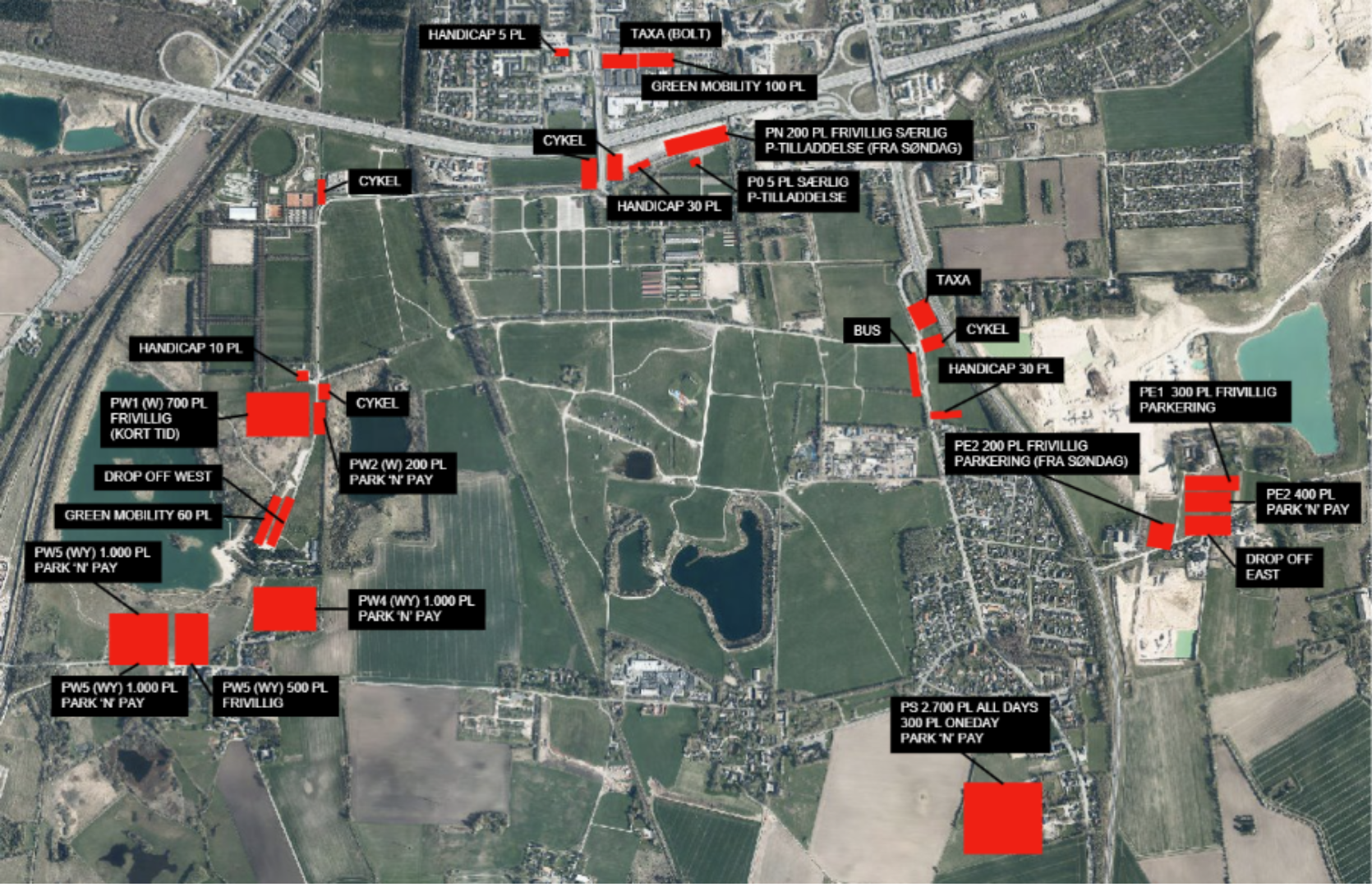
Driving to the festival is convenient but requires careful planning due to extensive road closures. Pre-book your parking via the official webshop from 7 May at 10:00. There are four paid parking areas: Park n' Pay Far West (Darupvej/Gammelgårdsvej), Park n' Pay West (Darupvej), Park n' Pay East (Øde Hastrupvej), and Park n' Pay South (Vor Frue Hovedgade). You can also purchase parking on arrival if spaces remain. Parking opens at 07:00 on Saturday, 27 June and operates 24 hours daily until closing at 15:00 on Sunday, 5 July. You can see map of the parking areas to find the lot closest to your camp.
There are two drop-off zones for those arriving by car without parking. Drop-Off West sits between Darupvej and Gammelgårdsvej; Drop-Off East is at Øde Hastrupvej. From either zone, a short walk brings you to the nearest entrance. GreenMobility electric shared cars have dedicated parking spaces at Park n' Pay Far West, Drop-Off Zone West, and north of Entrance North.
Disabled parking is available near all entrances for holders of a valid EU parking card. Volunteers have access to restricted lots near Entrance West but require a valid digital permit. Unauthorized vehicles in restricted zones are towed immediately at the owner's expense. Daily visitors find the train far more efficient than dealing with parking-lot exits after headliner sets — traffic can back up for an hour or more after midnight shows. If you are staying off-site, check out where to stay for Roskilde Festival for nearby accommodation options.
Entrances and Wristband Exchange Procedures
There are five entrances to Roskilde Festival 2026: Entrance North, East, South, West, and the Entrance Train Station. North, East, South, and West are open 24 hours a day throughout the festival. Entrance Train Station only operates when the festival train is running. You must exchange your festival ticket for a wristband before you can pass through any entrance — without a wristband, you cannot enter even if you hold a valid ticket.
The wristband exchange hours vary by location and day, and this is where most first-timers get caught out. Here is what the official 2026 schedule states: Entrance East closes at 22:00 on Saturday, 27 June and is open 09:00–21:00 on remaining days. Entrance West closes at 22:00 on Saturday and is open 09:00–21:00 on remaining days. Entrance South closes at 21:00 on Saturday, 27 June only. Entrance Train Station follows the same 22:00 Saturday cutoff as East and West. Check-In north of Entrance North is the only 24-hour wristband exchange — it opens at 16:00 on Saturday, 27 June and remains open around the clock until 23:59 on Saturday, 4 July.
The 22:00 cutoff is the most common trap for international travelers arriving on late-night flights into Copenhagen. If your flight lands after 20:00, do not attempt Entrance East or West — go directly to Check-In north of Entrance North (address: Maglegårdsvej 14). A taxi directly to that checkpoint is recommended over navigating by public transport after midnight. Wristbands are non-transferable and must be worn at all times; security runs internal spot checks. Losing a wristband requires proof of purchase and ID to resolve, and the festival does not typically replace stolen wristbands. Being found without a valid wristband inside the festival area carries a 4,500 DKK fine. For complete arrival details, you can see all our different arrival guides here.
Camping Wayfinding and Arrival Support
Once you are through the entrance with your wristband, finding your camping spot is the next challenge. How this works depends on your camping type. If you have Special Camping (Rent A Pitched Tent, Glamping Tent, Tenthouse, etc.), you will receive an email with your exact location approximately one week before the festival — unless you purchased after 11 June, in which case contact the nearest tower on arrival. If you have Community Camping, your area contacts you directly with placement details. Regular Camping is first-come, first-served within the designated open areas in West and East.
The Camping Wayfinding booth sits east of the railway bridge and is open 10:00–20:00 on Saturday, 27 June and 08:00–16:00 on Sunday, 28 June. If your preferred Regular Camping zone is full when you arrive, staff there will redirect you to an area with space. It is not permitted to reserve extra ground with tarpaulins or rope; campsite hosts will ask you to remove them. Get A Place, Get A Silent Place, and Get A Silent Spot reservations are held only until Sunday, 28 June at 16:00, after which spots open to anyone.
Taxi ranks are positioned on the far side of Entrance East and by the Check-In north of Entrance North. The BOLT app allows you to pre-book electric taxis to the festival — CO2 savings are displayed in-app. Pirate taxis outside the designated ranks should be avoided. For Caravans, Sleep-In Buses, and MC Camping, entry is through separate dedicated entrances listed on the arrival map; check-in for these units runs 07:30–22:30 on non-opening days, and after placing your unit you must drive the car out and walk to Entrance West for your wristband.
Transport Trade-off: Which Option Suits You
Choosing your transport mode comes down to where you are camping and how much gear you carry. The festival train (30 DKK, 4 minutes from Roskilde Station) is the fastest and most direct option — but it deposits you in Camping West. If your tent goes up in Camping East, you face a full cross-campsite walk with your bags, which can take 30 minutes or more. In that case the Nobina bus (30 DKK from Roskilde Station) drops you directly at Entrance East and is a smarter call.
Cycling beats both options for those who know the route and travel light — zero cost, no queuing, and bike parking is free within meters of the entrances. Walking from the station is free too, but adds 30–45 minutes of physical effort before you even pitch your tent; not ideal after an international flight. Driving gives you the freedom to load as much gear as you like, but parking costs 400–600 DKK for the week and traffic management means you could spend more time in a car queue than on the train.
For international visitors arriving at Copenhagen Airport, the fastest overall route is: airport Metro to Copenhagen Central Station, regional train to Roskilde Station (60 DKK, 25 minutes), then festival train or Nobina bus to your entrance. From airport to wristband in under 90 minutes is realistic if your flight lands before 18:00. Anyone landing after 20:00 should prioritize reaching Check-In north of Entrance North before the secondary exchanges close; a direct taxi from the airport to that checkpoint runs around 600–900 DKK but eliminates all transfer uncertainty.
Frequently Asked Questions
Is there a train from Copenhagen to Roskilde?
Yes, regional trains depart Copenhagen Central Station every 20 minutes. The journey takes 25 minutes and costs about 60 DKK / ~$9. You can buy tickets at the station or via the DSB app.
Is the train to Roskilde included in the Copenhagen Card?
The Copenhagen Card covers transport to Roskilde Station but not the dedicated Festival Train. You must purchase a separate ticket for the final 5-minute shuttle train to the site.
What is the fastest way to get to the festival?
The fastest method is taking a regional train to Roskilde Station and transferring to the Festival Train. This entire trip from Copenhagen usually takes under 45 minutes total.
Reaching Roskilde Festival is a straightforward process if you respect the schedules and entrance rules. By choosing the festival train and arriving before the 22:00 cutoff, you ensure a seamless start. Remember to pre-book your parking and keep your digital tickets ready for the wristband exchange. We hope this guide helps you enjoy the legendary orange feeling to its fullest extent this year.
Free guide: Europe's Festival Calendar
A month-by-month map of Europe's unmissable festivals — with the best dates to visit each and a local tip you won't find in the guidebooks.
You might also like

Continue reading
More guides you'll find useful