
11 Best Christmas Markets in France and Alsace Guide (2026)
Discover the 11 best Christmas markets in France and Alsace for 2026. Includes Strasbourg, Colmar, hidden gems, parking hacks, and what to eat.
On this page
11 Best Christmas Markets in France and Alsace
Our editors have reviewed every corner of the Rhine Valley to bring you this guide to the best christmas markets in france and alsace for the 2026 season. Last updated June 2026, this list reflects the most current pricing and transport updates for travelers seeking festive magic. Alsace transforms into a storybook setting during Advent, with timber-framed houses draped in lights and the scent of cinnamon filling the air. While many visitors flock to the famous hubs, we have included several hidden gems that preserve the region's 16th-century traditions.
The history of these markets is deeply rooted in local culture, stretching back to the first written mention of a Christmas tree in Sélestat in 1521. Today, the region offers a blend of French elegance and Germanic tradition that you won't find anywhere else in the world. We suggest planning for at least four days to properly experience the contrast between the grand city squares and the intimate village courtyards. Use the strasbourg and colmar christmas market itinerary as your baseline, then branch out into the smaller villages from there.
Free guide: Europe's Festival Calendar
A month-by-month map of Europe's unmissable festivals — with the best dates to visit each and a local tip you won't find in the guidebooks.
When to Go and How to Base Yourself
Most markets in the region open during the last week of November 2026 — typically Friday, 27 November — and run daily until 24 December. A handful remain open through the New Year. Opening dates vary slightly by town, so check the official Official Alsace Christmas Portal for real-time updates before you travel.
Strasbourg is the best base for the region. It has the widest range of hotels, direct TGV connections from Paris in under two hours, and the largest market in France within walking distance of most city-center accommodation. Colmar works well as an alternative base if you want to prioritize the southern wine-road villages like Eguisheim, Riquewihr, and Kaysersberg. We recommend booking accommodation at least six months in advance; rates rise sharply from early October onward.
Crowds peak on weekends, particularly Saturdays from early December through Christmas Eve. Tuesday through Thursday mornings are consistently the quietest window. Temperatures regularly drop below freezing, so thermal layers, waterproof boots, and gloves are essential. You will spend many hours on cobblestones, so prioritize comfort over style.
Strasbourg: The Capital of Christmas
Strasbourg's Christkindelsmärik is the oldest Christmas market in France, dating back to 1570. The city's historic center is a UNESCO World Heritage Site, and during Advent it hosts 13 distinct markets across the Grande Île. The main cluster at Place Broglie features over 300 traditional wooden chalets open daily from 11:00 to 20:00, with free entry.
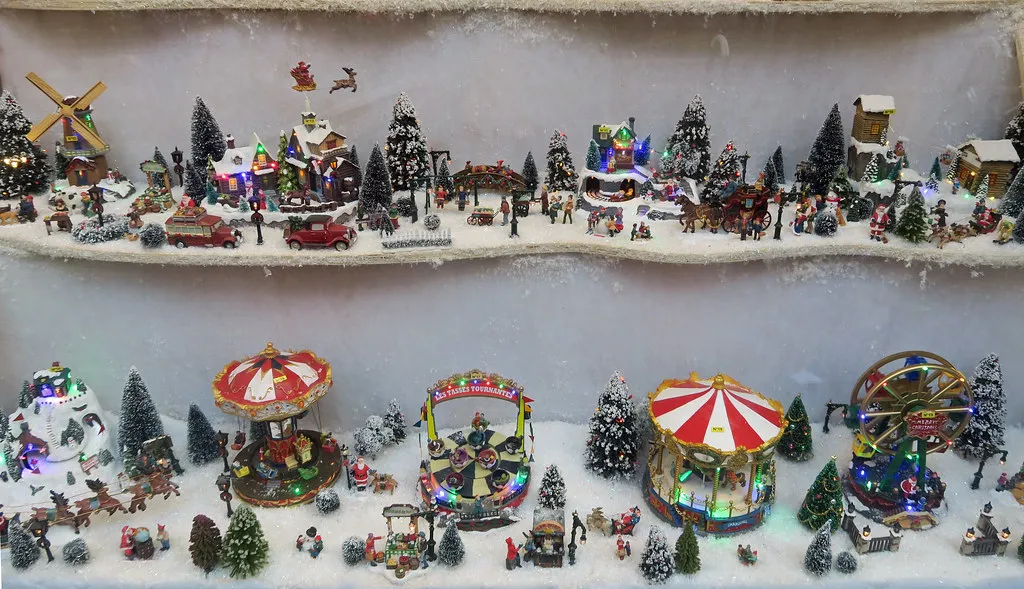
The Grand Sapin — the towering decorated Christmas tree — stands at Place Kléber, the city's main square, and is worth seeing both day and night. Nearby, the narrow streets of Petite France offer the most photographed view of timbered houses reflected in the water. White mulled wine, known locally as Vin Chaud Blanc, is a regional specialty made from Riesling and lighter than any red version you'll find elsewhere in Europe.
Parking note: The Grande Île is closed to private vehicles during the market season, including hotel garage access. Your best option is the P+Tram system: park at an outer lot and ride the tram into the center for roughly €2 to €4 for all passengers combined. The premium Parcus Parking Sainte-Odile costs €25 for 24 hours, billed in 15-minute blocks — use it only if you need city-center proximity at short notice.
Colmar: A Fairytale Setting
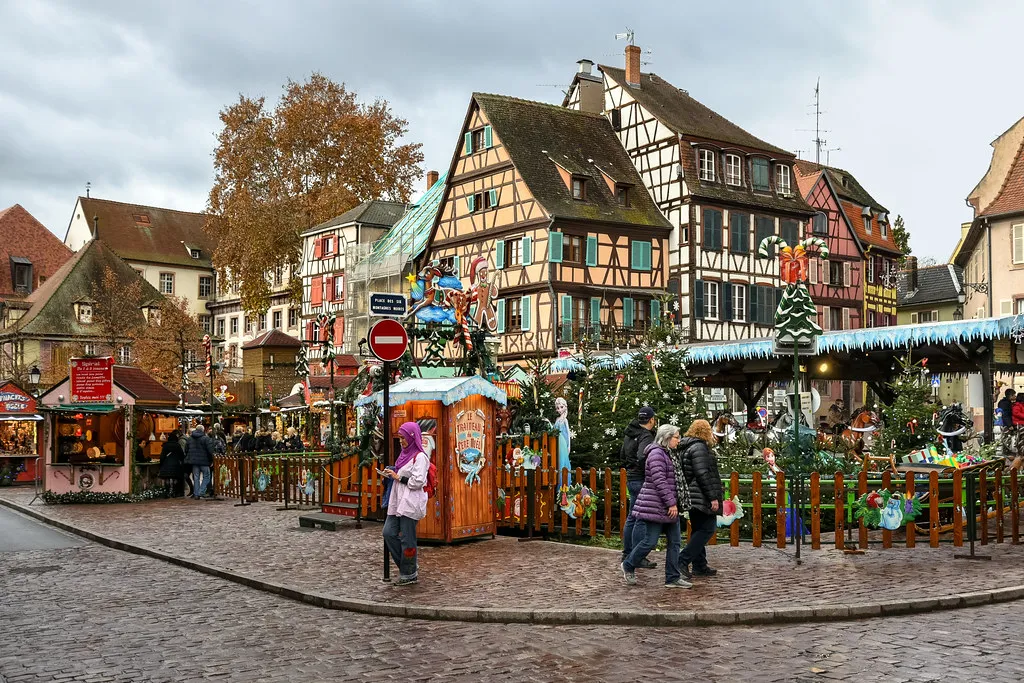
Colmar is home to the second-largest Christmas market in France. The old town hosts six distinct market zones, each occupying a different historic square, so the whole town feels like one extended festive experience. The canal district of Petit Venise is particularly spectacular at twilight, when the lights of the stalls reflect off the water. Most stalls open at 10:00 and close around 19:00, with hot snacks costing between €6 and €12.
For families, the Place des Six Montagnes Noires market in Petit Venise is designed specifically for children and draws visitors back year after year. The Marché Gourmand at Place de la Cathédrale runs food demonstrations with local chefs, making it the best spot to try tarte flambée — a thin-crust flatbread topped with crème fraîche, onions, and lardons — fresh from a wood-fired oven. The colmar christmas market is a 30-minute train ride from Strasbourg and easily combined in a two-city day trip.
Parking note: The city center is car-free during the season. Use Parking de la Mairie or Parking des Marronniers on the outskirts — both cost approximately €4 per day and are a short walk from the main market squares. Free shuttles run from the Colmar train station park-and-ride.
Riquewihr: Medieval Charm
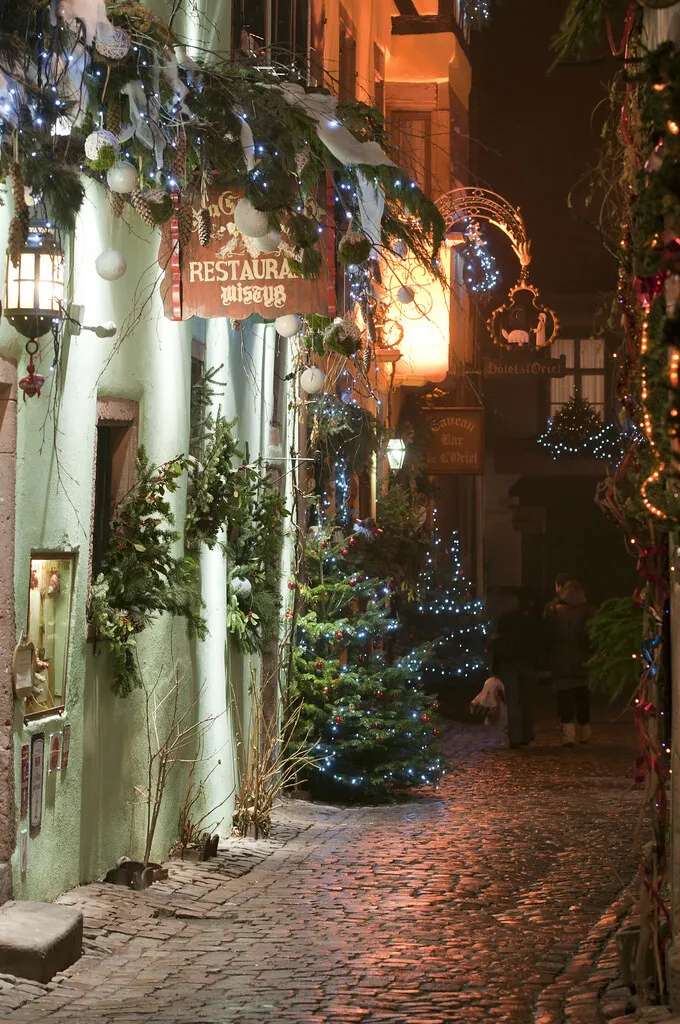
Riquewihr sits inside a perfectly preserved 16th-century walled village that requires no festive decoration to feel like a film set — the market simply adds to what is already there. The main market runs along Rue des Remparts near the city hall, with stalls selling handicrafts, local Alsatian wines, cheese, and seasonal food. The market is open daily from 10:00 to 18:30.
Arrive before 10:00 to walk the main street before tour buses arrive in the early afternoon. A Christmas treasure hunt, concerts, and special cellar events run throughout the season and are worth checking before your visit. The riquewihr christmas market is best combined with Kaysersberg on the same day, as both are accessible via the Navettes de Noël shuttle from Colmar.
Parking note: There is no parking inside the walls. A small lot outside the village gates costs approximately €4.50 per hour. We strongly recommend using the Christmas shuttle service (Navettes de Noël) from Colmar for a flat daily fee of around €10 per person and leaving your car in the city.
Kaysersberg: Authentic Traditions
Kaysersberg is widely considered the most authentic Christmas market in Alsace. Stalls at Cour de l'Arsenal and behind Sainte-Croix church prioritize local and handmade goods above all else — you will find far fewer mass-produced imports here than at the larger city markets. A separate Christmas farmers' market on Place de la Mairie sells local produce, honey, and regional preserves.
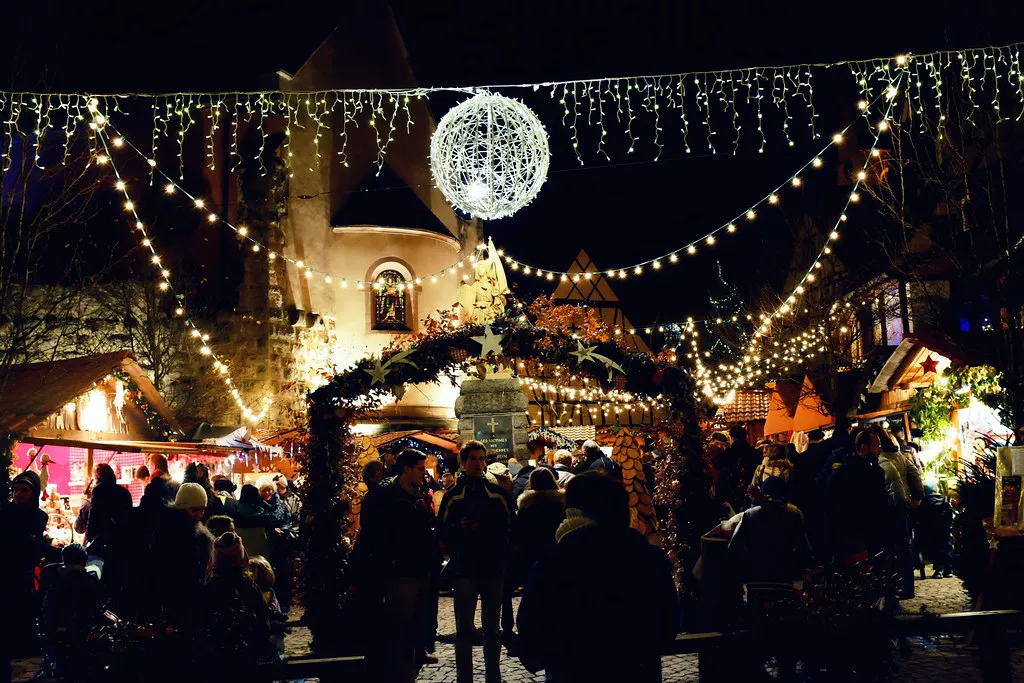
The market operates on Friday, Saturday, and Sunday only during Advent, from 10:00 to 20:00. This weekend-only schedule makes Kaysersberg feel genuinely festive rather than commercially extended. Climb to the castle ruins above the village for a panoramic view of the illuminated rooftops and surrounding vineyards — the sight at dusk is one of the best in the entire region.
Parking note: Space is limited. Use Parking Guebwiller or Parking P1 Vieille Ville, or take the Navette de Noël shuttle from Colmar to avoid the parking problem entirely.
Eguisheim: Intimate and Festive
Eguisheim is one of France's officially designated Most Beautiful Villages, and its concentric layout of colorful half-timbered houses makes it look like a Advent calendar come to life. Around 30 stalls run by local craftspeople and artisans occupy the central square of Saint-Léon, selling handmade ornaments, ceramics, and regional food. The Eguisheim Christmas Market 2026 is open daily from late November through late December.
The village is just 15 minutes from Colmar by car, making it an easy half-day add-on. Look for the Night Watchman, who tours the streets at 21:00 on specific dates to share local folklore and seasonal songs. The intimate scale means an hour or two is enough to cover everything without feeling rushed. Focus your budget on AOC wines and hand-thrown Soufflenheim pottery, which are regional specialties rarely found at larger markets.
Parking note: Small lots on the outskirts are the best option. Parking de la Mairie and Parking des Marronniers in Eguisheim both cost approximately €4 per day.
Obernai: A Hidden Gem
Obernai offers a sophisticated market focused on Alsatian flavors, just 25 minutes south of Strasbourg by TER train. Around 40 wooden chalets fill the square in front of the historic Belfry, with stalls concentrated on local produce: foie gras, bredele (spiced shortbread cookies), spiced bread, and the town's signature white mulled wine heated in a giant cauldron. This is the best market for food lovers who want quality over volume.
The town also runs a treasure quest and Christmas storytelling events throughout the season. Note that Obernai's market closes earlier than most — by 18:00 on most evenings — so plan your visit for mid-afternoon. We recommend it as a quieter alternative for anyone who finds Strasbourg too crowded on weekends.
Parking note: Parking Remparts offers free parking within walking distance of the center. The paid option, Parcus Parking Sainte-Odile, charges €25 for 24 hours in 15-minute blocks — excessive for a short visit; use Remparts instead.
Sélestat: The Birthplace of the Christmas Tree
Sélestat holds a genuinely unique place in Christmas history: the oldest written mention of a decorated Christmas tree anywhere in the world dates to 1521 and comes from this town. Each year, Sélestat builds its entire market around this heritage, with an exhibition tracing the evolution of Christmas tree decoration across five centuries. Entry to the main display inside Saint-Georges Church is free.
The market is open daily from 10:00 to 19:00. Sélestat often gets overlooked by visitors rushing between Strasbourg and Colmar, which means crowds are lighter and the experience feels more local. The Meisenthal glassworks display, showcasing hand-blown contemporary ornaments, is one of the more distinctive craft demonstrations in the entire region. If you are interested in the cultural roots of the Christmas tradition rather than just the spectacle, Sélestat is essential.
Mulhouse: The Fabric of Christmas
Mulhouse leans into its weaving and textile heritage in a way no other Christmas market in France does. Each year, a new Christmas Fabric is unveiled — a unique textile pattern that drapes the town hall and becomes the visual theme of the entire market. You can purchase items made from the year's fabric as genuinely distinctive souvenirs that are unavailable anywhere else.
The main market at Place Réunion sets up beneath the Temple of Saint Étienne and is open daily from 10:00 to 20:00 with free admission. A Ferris wheel in the square gives a panoramic view of the illuminated church facade. The mulhouse christmas market is also the best-connected of the smaller cities, with direct trains from Strasbourg (55 minutes) and Colmar (20 minutes).
Parking note: The most practical option is the Nouveau Bassin P+Tram or Université P+Tram car park. Both charge approximately €2 for parking plus a free tram ride into the city center for all passengers in the vehicle — making this the best-value parking deal in the entire Alsace region.
Gengenbach: A German Side Trip
Located 40 kilometres southeast of Strasbourg across the Rhine in Germany, Gengenbach is home to what is claimed to be the world's largest Advent calendar. From 1 December, the 200-year-old town hall facade opens one window per night at 18:00, each decorated by a different international artist. The ceremony draws a crowd worth experiencing at least once, and the surrounding half-timbered architecture looks strikingly like Alsatian villages just across the border.
A direct train from Strasbourg takes approximately 35 minutes, making this one of the most rewarding international day additions to any Alsace itinerary. Market stalls are open daily from 11:00 to 20:00. Gengenbach shares architectural DNA with Obernai — its old-wooden-framed houses could be transplanted into Alsace without anyone noticing — but its Advent calendar tradition is entirely its own.
Baden-Baden and Freiburg: German Extensions
Baden-Baden's Christkindelsmarkt sits against the backdrop of the elegant Kurhaus casino and its formal gardens. Over 100 stalls are open daily from 11:00 to 21:00, offering a more upscale and unhurried atmosphere than the busiest Alsatian markets. The town's famous thermal baths make Baden-Baden a natural overnight stop after a day on cold cobblestones — book ahead, as spa slots fill quickly in December.
Freiburg, nestled in the Black Forest, hosts its market across the Rathausplatz and Kartoffelmarkt squares, open daily from 10:00 to 20:30. It is known for hand-carved wooden toys and traditional Black Forest crafts rarely found on the French side of the border. Try a Lange Rote, a nearly 35-centimetre-long sausage in a crusty roll — a genuinely local specialty that does not appear at any market in Alsace itself.
Essential Food, Drink, and What to Buy
Vin Chaud is the defining drink of the region. Expect to pay €3 to €5 per cup, with a €1 to €2 deposit on the reusable mug. White mulled wine — made with local Riesling or Pinot Blanc — is a regional specialty that is considerably lighter and more aromatic than the standard red version found across the rest of Europe. Most vendors will refund your mug deposit at any stall, not only where you bought the drink.
For food, start with Flammekueche (tarte flambée), a wood-fired flatbread with crème fraîche, onions, and bacon that costs €8 to €12 and is ideal for sharing. Pain d'épices (gingerbread) and Bredele (spiced shortbread cookies) are the classic sweet treats, available at almost every stall for a few euros. If you sit down at a winstub or tavern, order Choucroute Garnie — fermented cabbage with mixed meats — the definitive Alsatian winter dish. Knack d'Alsace sausage with sauerkraut and Baeckeoffe (a slow-cooked wine-marinated casserole) are the other local staples worth tracking down.
For souvenirs, the most distinctive options are Soufflenheim pottery (a regional ceramic tradition dating to the Bronze Age), Meisenthal hand-blown glass ornaments from Sélestat, Alsatian wine (Gewürztraminer and Riesling are the best choices), and the Mulhouse Christmas Fabric from the current year's design. Wooden hand-carved forest animals, regional jams made from mirabelle plums or cherries, and foie gras are all far better quality at the Alsace markets than at generic Christmas fairs elsewhere in France. For a christmas markets day trip from paris, carry a cooler bag for anything perishable — the train journey back is around two hours.
Is Alsace Worth Visiting in Winter?
The region is absolutely worth the trip, provided you enjoy festive atmosphere and don't mind the winter chill. Four to five days is the ideal duration to see the major sites without feeling rushed through the crowds. Photographers should aim for the blue hour just after sunset, when the lights are brightest but the sky still holds some color.
If you are looking for a quieter experience, the week following the initial opening in late November is usually less chaotic than the December weekends. Staying in a smaller village like Obernai or Eguisheim can provide a more peaceful home base than the center of Strasbourg. Overall, the combination of 500-year-old history, serious gastronomy, and the most concentrated light displays in Europe makes this the premier Christmas destination on the continent.
Frequently Asked Questions
Which is better, the Strasbourg or Colmar Christmas market?
Strasbourg is grander with a massive cathedral and over 300 stalls, while Colmar feels more like a intimate fairytale with its canals. We recommend visiting both, as they are only 30 minutes apart by train.
When do the Alsace Christmas markets start in 2026?
Most markets in the region are expected to open on Friday, November 27, 2026. They typically run daily until December 24, with a few remaining open through the end of the year.
Is it easy to visit the markets without a car?
Yes, the region is very accessible via the TER train network and the dedicated Navettes de Noël shuttles. These shuttles connect the main rail hubs to smaller villages like Riquewihr and Kaysersberg.
Related in France: Strasbourg Vs Colmar Christmas Market Travel Guide. See also: festivals and events in Cannes.
The best christmas markets in france and alsace offer a timeless escape into a winter wonderland that has been perfected over centuries. By prioritizing the P+Tram system and visiting the smaller villages on weekdays, you can avoid the worst of the crowds. Don't forget to try the white mulled wine and take a moment to appreciate the 500-year-old history of the Christmas tree in Sélestat.
Whether you are exploring the grand squares of Strasbourg or the quiet circles of Eguisheim, the magic of the region is undeniable. Safe travels and enjoy the festive spirit of the Rhine Valley in 2026.
Explore More Festival Guides
Keep planning with our other in-depth festival guides across Europe.
- 8 Tips for a Christmas Market Day Trip from Paris
- 9 Essential Tips for the Colmar Christmas Market
- 10 Essential Colmar Christmas Market Dates and Planning Tips
- Eguisheim Christmas Market 2026
- Metz Christmas Market Guide
- 7 Things to Know About the Mulhouse Christmas Market
- Reims Christmas Market Guide
- Riquewihr Christmas Market
- Strasbourg and Colmar Christmas Market Itinerary
- Strasbourg Christmas Market
- 8 Key Details for Strasbourg Christmas Market Dates & Planning
- Where To Stay For Colmar Christmas Market
- Where To Stay For Strasbourg Christmas Market
Free guide: Europe's Festival Calendar
A month-by-month map of Europe's unmissable festivals — with the best dates to visit each and a local tip you won't find in the guidebooks.
You might also like

Continue reading
More guides you'll find useful


