When Do Christmas Markets Open in Europe? 10 Essential Tips
When Europe's Christmas markets open in 2026: regional opening dates for Germany, France, and Austria, plus tips on routes and costs.
On this page
When Do Christmas Markets Open in Europe? 10 Essential Planning Tips
Last updated May 2026 for the upcoming holiday season. Most travelers find that late November to mid-December is the best window for visiting. This period offers the full festive atmosphere before the intense holiday crowds arrive.
Knowing exactly when do christmas markets open in europe helps you secure better hotel rates. Many cities launch their festivities on the Monday before the first Sunday of Advent. Planning early ensures you see the most beautiful christmas markets in europe without stress.
Temperatures across central Europe often range from 2°C to 7°C / 35°F to 45°F during the day. Evening visitors should prepare for the mercury to drop toward freezing quite quickly. Regional variations mean that some markets open as early as mid-November.
Free guide: Europe's Festival Calendar
A month-by-month map of Europe's unmissable festivals — with the best dates to visit each and a local tip you won't find in the guidebooks.
2026 Opening and Closing Trends
The 2026 season begins in earnest during the third week of November. The earliest German openers — Cologne and Berlin — launch on 13–18 November 2026. Most cities follow during the first Advent weekend, which falls on 29 November 2026.
The safest travel window is 26 November – 22 December 2026. During this span almost every major market across Germany, France, Austria, and Switzerland is fully operational. Checking the cheapest christmas markets in europe can reveal shorter, more affordable windows outside peak weekends.
Most major events wrap up on 22 or 23 December, just before Christmas Eve. Berlin, Cologne, and Düsseldorf are exceptions that run through 30 December or into early January 2027. A few Eastern European cities — Prague, Budapest, Vienna — also stay open into the new year.
| Period | Weather | Crowds | Prices | Events | Best for |
|---|---|---|---|---|---|
| Late Nov | 2–8°C / 36–46°F | Moderate | Lower | Opening Ceremonies | Shopping |
| Early Dec | 0–6°C / 32–43°F | High | Peak | St. Nicholas Day | Atmosphere |
| Mid-Dec | −2–4°C / 28–39°F | Very High | Peak | Choral Concerts | Tradition |
| Late Dec | −3–3°C / 27–37°F | Low | Moderate | New Year Prep | Quiet Walks |
Best Christmas Markets in Germany
Germany is the spiritual home of the Christkindlmarkt, with records dating back to Dresden's Striezelmarkt in 1434. Every city, and most small towns, runs its own version. The dates below are sourced from official tourism boards and were last verified in April 2026.
| City | 2026 Dates | Highlight |
|---|---|---|
| Cologne | 13 Nov – 3 Jan 2027 | Six markets around the cathedral |
| Berlin | 18 Nov – 3 Jan 2027 | 60+ locations across the city |
| Düsseldorf | 20 Nov – 30 Dec | Seven themed squares |
| Aachen | 20 Nov – 23 Dec | Cathedral backdrop, Printen gingerbread |
| Freiburg | ~20 Nov – 23 Dec | Black Forest gateway; Ravenna Gorge weekends |
| Munich | 20 Nov – 24 Dec | Marienplatz + medieval themed market |
| Heidelberg | 23 Nov – 22 Dec | Pedestrian Haupstrasse, easy to walk |
| Frankfurt | 23 Nov – 22 Dec | Römerberg square, Goethe House nearby |
| Hannover | 23 Nov – 22 Dec | Finnish village and medieval quarter |
| Hamburg | 20 Nov – 23 Dec | Rathausmarkt + harbor boat tours |
| Leipzig | 24 Nov – 23 Dec | Market dates to 1458; Bach Museum |
| Berlin | 24 Nov – 31 Dec | Multiple city-wide locations |
| Nuremberg | 27 Nov – 24 Dec | Christkind ceremony, striped red-white stalls |
| Dresden | 25 Nov – 24 Dec | Oldest market in Germany |
| Lübeck | 23 Nov – 30 Dec | "Christmas City of the North"; marzipan |
Nuremberg's Christkindlesmarkt opens with a ceremony by the Christkind — a golden-robed figure who reads a prologue from the Frauenkirche balcony. It remains one of the most photographed market openings in Europe. Dresden's Striezelmarkt focuses on traditional Saxon sweets: Stollen cake, Pulsnitzer gingerbread, and Erzgebirge wooden crafts.
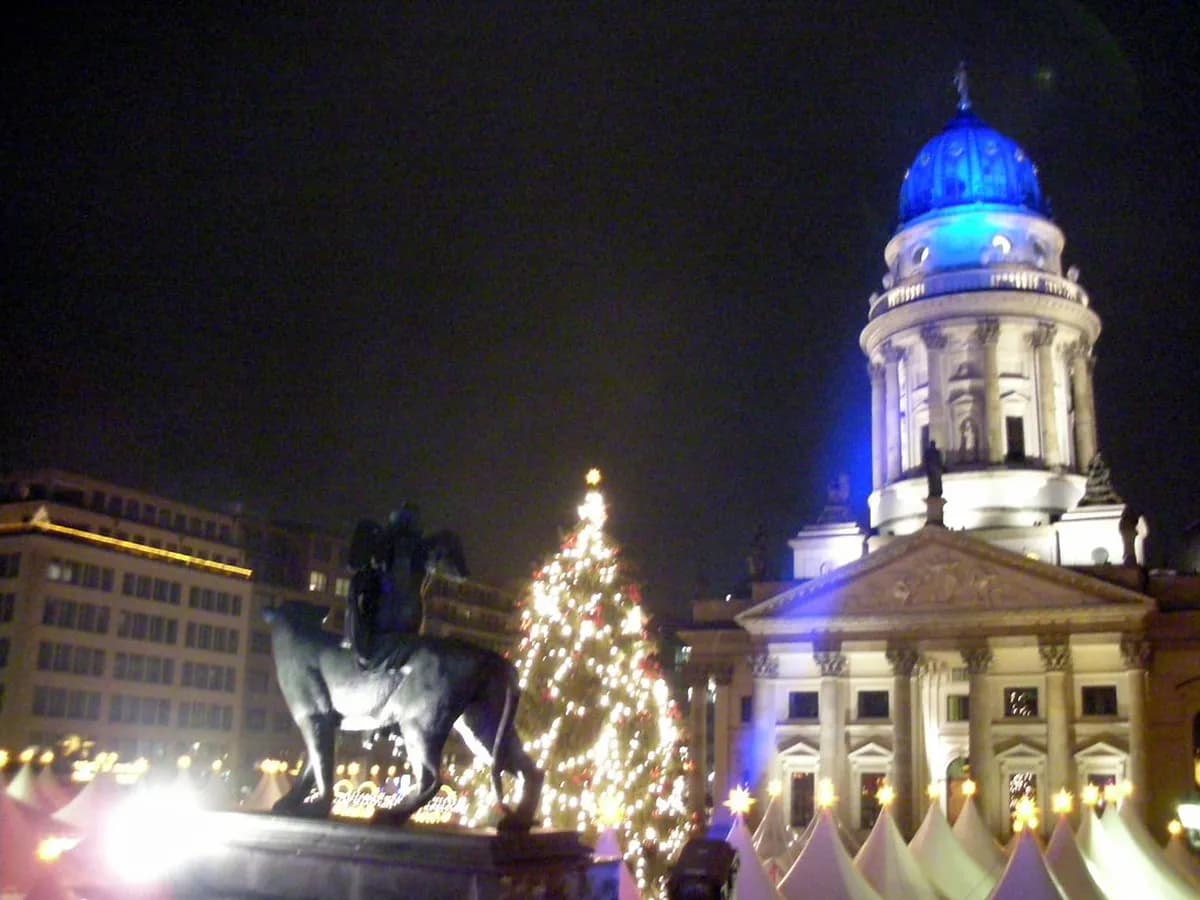
Berlin's sheer size means you need a plan. The market at Charlottenburg Palace is consistently rated among the most atmospheric in the capital. The Berlin Christmas Markets Guide lists the full city calendar and opening hours by venue. Cologne's Cathedral Market is another must — the Gothic spires create an incomparable backdrop after dark.
Best Christmas Markets in France
Alsace sets the standard for French Christmas markets. The region's half-timbered villages, wine-route backdrop, and Teutonic-French culinary mix make it unlike anywhere else in Europe. Strasbourg calls itself the "Capital of Christmas" — a claim backed by a 30-metre tall tree in the city centre and markets spread across ten different squares.
Colmar is smaller and even more photogenic. Every building in the old quarter is adorned with lights, ornaments, and garlands. The combination of narrow cobblestone lanes and decorative facades makes it feel like a life-size gingerbread village. Colmar's markets run daily from late November through late December 2026, giving more flexibility than the weekend-only villages further south.
| City / Village | 2026 Dates (est.) | Format |
|---|---|---|
| Strasbourg | 27 Nov – 24 Dec | Daily; 10+ squares |
| Colmar | 25 Nov – 29 Dec | Daily; 6 themed zones |
| Mulhouse | 21 Nov – 27 Dec | Daily (closed 25 Dec) |
| Obernai | 28 Nov – 31 Dec | Daily (closed 25 Dec) |
| Riquewihr | 28 Nov – 21 Dec | Fri–Sun only |
| Kaysersberg | Four Advent weekends | Fri–Sun only |
| Eguisheim | 28 Nov – 30 Dec | Daily (closed 24–26 Dec) |
| Ribeauvillé | 6–7 Dec & 13–14 Dec | Medieval weekends only |
Paris holds smaller but growing markets at La Défense, Trocadéro, and the Champs-Élysées. These tend to run from mid-November through late December and attract large crowds on weekend evenings. They are best treated as a complement to an Alsace visit rather than a stand-alone destination for market enthusiasts.
Best Christmas Markets in Austria
Vienna opens earlier than almost any other European capital. The iconic Vienna Christmas Dream at Rathausplatz typically starts on 14 November 2026 — two weeks before the first Advent Sunday. The city runs more than a dozen separate markets, each with its own character: the palace markets at Schönbrunn and Belvedere are the most elegant, while the Altes AKH university campus market is the most local in feel.
Salzburg's Christkindlmarkt on Cathedral Square is one of the oldest in the world. Surrounded by baroque church facades, it has an atmosphere that purpose-built markets cannot replicate. The 2026 edition is expected to run from 20 November through 26 December, making it one of the few traditional markets open on Christmas Day itself.
| City | 2026 Dates (est.) | Highlight |
|---|---|---|
| Vienna | 14 Nov – 24 Dec | 12+ markets; Rathausplatz ice rink |
| Innsbruck | 15 Nov – 6 Jan 2027 | Old Town + Alpine backdrop |
| Salzburg | 20 Nov – 26 Dec | Cathedral Square; one of Europe's oldest |
| Graz | 22 Nov – 24 Dec | UNESCO old town; ice sculptures |
| Linz | 22 Nov – 23 Dec | Hauptplatz and Volksgarten venues |
| Kitzbühel | 29 Nov – 26 Dec | Tyrolean crafts; après-ski access |
Austria's markets lean more elaborate than Germany's. Expect ornate decorations, indoor sections with wood-burning stoves, and a stronger emphasis on crafts and food. Hot punch (Punsch) is the local rival to Glühwein and comes in a range of fruit and spice blends. The mugs here are often more decorative than their German counterparts and make better keepsakes.
Best Christmas Markets in Switzerland
Switzerland's markets open earlier than most — Zürich and Basel usually launch in the third week of November. The country's strengths are artisan quality and dramatic settings. Basel spreads its stalls across Barfüsserplatz and Münsterplatz with over 150 vendors. Zürich's famous indoor market inside the main train station is dominated by a towering Swarovski crystal Christmas tree that draws visitors who never planned to go shopping.
Montreux sits on the shores of Lake Geneva and is consistently ranked among the most beautiful markets on the continent. The combination of mountain backdrop, lakeside chalets, and extended dates (typically to 24 December) makes it a strong standalone destination. Lugano, in the Italian-speaking canton, runs into January 2027 — one of the longest market seasons in Switzerland.
| City | 2026 Dates (est.) | Highlight |
|---|---|---|
| Basel | 27 Nov – 23 Dec | 150+ stalls across two main squares |
| Zürich | 20 Nov – 23 Dec | Swarovski tree at main station |
| Bern | 20 Nov – 28 Dec | Sternenmarkt; handicrafts focus |
| Montreux | 20 Nov – 24 Dec | Lake Geneva setting; Santa at Rochers-de-Naye |
| Lausanne | 20 Nov – 31 Dec | "Bô Noël"; art and light installations |
| Lucerne | 22 Nov – 21 Dec | Franziskanerplatz; mountain views |
| Lugano | 27 Nov – 6 Jan 2027 | Italian-Swiss flair; longest season |
The distance from Colmar to Basel is roughly 90 minutes by car or train. This makes a combined Alsace-Switzerland itinerary very practical. Crossing the border also lets you compare the two market cultures side by side — French warmth and colour in Alsace, Swiss precision and artisan quality just across the Rhine.
Your European Christmas Market Route
The most efficient starting point is Frankfurt Airport, which connects directly to the rest of Europe by train. From Frankfurt, the first stop is Heidelberg (45 minutes by regional train), a relaxed market with stalls spread along the car-free Haupstrasse. Then head east to Nuremberg (one hour by ICE) for the iconic Christkindlesmarkt. From Nuremberg, Dresden is another 90-minute train ride.
From Dresden, pivot west to Cologne or south into France. The train from Heidelberg to Strasbourg takes about 90 minutes. From Strasbourg, Colmar is 30 minutes by regional train. After Alsace, cross into Switzerland: Basel is 45 minutes from Colmar by rail, and Zürich is another 55 minutes from Basel. This five-day loop covers the essential German, French, and Swiss markets without any backtracking.
If you have a full week, continue from Zürich to Salzburg (4 hours by train via Innsbruck) and then to Vienna (2.5 hours by ÖBB Railjet). Vienna can also serve as the starting point for a second loop east toward Budapest (2.5 hours by train) and Prague (4 hours). These Eastern European cities have extended dates that make them ideal for a post-Christmas visit. Check the best christmas markets to visit by train guide for specific rail connections and pass options.
What to Eat and Buy at the Markets
Food is the best reason to stay longer than planned. Bratwurst (grilled sausage) is the universal constant — every market in every country does a version. German markets pair it with crusty bread and sharp mustard. Kartoffelpuffer (fried potato pancakes) are served with apple sauce or garlic sour cream and are best eaten immediately from the stall. Germknödel, a steamed dumpling filled with plum jam and coated in vanilla cream sauce, is a warming mid-afternoon staple in Austria and Bavaria.
Sweet options include Lebkuchen (spiced gingerbread), Schokokuss (marshmallow discs dipped in chocolate), and roasted candied nuts whose caramel smell will locate the stall before you see it. In Alsace, Bredele (small butter biscuits shaped like stars and moons) are the local speciality. Lübeck is the place to buy marzipan: Café Niederegger on Breite Straße sells over 50 varieties, including some shaped as miniature market scenes.
For souvenirs, the most practical purchases are hand-painted glass ornaments (€5–€15 each at most stalls), Erzgebirge wooden nutcrackers from Saxony (€20–€60 depending on size), and locally produced fruit liqueurs in decorative bottles. Sheepskin gloves, hats, and blankets are sold at almost every Alpine-adjacent market and are genuinely useful rather than purely decorative. Budget €10–€30 for handicraft ornaments and €40–€80 per person for a full day of food and drinks.
The Totensonntag Trap and Other Closure Dates
One date trips up first-time visitors to Germany every year: Totensonntag on 22 November 2026. This is Germany's "Sunday of the Dead," a Protestant day of remembrance dedicated to those who have passed. The vast majority of German Christmas markets are closed that day by law in most federal states, even if they opened the previous weekend. Travelers who book flights and hotels for the third weekend of November expecting a full market experience often arrive to find locked stalls.
The fix is simple: arrive no earlier than Monday 23 November 2026 if you are planning a Germany-only trip. If you want to be in Europe that particular weekend, Strasbourg and the Alsace markets are not affected by Totensonntag — French markets operate on their own calendar.
Beyond Totensonntag, most markets across all countries close entirely on 24 December (Christmas Eve) by mid-afternoon. Public transport on 25 and 26 December runs on reduced schedules. Smaller towns may have no restaurant or pharmacy open on 25 December. If you plan to travel between Christmas and New Year, stick to the large cities — Berlin, Vienna, Cologne, and Prague — which have enough infrastructure to remain functional for tourists during the full holiday period.
Essential Tips: Cash, Clothing, and Pfand
Bring cash to every market. The majority of food and drink stalls across Germany, France, and Austria do not accept card payments. A practical amount is €50–€80 per person per day, which covers entry to any paid sections, several drinks, food, and one or two small purchases. ATMs are usually within a five-minute walk of the main market squares but lines grow long on weekend afternoons.
The Pfand (deposit) system applies at almost every drink stall in Germany and Austria. You pay an extra €3–€5 when ordering Glühwein or Kinderpunsch (non-alcoholic spiced punch). This fee covers the ceramic mug. Return the mug to any drink stall — not necessarily the same one — to reclaim your deposit. Many visitors keep the mug as a souvenir since each city produces a unique design for the year. The mugs are usually the cheapest market memento you can find: €3–€5 for a dated, city-specific piece of ceramics.
For clothing, the single most important item is footwear. Standing on cold stone or cobblestone pavement for two to three hours is the primary cause of discomfort. Refer to the guide on what to wear to a christmas market for a full packing list, but the short version is waterproof boots with thick insulation, thermal socks, and a windproof outer layer. The 16:00 timing trick also helps — arriving at 16:00 gives you an hour of market atmosphere in natural light, then you watch the stall lights switch on as it gets dark, before the main evening crowd arrives after 18:00. Photography is at its best in that 16:00–17:30 window when artificial and ambient light are balanced.
Frequently Asked Questions
Which country has the best Christmas markets in Europe?
Germany is widely considered the best country for traditional markets. It offers the highest density of events and the most historic atmospheres. Cities like Dresden and Nuremberg set the global standard for festive stalls.
When to visit Germany for Christmas markets?
The best time to visit is from late November to mid-December. This window avoids the final holiday rush while ensuring all stalls are fully operational. Most markets in Germany open by November 25th each year.
Which Christmas markets in Europe are open after Christmas?
Markets in Prague, Budapest, and Vienna often stay open until early January. Some Berlin locations also continue until the New Year. However, most traditional German and French markets close by December 24th.
Visiting Europe for more than one festival? See our complete guide to festivals and events in Europe.
Planning around the specific opening dates ensures a smooth and festive European holiday. Focus on the late November window to balance costs and crowd levels effectively. Remember to pack for damp, cold weather to enjoy the outdoor stalls comfortably.
The magic of the season is best experienced with a bit of logistical preparation. Use official tourism links to verify 2026 dates before booking your final transport. Enjoy the unique flavors and crafts that make these markets a global winter highlight.
Free guide: Europe's Festival Calendar
A month-by-month map of Europe's unmissable festivals — with the best dates to visit each and a local tip you won't find in the guidebooks.
You might also like


Continue reading
More guides you'll find useful